Data Lake Monitoring: Prevent Failures, Ensure Reliability
|
0
minuto de lectura

Your lake looks healthy. Storage is available, jobs are green, query engines respond, and nobody sees an outage. Then a revenue dashboard starts showing a dip that isn't real, or an ML feature table unexpectedly shifts shape and a model begins making worse decisions. That's the moment it becomes apparent that the lake itself wasn't being monitored; the focus had been on the plumbing around it.
Data lake monitoring gets difficult when the platform grows faster than the team's habits. New pipelines land, schemas evolve, late arrivals become normal, and one-off checks turn into brittle tribal knowledge. What breaks trust usually isn't a dramatic failure. It's a quiet one.
Table of Contents
Why Your Data Lake Needs More Than a Health Check
A common failure pattern looks like this. An ingestion job completes, object storage is reachable, Spark clusters are available, and every infrastructure alert stays green. But one source system changes a field format, or a daily delivery arrives late, or a partition is empty when it shouldn't be. The dashboard still refreshes. The model still scores. The data is wrong anyway.
That's why data lake monitoring has to start with a hard distinction. System uptime is not data reliability. A lake can be fully online and still feed stale, malformed, or misleading data into reports, features, and decisions.
Growth is expanding the failure surface
The scale problem is getting bigger, not smaller. The global data lake market is projected to grow from USD 20.18 billion in 2025 to USD 148.50 billion by 2035, driven by rising data volumes and the need to prevent lakes from turning into untrustworthy “data swamps,” according to Market Research Future's data lakes market analysis. More data sources, more formats, and more AI pipelines mean more places for silent failures to hide.
That risk shows up first in teams that treat monitoring as an ops-only concern. They watch S3, CloudWatch, cluster health, cost spikes, and job runtimes. Those checks matter. They just don't answer the question the business cares about: can anyone trust today's data?
Practical rule: If your monitoring stack can tell you a job finished but can't tell you whether the output is late, incomplete, or structurally changed, you don't have reliable monitoring yet.
A reliability mindset changes the goal
The right mental model comes from application reliability, where teams already separate service availability from user experience. That same discipline applies to the lake. Rite NRG's saas reliability strategies are useful here because they frame observability as a way to reduce hidden failure modes, not just chase outages.
For data teams, that means monitoring has to answer content-level questions. Did the data arrive when expected? Did row patterns shift unexpectedly? Did a field disappear? Did a source send values that are technically valid but operationally nonsense?
A healthy data lake isn't one that stays online. It's one that stays trustworthy under change.
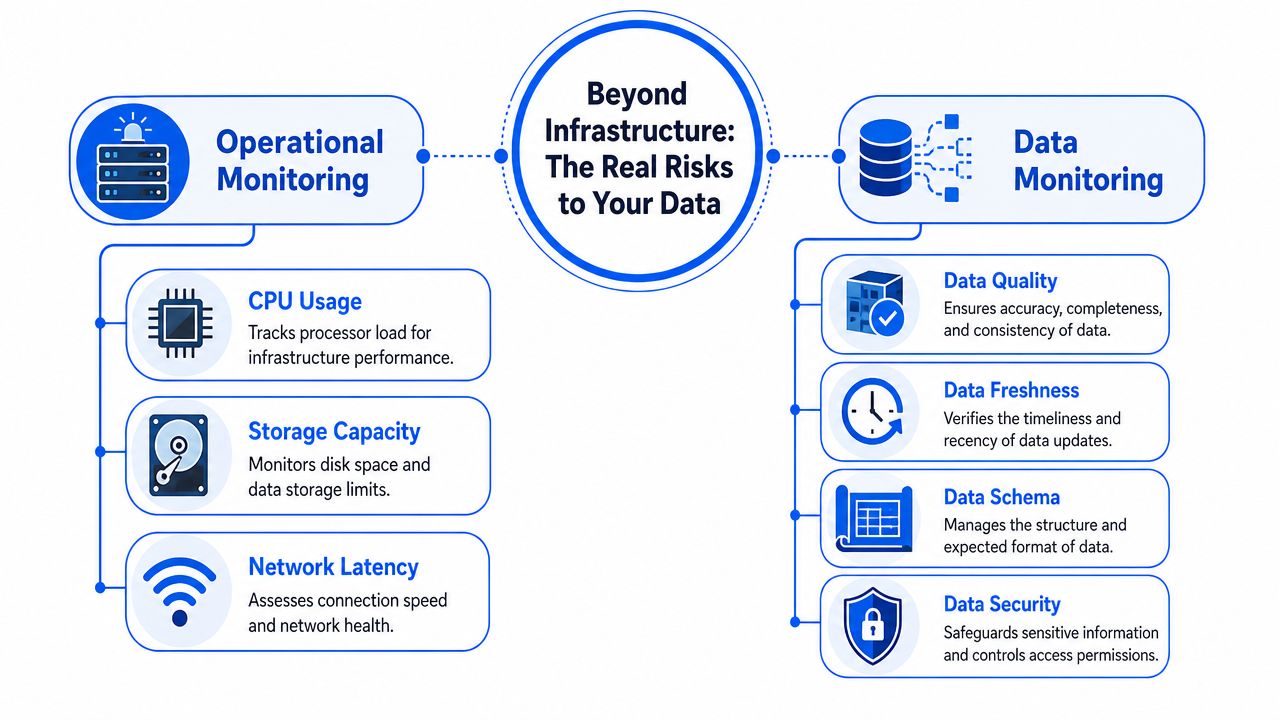
Beyond Infrastructure The Real Risks to Your Data
Organizations often inherit a dangerous assumption from cloud operations. If storage, compute, and orchestration look healthy, the data must be healthy too. That's false.
Infrastructure monitoring checks the building. Data monitoring checks the books inside it. You can have lighting, climate control, and security cameras working perfectly while the catalog is wrong, shelves are half-empty, and the newest books never arrived.
What infrastructure monitoring sees
Cloud-native tools are good at operational visibility. They tell you whether storage access failed, whether latency climbed, whether costs jumped, and whether a scheduled job ran. Those signals are necessary for keeping the platform available.
They don't tell you whether a source suddenly stopped populating a critical column. They don't detect semantic drift in a business field. They don't explain why a downstream dashboard is wrong even though every task succeeded.
A related security problem shows up in practice too. Teams often discover that weak observability creates blind spots not just for performance but for incident response and auditability. Vulnsy's write-up on logging and monitoring issues is a useful reminder that “we had logs” doesn't mean “we had visibility.”
What data monitoring must catch
Content-aware monitoring looks for integrity failures inside the lake:
Quality failures: Null spikes, duplicate records, invalid values, or broken record-level logic.
Freshness failures: Data arrives, but too late to support the report or model that depends on it.
Schema failures: Columns are added, removed, renamed, or implicitly cast into incompatible types.
Behavior failures: Value distributions shift enough to break analytics without causing a pipeline error.
One of the most expensive examples is schema drift. It often starts as a harmless upstream change and ends with broken joins, missing dimensions, or dashboards full of blanks. If you want a concrete breakdown of how structural changes break downstream systems, this guide to schema drift is worth reading.
Infrastructure metrics create confidence. Content checks create trust.
The gap is wider than many teams expect. A 2023 industry survey found that 68% of data engineers struggle with silent data drift in data lakes because existing tools focus on operational metrics rather than data integrity, as summarized in AWS monitoring guidance for data lake environments. That number rings true because silent drift rarely throws an obvious exception. It changes what “normal” looks like slowly enough that nobody notices until a business process depends on the wrong answer.
The false comfort of green dashboards
A lake can pass every infrastructure check and still fail its consumers. That's the core reason data lake monitoring has to move above the platform layer.
Use cloud tooling for what it's built to do. Watch storage, execution, access, and cost there. But put freshness, quality, schema, and semantic drift under a separate observability layer with its own alerts, ownership, and escalation path.
If you collapse those two concerns into one dashboard, you'll keep proving the platform is up while the data keeps letting people down.
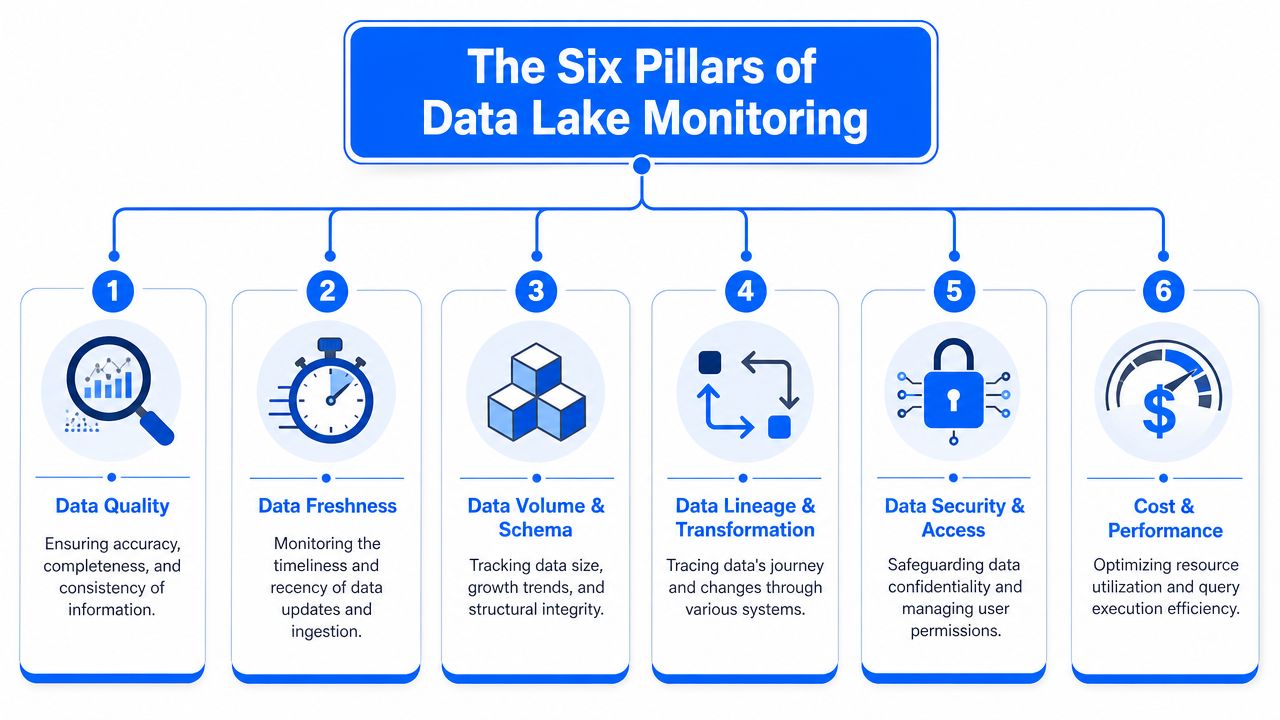
The Six Pillars of Data Lake Monitoring
A reliable lake needs a small set of signals that tell you whether the data is usable, not just present. I've found six pillars matter more than long checklists because they map directly to the failure modes teams face in production.
Early in the rollout, keep the scope narrow. Monitor a few high-value datasets thoroughly rather than trying to score every table shallowly.
Timeliness catches broken promises fast
Timeliness asks whether data arrived when it was supposed to arrive. That sounds simple, but it's often the fastest way to detect failures that haven't propagated into visible breakage yet.
A late load can leave executive reporting stale while the underlying tables still look structurally valid. A feature set can miss its scoring window even though the pipeline finishes later in the day. Timeliness monitoring should compare actual arrival against expected schedules and learned patterns, not just job completion states.
What works: expected-delivery monitoring tied to business cutoffs.
What fails: treating “job succeeded” as evidence that downstream users received data on time.
Freshness tells you whether the lake is still useful
Freshness is related to timeliness, but it isn't the same. Timeliness measures delivery against an expectation. Freshness measures how current the data is when someone queries it.
That distinction matters in lakes with mixed batch, API, and streaming inputs. A table may load on schedule but still contain old records because an upstream source stopped sending updates. Freshness checks should look at event time, partition recency, and update cadence.
A practical way to view this is:
Timeliness asks, “Did the load show up when expected?”
Freshness asks, “Is the content recent enough for this use case?”
Business impact shows up when a dashboard refreshes on time but still presents yesterday's world
Automated real-time monitoring matters here. Alation's data lake architecture guide notes that continuous quality monitoring should assess incoming data in real time, detect anomalies immediately, and help teams trace downstream issues back to source systems within minutes. That's exactly the standard lakes need once multiple delivery patterns coexist.
For a broader view of the discipline around these checks, this explainer on what data observability is gives a useful framing.
Schema drift breaks trust at the structural layer
Schema drift is one of the few failures that can be both obvious and silent. Sometimes a pipeline crashes. Sometimes a permissive engine accepts the change and pushes broken assumptions downstream.
Look for column additions, removals, renames, order shifts where relevant, and type changes. Also watch partition layout and nested structure changes in semi-structured data. A small upstream change in JSON structure can subtly invalidate extraction logic and leave consumers with sparse or malformed fields.
Operational advice: Treat schema changes as contract events, not incidental metadata updates.
Distributional drift exposes silent behavioral change
Many lake monitoring strategies fail when basic data validation appears successful. Rows arrive, the schema holds, and null checks pass, yet the values no longer behave as expected. Category mixes shift, averages move, rare events disappear, or seasonality breaks.
Static thresholds don't hold up well here. AI-powered anomaly detection is more effective because it can learn normal behavior over time instead of forcing teams to hand-maintain endless rules. The core idea behind modern approaches is that anomaly detection monitors streams for outliers affecting accuracy, completeness, and reliability while adapting to trends and seasonality, as explained in digna's overview of AI anomaly detection techniques.
Later in the setup, more advanced methods help. Oracle's review of anomaly detection methods notes that clustering approaches such as K-means and neural networks can detect complex nonlinear outliers that simpler statistical rules miss.
A short implementation principle:
Use adaptive baselines for volatile metrics.
Segment where needed by source, region, customer type, or time pattern.
Alert on meaningful deviations tied to business use, not every wiggle in the data.
Here's a practical walkthrough on the subject before the implementation details:
Lineage health determines blast radius
When an anomaly appears, the first question is never “is there a metric?” It's “what broke upstream and who downstream is affected?” That's lineage health.
You need enough lineage to trace data from ingestion through transformation to the report, dashboard, model, or operational workflow that consumes it. Without that map, every alert becomes a manual investigation. With it, teams can prioritize based on impact instead of guesswork.
Lineage doesn't need to be perfect on day one. It does need to cover critical paths, especially revenue reporting, regulatory outputs, and model inputs.
SLA gaps turn technical noise into business risk
The last pillar turns engineering signals into business accountability. An SLA gap exists when a dataset misses the quality, freshness, or delivery commitments that consumers rely on.
That's where monitoring becomes governance. If a reporting table is allowed to be late by design, that's one kind of expectation. If a fraud feature store needs near-immediate updates, that's another. Both are manageable if teams define and monitor the contract.
The mistake is running every table with the same severity model. Some datasets need strict paging. Others just need a morning review queue. Good data lake monitoring doesn't only detect issues. It classifies which ones matter.
Choosing Your Monitoring Architecture
Once you know what to monitor, the harder decision is where the monitoring logic should run. The choice often falls between three patterns: in-database execution, agent-based monitoring, and pipeline hooks inside orchestrators or transformation layers such as Airflow or dbt.
Each can work. They don't work equally well at enterprise scale.
The trade-offs that matter
The important criteria are straightforward. How much data has to move? How fast can the system detect issues? How hard is it to implement and maintain? How much privacy risk does the architecture introduce? And can it monitor data outside a single pipeline path?
The strongest recent shift is toward in-database monitoring. The trend matters because it aligns with two enterprise constraints that get tougher over time: privacy and speed. According to InfluxData's data lake overview, in-database anomaly detection reduces data movement and improves detection speed by 40 to 60% compared to external tools, and 52% of enterprise data teams prioritize privacy-preserving observability.
Data Lake Monitoring Architectures Compared
Criterion | In-Database | Agent-Based | Pipeline Hooks |
|---|---|---|---|
Data privacy | Strong. Data stays resident in the customer environment. | Moderate. Agents may still transmit metrics or samples externally. | Varies. Depends on what the hook emits and where alerts are processed. |
Detection speed | Strong for continuous checks close to the data. | Good for operational telemetry, mixed for content checks. | Good at pipeline time, weak for post-load drift between runs. |
Coverage | Broad across tables, historical behavior, and shared assets. | Broad for infrastructure, narrower for semantic data checks. | Narrower. Best for places where code already exists. |
Implementation complexity | Moderate upfront, lower long-term sprawl. | Moderate to high across many environments. | Low to moderate initially, higher as pipelines multiply. |
Performance overhead | Usually efficient if queries are designed carefully. | Depends on agent footprint and collection pattern. | Often light, but limited to execution moments. |
Best fit | Enterprise lakes, private cloud, regulated environments. | Platform operations and host-level visibility. | Teams wanting targeted checks in dbt, Airflow, or ingestion jobs. |
A balanced setup often combines all three. Use pipeline hooks for immediate contract checks, agent-based monitoring for infrastructure, and in-database execution for the content-level observability that cloud tools don't provide.
The architecture question is really a trust question. The less data you have to copy into another system to understand its health, the fewer privacy and latency problems you create for yourself.
Why in-database keeps winning
In-database monitoring avoids the oldest observability trap in data systems: exporting large amounts of data into a second platform just to decide whether the first platform is trustworthy. That creates extra cost, more permissions, more latency, and one more moving part to fail.
It also handles hybrid realities better. Many enterprises don't have a single clean pipeline path. They have ingestion jobs, ad hoc backfills, streaming updates, notebook-driven transformations, and vendor-managed loads. A monitoring layer that runs where the data already lives has a better chance of seeing the full picture.
If you're evaluating real-time designs, this overview of real-time data monitoring is a useful companion because it focuses on how detection timing changes operational response.
A Step-by-Step Implementation Blueprint
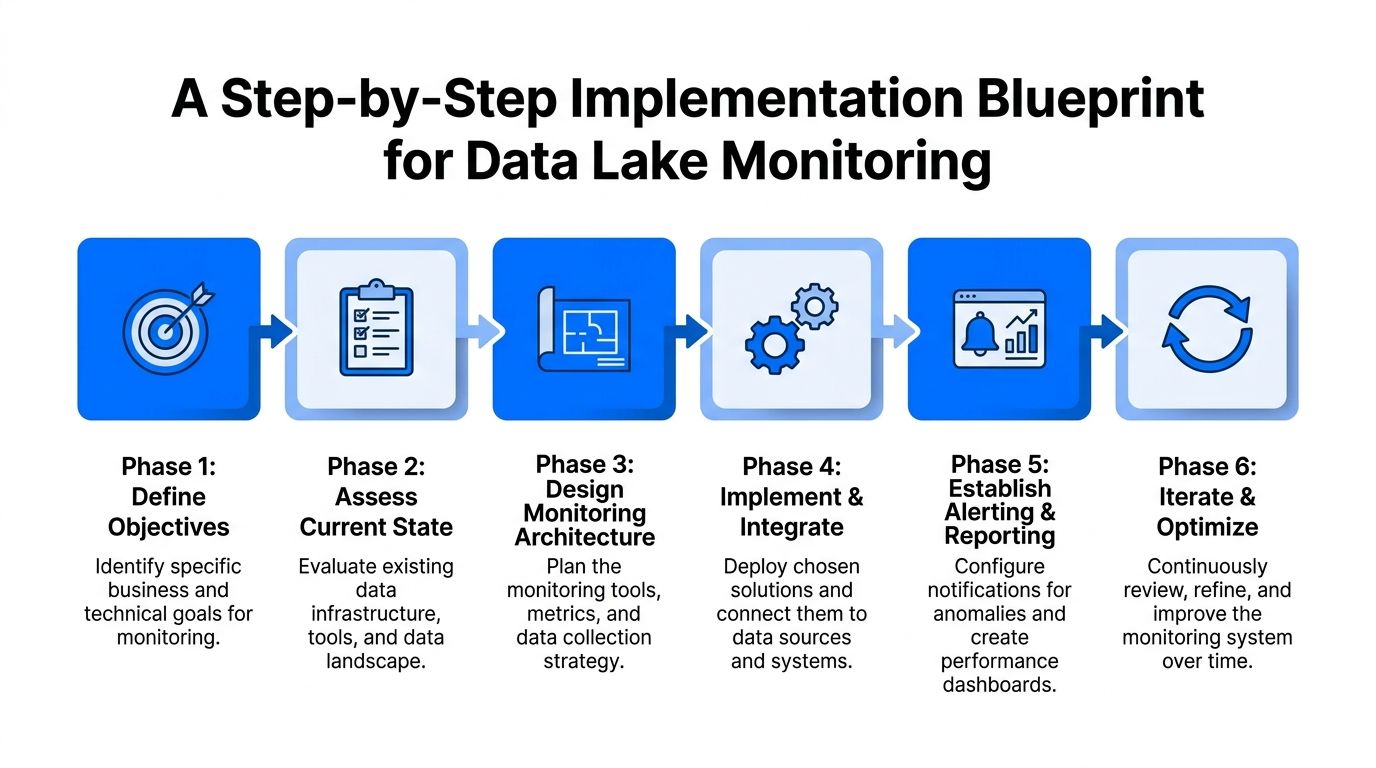
Teams usually fail at data lake monitoring in one of two ways. They either try to instrument everything at once, or they stay stuck in pilot mode and never connect alerts to real owners. The better path is phased. Start with the data that hurts most when it breaks, then expand with governance built in.
Discovery and prioritization
Begin with business-critical assets, not the noisiest ones. Revenue reporting, regulatory extracts, customer-facing analytics, and ML feature inputs usually belong in the first wave.
Create a simple inventory:
Dataset owner: Name the engineer, analyst, or team accountable for response.
Business dependency: Record which dashboards, models, or decisions depend on it.
Failure mode: Note whether lateness, schema change, or value drift is the primary risk.
Severity: Distinguish between page-now incidents and next-business-day review items.
This phase benefits from concrete platform understanding. If you operate in Microsoft Fabric environments, a practical reference like the DP-700 Microsoft Fabric study guide helps teams align monitoring choices with the actual data engineering surface they're running.
Baseline and configuration
Once the first datasets are selected, don't start with dozens of rules. Establish a baseline first. Learn normal arrival times, normal row patterns, expected null behavior, and structural characteristics.
Preprocessing matters more than many teams expect. Before anomaly detection can work well, the monitoring layer usually needs normalized metrics, sensible handling of missing values, and useful features such as time-of-day or source-type context. MindBridge's explanation of preprocessing for anomaly detection is a good reminder that model quality depends on feature quality.
Field note: Start with a handful of high-value tables and let the baseline stabilize before widening scope. Early over-alerting kills adoption faster than missing one low-priority issue.
Alerting and triage
An alert is only useful when someone knows what to do next. Pipe monitoring events into the systems your team already uses, whether that's Slack, PagerDuty, a ticket queue, or an incident channel. Then define triage rules.
A workable triage model usually includes:
Classify the alert by timeliness, quality, schema, or drift.
Attach ownership so the first responder is obvious.
Link dependencies so downstream consumers are visible.
Specify action such as rerun, source escalation, schema review, or suppression.
The critical move here is reducing ambiguity. “Metric moved” isn't enough. “Daily orders table is late and blocks finance dashboard refresh” gets acted on.
Governance and scaling
After the first monitors prove useful, formalize the operating model. Add data quality views for stakeholders, document severity expectations, and define how new datasets enter the monitoring program.
Many organizations need discipline around three things:
Ownership: Every critical dataset needs an accountable team.
Contracts: Delivery and quality expectations should be explicit.
Onboarding pattern: New sources should inherit a standard set of checks instead of bespoke setup every time.
Scaling works when monitoring becomes part of platform engineering, not a side project. The lake gets more complex every quarter. Your monitoring approach has to get more repeatable at the same time.
Putting Theory into Practice with digna
A modern platform for data lake monitoring should solve three problems at once. It should detect drift without endless manual rule-writing, track timeliness against expected behavior, and surface structural changes before they break downstream systems. It also shouldn't require shipping your data into yet another vendor-controlled environment.

How the capabilities map to the monitoring pillars
The cleanest way to evaluate a platform is to map features to actual failure modes.
digna Timeliness addresses late and missing loads. It monitors expected delivery times, delay patterns, and schedule adherence, which makes it useful for freshness-sensitive reporting and downstream SLA enforcement.
digna Schema Tracker focuses on structural integrity. It flags added or removed columns and data type changes before they cascade into broken transformations, dashboards, or feature pipelines.
digna Data Anomalies handles distributional drift. It learns normal behavior and detects unexpected changes without requiring teams to hand-maintain static thresholds for every metric.
digna Data Validation covers rule-based quality needs at the record level, which matters when auditability or business logic can't be left to statistical inference.
digna Data Analytics gives teams historical observability context so they can inspect trends, fast-changing signals, and patterns instead of reacting to isolated alerts.
That combination matters because effective lake monitoring needs both adaptive detection and explicit validation. Some failures are statistical. Some are contractual.
Why the execution model matters
The architectural choice is a big part of the value. digna computes metrics and baseline learning inside the customer's own environment. That keeps production data resident in private cloud or on-prem infrastructure and avoids unnecessary movement into a third-party system.
That's important for performance, but also for control. Enterprise teams usually want observability without expanding the list of systems that can touch sensitive data. In-database execution is one of the few approaches that improves visibility while tightening that boundary.
The need for this kind of observability is broader than one product category. Effective data lake monitoring now depends on AI-powered anomaly detection and statistical methods to identify precise signals and prevent silent data drift that makes analytics or AI unreliable, as summarized in Market.us coverage of data lake statistics and monitoring needs. A platform built for lakes has to bring those methods into day-to-day operations, not leave them as theory.
Good monitoring platforms reduce specialist overhead. They don't create a second analytics project just to explain why the first one broke.
What this changes in day-to-day operations
In practice, the payoff is operational clarity. Teams stop relying on manual spot checks and brittle custom rules scattered across jobs. Analysts get a clearer view of trend shifts. Engineers get faster root-cause paths. Governance owners get evidence that quality expectations are being measured, not assumed.
That's what mature data lake monitoring should look like. Not more dashboards for their own sake, but a tighter loop between signal, ownership, and remediation.
From Data Swamp to Data Trust
Reliable data lake monitoring starts when teams stop asking only whether the platform is up and start asking whether the data is still trustworthy. That shift sounds small. It changes everything.
Infrastructure monitoring remains necessary. You still need to watch compute, storage, execution, cost, and access. But that layer can't tell you whether a model is learning from drifted inputs, whether a finance table is stale, or whether a schema change has already broken downstream logic. Content-aware monitoring has to sit beside platform monitoring, not inside its shadow.
The strongest strategies share a few traits. They monitor timeliness, freshness, drift, lineage, and service expectations. They connect alerts to owners. They run close to the data whenever possible. And they use adaptive detection where static thresholds fall apart.
A data lake becomes a swamp when teams keep adding data but don't increase trust with the same discipline. It becomes a durable asset when monitoring is treated as part of the data architecture itself.
If your team wants that kind of coverage without exporting production data into another vendor environment, digna is built for it. It runs inside customer-controlled infrastructure, detects anomalies with AI and statistical methods, tracks timeliness, validates records, and flags schema changes so teams can catch silent failures before they reach dashboards, models, or business decisions.