What Is Data Observability
|
6
min. Lesezeit

A dashboard can be technically available and still be operationally useless.
That's the situation many teams are in right now. The pipeline ran. The warehouse is up. BI loads without errors. Then someone notices that revenue is flat at noon, yesterday's orders are missing, or a key column changed type overnight and unexpectedly broke a downstream model. Nothing looked down, yet the business was already making decisions on bad data.
That gap between system uptime and data trust is where data observability matters. If your company uses data to allocate budget, manage operations, support compliance, or feed AI systems, observability stops being a nice-to-have engineering layer. It becomes part of business continuity.
Table of Contents
Why Data Trust Is More Fragile Than Ever
A common failure pattern looks like this. Finance opens the executive dashboard before a board meeting and sees numbers that don't line up with the close report. Marketing says campaign spend looks normal. Sales says pipeline dropped. Data engineering checks orchestration logs and sees green jobs. Nobody knows whether the problem is a late load, a broken transformation, a schema change, or a duplicated feed.
That's why bad data incidents are so disruptive. They aren't loud like infrastructure outages. They're silent. Reports still render, charts still refresh, and people keep using them until someone spots the inconsistency by accident.
For teams trying to treat data as an asset, trust isn't abstract. It affects planning, compliance, forecasting, and model outputs. If you're working on that broader business framing, this expert guide for data asset ROI is useful because it connects technical reliability to executive value, which is often the missing conversation.
Silent failures create business continuity risk
The issue isn't only correctness. It's timing.
A stale dashboard an hour before a pricing decision is a continuity problem. A missing batch in a claims workflow is a continuity problem. An unnoticed shift in model input data is a continuity problem. In each case, the business keeps moving, but it's moving with compromised information.
Data teams rarely get blamed because a pipeline failed visibly. They get blamed when everything looked normal and the numbers were still wrong.
That pressure explains why the category is expanding so quickly. The global data observability market is projected to reach USD 7.01 billion by 2033, expanding from USD 2.3 billion in 2023 at a CAGR of 11.8%, according to market projections on data observability growth. The same projection ties that growth to the need to detect anomalies, identify root causes, and prevent disruptions before they affect business outcomes.
Reactive fixing doesn't scale
Many teams start with manual checks, SQL assertions, and a few high-value alerts. That works for a while.
Then the platform expands. More sources arrive. Ownership gets distributed. BI and ML consume the same upstream tables. A dashboard problem now might originate five transformations earlier, and by the time someone notices, several downstream products are already affected.
At that point, reactive debugging becomes expensive because every incident turns into a discovery exercise. You aren't just fixing bad data. You're reconstructing the chain of events that caused it.
What Is Data Observability Exactly
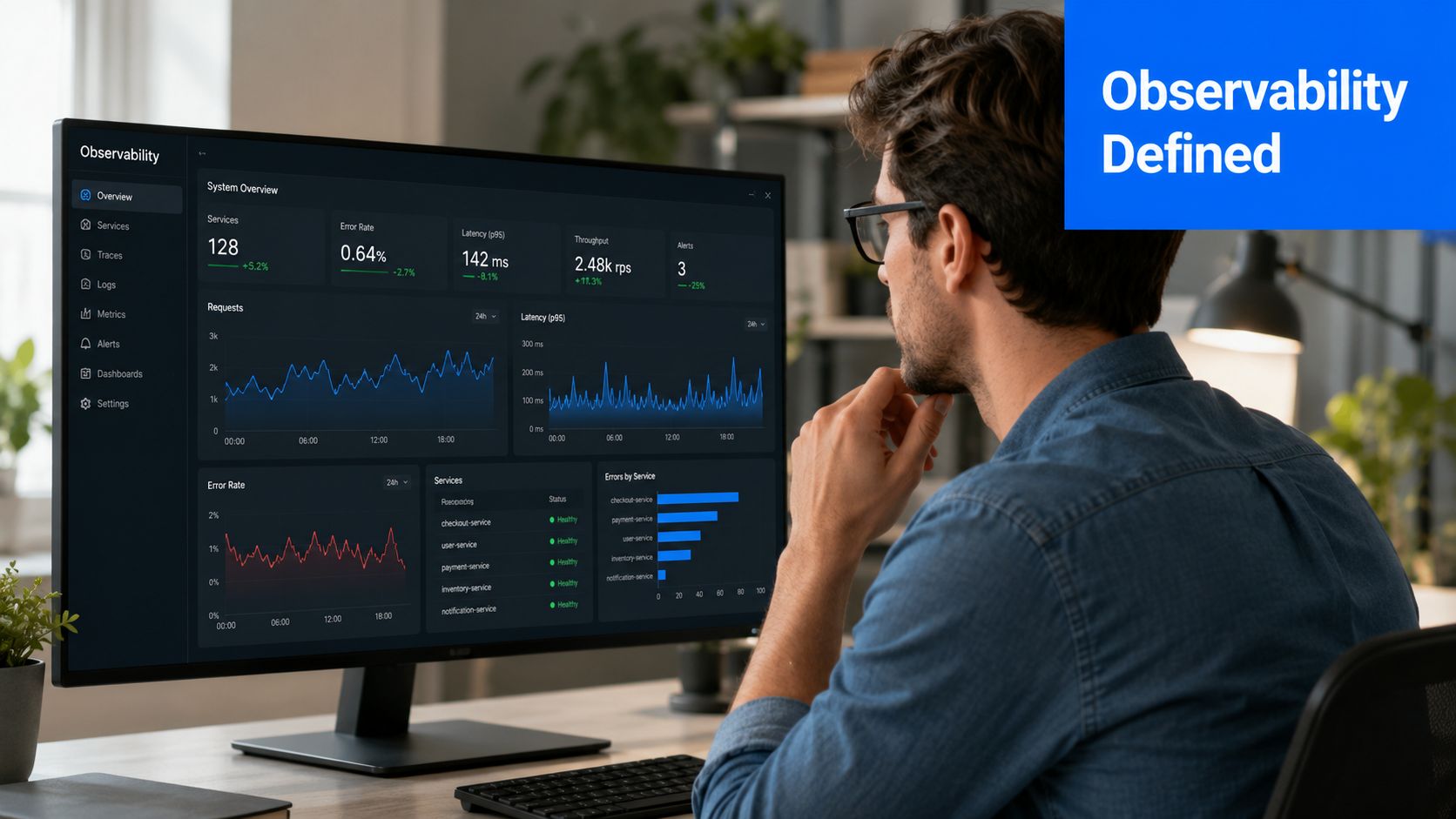
Data observability is the practice of understanding the health of data systems by continuously inspecting the signals that data and pipelines produce. In practical terms, it tells you whether data is arriving on time, in the expected shape, with the expected behavior, and with enough context to trace problems back to the source.
A useful analogy comes from software operations. Application Performance Monitoring tells engineers that an app is slow, failing, or behaving abnormally. Data observability applies that same mindset to data platforms. It doesn't stop at “the job succeeded.” It asks whether the output is trustworthy.
Monitoring catches known failures
Traditional monitoring is useful, but it's narrower.
It works best when you already know the failure mode. If a pipeline fails, alert. If latency crosses a threshold, alert. If a table didn't update by a fixed time, alert. Those checks are necessary, but they assume the problem has been anticipated and encoded.
Observability handles the cases your static checks didn't predict. A pipeline may complete successfully while producing half the expected rows. A join may still run while causing a distribution shift in a critical metric. A column may remain present but change meaning through upstream logic.
Observability helps answer why
That's the core shift in the phrase what is data observability. It's not just a monitoring layer with more alerts. It's a way to move from reactive symptom chasing to system-level diagnosis.
A solid observability practice usually does four things at once:
Detects hidden anomalies: It flags unexpected behavior even when jobs succeed.
Provides context: It shows what changed, when it changed, and what depends on it.
Accelerates triage: It helps route incidents to the right owner faster.
Supports prevention: It exposes patterns that let teams remove recurring causes, not just clean up outcomes.
Practical rule: If your current setup tells you that a pipeline ran but can't tell you whether the resulting data is usable, you have monitoring. You don't yet have observability.
The difference matters because business users don't care whether Airflow, dbt, or the warehouse completed a task. They care whether the dashboard, report, or model can be trusted right now.
The Five Pillars of Data Observability
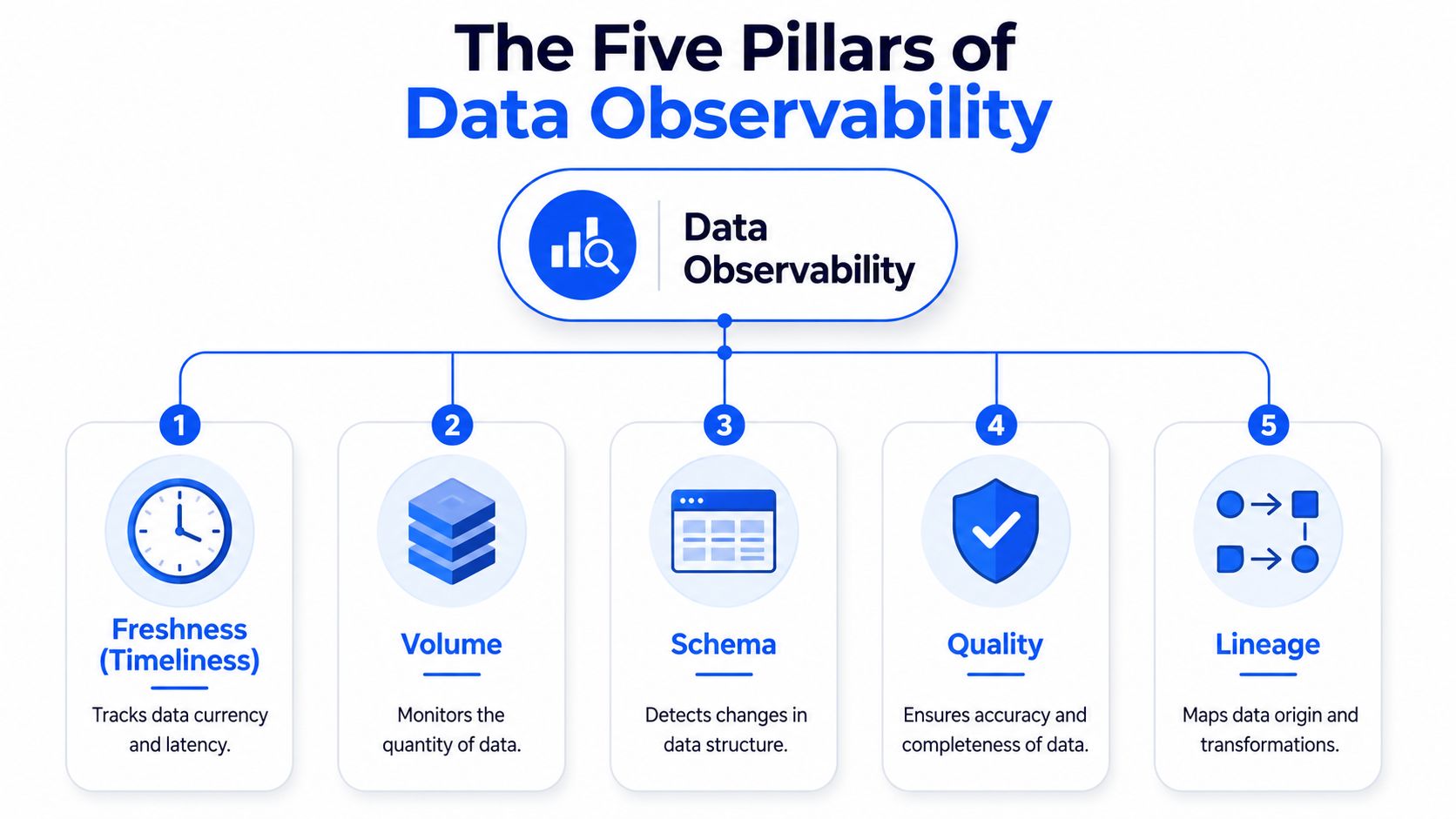
Data observability becomes easier to operationalize when you break it into signals. Industry research notes that the average time to detect and resolve data quality issues is approximately 4 to 9 hours without effective observability practices, and that continuous monitoring across freshness, volume, schema, distribution, and lineage helps teams reduce the impact of those issues, as described in this overview of the five pillars of data observability.
Freshness and timeliness
Freshness asks a basic operational question. Did the data arrive when the business expected it?
That sounds simple, but it's one of the most important checks in production. A report that's structurally correct but six hours late can still trigger bad decisions.
Use freshness monitoring for:
Scheduled feeds: Daily or hourly loads that must land on time.
Operational dashboards: Metrics tied to staffing, inventory, fraud review, or trading windows.
Time-sensitive AI inputs: Features that become misleading when they lag.
If your team wants a concrete example of this signal category, timeliness monitoring in practice shows how schedule awareness and expected-delivery tracking fit into observability.
A practical example is a daily orders table that usually updates before business opening hours. If it hasn't landed, finance and operations may both be looking at stale numbers without realizing it.
Before going deeper, this short video gives a good visual overview of the concept.
Volume
Volume tracks whether the quantity of data is within an expected range.
This catches blunt failures fast. If row counts suddenly collapse, something upstream probably broke. If counts spike unexpectedly, duplication or replay may be happening.
A useful mental model is warehouse receiving. If ten trucks usually arrive and only two show up, you don't need a perfect root-cause analysis to know operations are at risk.
Schema
Schema observability watches structure. Columns added, removed, renamed, or changed in type can break downstream logic even when ingestion and transformation jobs still report success.
This is why schema incidents are so frustrating. The pipeline often isn't technically “down.” It's just producing output that downstream consumers can no longer interpret correctly.
Common examples include:
Type changes: Integer to string, or timestamp formatting changes.
Column removals: A field disappears from a source API or transformation model.
Nullability shifts: A previously required field starts arriving partially empty.
Distribution
Distribution goes beyond counts and structure. It looks at the behavior of values.
If conversion rate, null rate, category mix, or average basket size suddenly shifts outside normal patterns, distribution checks surface it. Observability then starts catching subtle business problems that fixed thresholds often miss.
A broken join is the classic example. Row counts may look healthy, and the schema may be unchanged, but important values can still drift in ways that damage reports and models.
Lineage
Lineage answers the question every incident commander asks first. Where did this start, and what else did it affect?
Lineage matters because data failures spread. A single upstream transformation can affect multiple marts, dashboards, reverse ETL outputs, and feature pipelines. Without lineage, teams spend too much time guessing where to look and whom to notify.
If you can't trace a metric back to its source and forward to its consumers, you'll debug incidents by interviewing people instead of inspecting systems.
Taken together, these pillars form a practical checklist. If a platform or process covers only one or two of them, teams usually end up with fragmented visibility and slower resolution.
Data Observability vs Data Quality A Critical Distinction
Teams often use these terms interchangeably, which creates confusion in tool selection and operating models. They're related, but they are not the same thing.
A simple analogy helps. A doctor checking pulse, oxygen level, and temperature is observing the patient's condition. A doctor ordering a specific test for a known disease is validating against a defined rule. Data observability is closer to the first. Data quality is closer to the second.
Why teams confuse them
The confusion happens because both disciplines are trying to produce trusted data.
Data quality focuses on whether data meets defined business expectations. Is an email valid? Is an account ID unique? Is a mandatory field present? Those are explicit rules, often tied to compliance, contracts, or operational standards.
Data observability focuses on whether the data system is behaving normally and whether anomalies are emerging. It watches patterns, movement, dependencies, and change over time. If you want a more product-focused breakdown, this explanation of data observability vs data quality is a helpful complement.
Where each one fits
Here's the practical distinction:
Dimension | Data Quality | Data Observability |
|---|---|---|
Primary focus | Data content and conformance to rules | Data health, behavior, and system context |
Typical method | Validation rules and assertions | Anomaly detection, monitoring, and lineage analysis |
Best at catching | Known issues | Unknown or emerging issues |
Example question | Is | Why did null rates suddenly spike in |
Time orientation | Point-in-time correctness | Continuous operational awareness |
Main outcome | Rule compliance | Early detection and faster diagnosis |
A mature platform needs both.
Data quality without observability becomes brittle because teams can only catch what they predicted. Observability without quality leaves gaps where explicit business rules are mandatory. Regulated workflows, audit requirements, and contractual data standards still need deterministic checks.
Good data quality tells you whether a record passes. Good observability tells you whether the system that produced the record is drifting toward failure.
The strongest operating model treats quality and observability as complementary layers, not competing categories.
How Modern Data Observability Architectures Work
A pipeline fails at 2:00 a.m. The dashboard break is only the visible symptom. By the time finance, operations, or a customer-facing model shows bad numbers, the business has already absorbed the first cost of data downtime: stalled decisions, lost trust, and engineers pulled into manual triage.
Architecture determines whether observability shortens that incident or stretches it across the day.
A modern design monitors the full production path, including ingestion, transformation layers, serving tables, BI assets, and ML consumers. Problems rarely begin at the final dashboard. They start earlier, in an upstream schema change, a delayed dependency, a broken transformation, or a drift pattern no one explicitly modeled. Without lineage across those layers, incident response becomes expensive guesswork.
That is why execution model matters as much as feature list. If a platform only watches downstream tables, teams detect failures after business impact appears. If it requires extracting data into a vendor environment, security review, latency, and added cost can slow adoption. If monitor coverage depends on hand-built checks for every important asset, the system becomes another maintenance burden instead of an operating layer.
The T shaped model in practice
One architecture pattern works well in large estates: the T-shaped monitoring model.
The horizontal layer applies lightweight monitoring across the warehouse. That usually includes freshness, volume shifts, failed runs, lineage gaps, and other broad signals that indicate something changed. The vertical layer goes deeper on the assets tied to revenue reporting, executive dashboards, compliance workflows, and production ML. DataHub describes this approach in its explanation of T-shaped monitoring.
This is a business continuity decision, not just a monitoring preference. Equal coverage everywhere sounds disciplined, but it often creates alert noise and wastes engineering time on low-impact assets. Focusing only on a narrow set of critical tables creates blind spots upstream, where many incidents begin. The T shape balances both trade-offs. Broad awareness across the estate. Deeper inspection where downtime costs the most.
In practice, strong teams also extend that model with usage and behavioral context. Monitoring gets more useful when architects can connect technical signals to consumption patterns, ownership, and downstream business processes. That is the point of extending data observability with analytics. It helps teams decide which anomalies are operational noise and which ones threaten a quarter-close process, executive KPI, or customer workflow.
Why AI matters operationally
Static thresholds break down in live systems.
Data patterns change with seasonality, launches, pricing updates, acquisitions, and shifting user behavior. A rule that worked three months ago can miss a real incident today or fire continuously on normal variation. Teams then spend their time tuning monitors instead of improving pipeline reliability.
AI-driven observability addresses that problem by learning historical behavior and evaluating anomalies in context. It is better suited to detecting drift, unusual joins, changing distributions, and timing shifts that do not map cleanly to one fixed rule. That reduces false positives and cuts time to root cause, especially in environments with hundreds or thousands of assets.
The strongest architecture is hybrid. Use learned baselines to catch unknown failure modes. Keep deterministic checks for contractual SLAs, regulated fields, and business rules that need explicit pass or fail logic. That combination moves observability from reactive cleanup to an early-warning system for the data business depends on every day.
Putting Theory into Practice with a Platform
The theory only matters if it changes day-to-day operations. In practice, teams need one layer for anomaly detection, another for deterministic validation, and enough historical context to decide whether an alert is noise or the start of an incident.
A major operational drag is the upkeep of brittle monitors. A 2025 Accenture report on data engineering productivity indicates that 40–60% of data team time is spent on preventive maintenance of threshold-based rules, a cost highlighted in Databricks' discussion of the hidden maintenance burden in data observability. That's one reason teams are moving toward AI-driven detection that can reduce false positives and shorten root-cause analysis.
How capabilities map to day to day failure modes
A practical platform maps directly to the incident patterns data teams already know:
Late or missing loads: Timeliness monitoring detects stale arrivals before a board dashboard or SLA-driven workflow is affected.
Silent metric drift: Anomaly detection surfaces unexpected changes in volume or value behavior without waiting for a human to notice.
Breaking structural changes: Schema tracking flags added, removed, or modified fields before downstream transformations fail.
Record-level policy needs: Validation rules still matter where business logic, audits, or compliance require explicit pass-fail checks.
Pattern review over time: Historical analytics help teams see whether an alert is an isolated spike or part of a recurring operational weakness.
One example is digna's analytics extension for observability, which pairs anomaly detection and timeliness monitoring with historical trend analysis, schema tracking, and record-level validation in customer-controlled environments. That combination reflects a practical reality. Observability and quality are easiest to operate when they aren't split across disconnected tools.
What usually fails in rollout
The most common rollout mistake is trying to instrument every table at the same depth from day one.
That creates too many alerts, unclear ownership, and skepticism from business users. A better sequence is narrower. Start with assets tied to revenue, finance, customer reporting, regulated processes, or model inputs. Put freshness, volume, schema, and lineage around those first. Then expand.
Another mistake is treating observability as a pure engineering concern. Operations, analytics, governance, and ML owners all need visibility because they experience different symptoms from the same upstream defect.
Your Data Observability Implementation Checklist
A rollout usually starts the same way. Finance asks why yesterday's board metric changed. Operations sees a broken SLA report. The data team starts tracing jobs, checking dbt runs, and comparing row counts by hand. By the time the root cause is clear, the business has already been operating on bad information.
That is why implementation should be treated as a business continuity exercise, not a monitoring project. Start where bad data would interrupt decisions, reporting, revenue, compliance, or model performance. Then expand coverage in a way your team can operate.

A practical starting sequence
Coverage should follow the path of business impact. If a KPI breaks in a dashboard, the fault often sits several steps upstream in ingestion, transformation, or a schema change that never reached the reporting layer. Teams need enough lineage and monitoring depth to trace that path quickly, without trying to instrument every table on day one.
Use this checklist as a starting sequence:
Define critical data assets
List the dashboards, reports, models, and operational tables the business cannot run safely without. Prioritize by consequence, not by table count.Start with freshness and volume
These signals catch many operational failures early and are usually the fastest to set up. They also create a clear first alerting baseline.Map one high-value lineage path
Trace one important metric from source to downstream consumption in BI or ML. This usually exposes ownership gaps, undocumented dependencies, and brittle transforms faster than broad but shallow coverage.Add schema change detection
Structural drift causes quiet failures. Columns get renamed, types change, nullable fields stop being nullable, and downstream logic breaks hours later.Layer in distribution checks for high-impact datasets
Fresh data can still be wrong. Distribution checks help catch join failures, business logic regressions, skew, and drift before users spot them in a report or model output.Choose a platform that limits manual rule maintenance
If every monitor needs constant threshold tuning, observability turns into another backlog. AI-assisted baselining and triage help teams spend more time fixing real issues and less time babysitting alerts.
The test is straightforward. Can your operating model tell finance, operations, product, and analytics whether the data products they depend on are healthy right now, and can it do that before a defect turns into business downtime?
If your team wants to move from reactive debugging to proactive control, digna offers data observability and data quality capabilities such as anomaly detection, timeliness monitoring, schema tracking, validation, and in-database execution for customer-controlled environments.