Data Reconciliation Meaning: Guide to Accuracy
|
0
min. Lesezeit

You're probably dealing with this already. Sales is showing one revenue number in the dashboard, finance has another in the ERP export, and the data team is stuck explaining why both numbers are “technically correct” depending on which table someone queried.
This is why people search for data reconciliation meaning. They're not looking for a dictionary definition. They're trying to fix trust. When leaders stop trusting reports, every meeting gets slower, every metric gets challenged, and every model built on top of that data inherits the same uncertainty.
Data reconciliation is the discipline that turns conflicting datasets into something teams can use. It prevents inventory mismatches, broken dashboards, and unreliable AI outputs by checking whether different systems agree, then resolving the gaps. If you've ever had to estimate the downstream impact of bad data on reporting delays or incident response, a data downtime cost calculator makes that operational pain easier to frame.
Table of Contents
The Silent Cost of Mismatched Data
A common failure starts with something small. Marketing exports customer records from a CRM. Finance works from billing data. Operations uses a warehouse snapshot from the night before. Nobody notices the differences until a leadership review turns into a debate about which report is “real.”
The damage isn't just technical. Teams stop acting on dashboards because they don't trust them. Analysts spend hours reconciling CSVs instead of answering business questions. Engineers get pulled into support loops because downstream consumers found missing rows, duplicate records, or totals that don't tie out.
Trust breaks before systems break
In most companies, mismatched data doesn't arrive as one dramatic outage. It shows up as friction.
Revenue friction: Sales and finance report different totals for the same period.
Operational friction: Inventory in the warehouse system doesn't match what storefront teams see.
Analytics friction: BI dashboards disagree with exported reports from source systems.
Model friction: Features used by AI systems drift, so outputs become less reliable.
Those are all reconciliation problems, even if nobody calls them that yet.
Broken trust in data is expensive because every downstream decision needs an extra layer of human verification.
Why the issue persists
Teams often validate data inside one system and assume that's enough. It isn't. A perfectly valid record can still conflict with the same entity in another platform. That's why data reconciliation matters. It compares datasets across systems and forces agreement where business processes require consistency.
In practice, reconciliation is what keeps a company from running multiple versions of reality at once. Without it, the organization starts compensating with manual checks, spreadsheet side calculations, and meeting-time arguments. That patchwork works for a while. It doesn't scale.
Understanding the Core Concept of Data Reconciliation
The simplest way to understand data reconciliation is to think about balancing your bank account. Your personal record says you spent one amount. The bank statement says something slightly different. You compare both, find missing or mistyped entries, and decide which record reflects what occurred.
That same logic applies to pipelines, warehouses, ERPs, SaaS tools, and analytical stores.
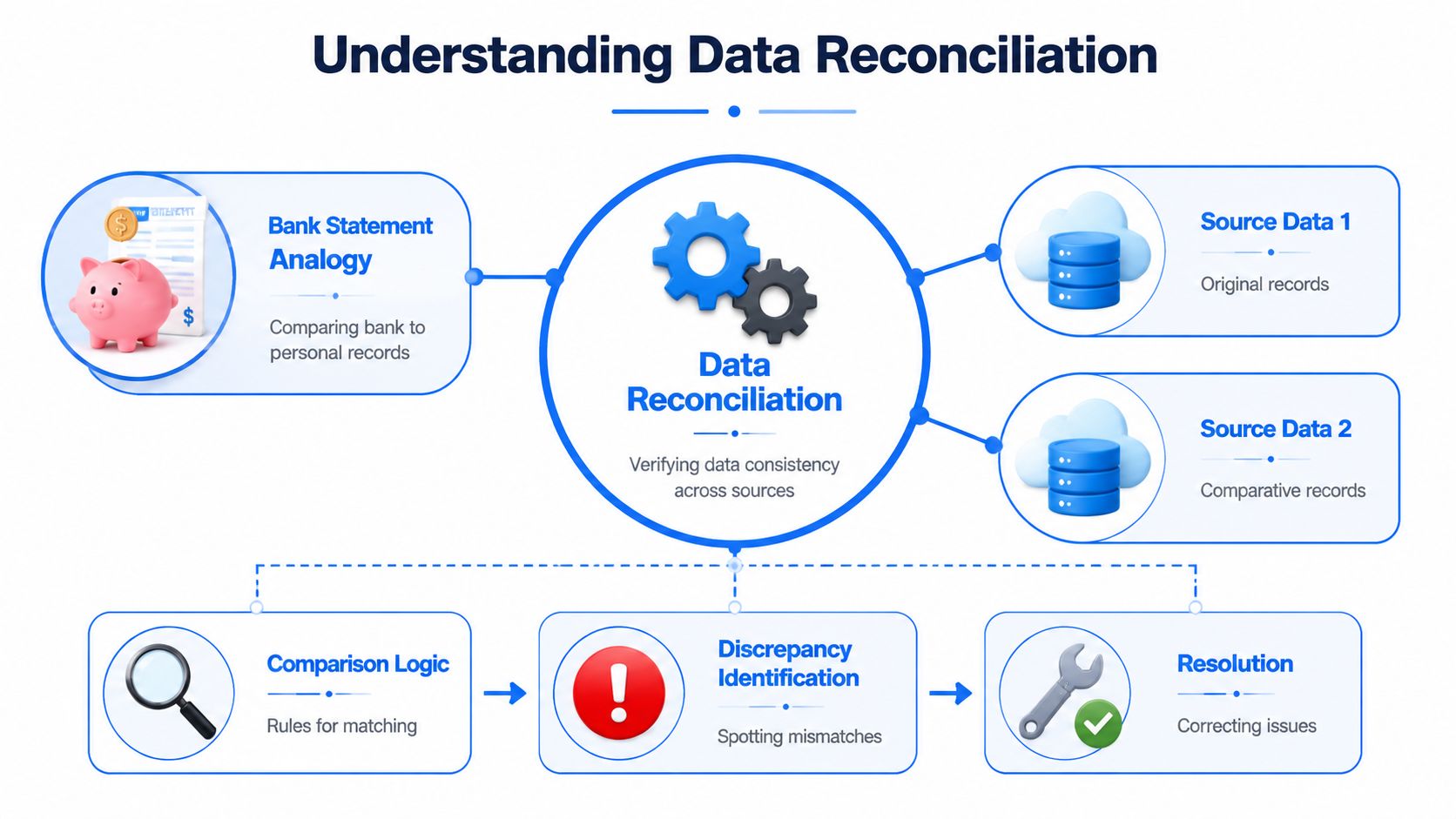
A familiar analogy
If a bank reconciles its books, it isn't just checking whether numbers exist. It's checking whether two records that should describe the same reality line up. The same thing happens in data engineering when a transaction lands in an application database, passes through ETL or ELT, and ends up in a warehouse. If the source says one thing and the target says another, someone needs to identify the discrepancy and resolve it.
That's why accounting examples are still useful, even for modern data teams. If you want a simple business-side illustration, these reconciliation in accounting examples map well to what engineers do with system-to-system checks.
What the term really means
Data reconciliation is the systematic process of comparing two or more datasets to reveal discrepancies, ensuring data accuracy, consistency, and completeness across sources. In practice, financial data typically requires daily reconciliation, whereas reference data may only need weekly checks, as described in the Precisely glossary on data reconciliation.
That definition matters because it separates reconciliation from generic “data cleanup.” The goal isn't just finding bad rows. The goal is to produce a dataset the organization can trust.
A few implications follow from that:
It's comparative, not isolated. Reconciliation only makes sense when at least two records, tables, or systems should agree.
It's operational, not academic. The output affects reporting, compliance, and daily decision-making.
It's about resolution, not just detection. A mismatch that nobody triages is only a discovered problem, not a solved one.
Organizations use reconciliation to create a single source of truth, but that phrase gets abused. In practice, it means agreeing on which dataset is authoritative for a given business question and proving that downstream copies mirror it correctly.
Reconciliation becomes valuable the moment two teams need the same number for different purposes and can't get it from the same place.
That's the practical data reconciliation meaning. It's the process that turns “which number is right?” into a controlled workflow instead of a recurring argument.
Reconciliation vs Validation vs Quality
These terms get blurred together all the time, and that confusion causes bad system design. Teams label everything “data quality,” then miss the fact that different problems require different controls.
Why teams mix these up
Validation checks whether data fits rules. Reconciliation checks whether datasets agree with each other. Data quality is the broader umbrella that includes both, plus concerns like completeness and consistency.
In industrial process contexts, that distinction is even sharper. From a statistical viewpoint, process data reconciliation assumes no systematic errors exist in the measurement set, while data filtering is a mandatory prerequisite step to strengthen the correction phase, as explained in the overview of data validation and reconciliation.
If you want a more implementation-oriented walkthrough of rule checks, this practical guide to data validation is useful, especially for teams that still treat field-level validation and cross-system reconciliation as the same task. For a platform-oriented explanation of the validation side, data validation in modern pipelines is also worth reviewing.
Reconciliation vs Validation vs Quality
Concept | Primary Question | Scope | Example |
|---|---|---|---|
Reconciliation | Do these datasets agree? | Across systems, tables, or records that should match | Comparing ERP invoice totals with warehouse billing tables |
Validation | Is this value structurally or logically acceptable? | Within a record, field, or single dataset | Checking whether a date is valid or a required field is missing |
Data Quality | Can people trust this data for use? | Broad program across accuracy, consistency, completeness, timeliness, and more | Measuring whether a reporting table is complete, current, and usable |
A few practical rules help:
Use validation first: Validate formats, ranges, null handling, and required fields before comparing systems.
Use reconciliation where data crosses boundaries: Any ETL job, migration, sync, or replicated dataset needs a comparison control.
Use data quality as the management layer: Within this layer, teams track policy, ownership, monitoring, and business impact.
Practical rule: Validation stops bad data from entering a system. Reconciliation catches disagreement after data has moved or been transformed.
This distinction matters because many failed reconciliation projects are upstream validation failures in disguise. If your keys are inconsistent, timestamps are malformed, or units differ between systems, reconciliation will produce noise. It won't produce trust.
A Practical Data Reconciliation Workflow
Most production workflows aren't mysterious. They follow a consistent pattern. The challenge is doing each stage well enough that the output is actionable instead of noisy.
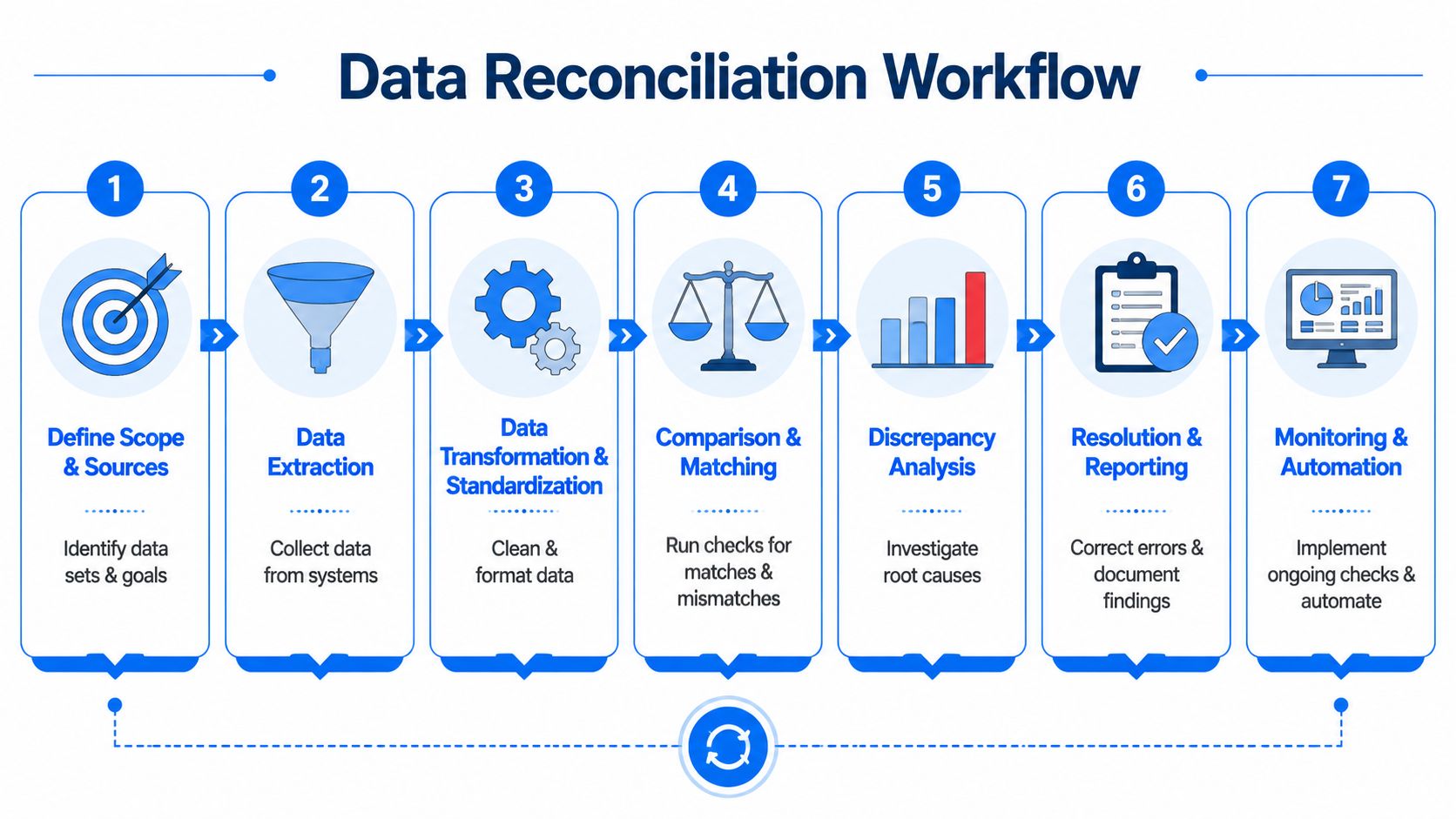
The four operational stages
A standard workflow includes extraction, matching, validation, and resolution, which the Datafold explanation of data reconciliation describes as a four-stage process that creates an audit trail through updates, insertions, or deletions.
Extraction
Pull the relevant data from the systems that should agree. That might mean a source database, an ERP export, a warehouse table, or a CDC-fed target. Scope matters. Don't compare everything if the business question only concerns a subset, such as yesterday's posted invoices or the latest active customer records.Matching
Align records using primary keys, composite keys, or fuzzy logic where exact identifiers don't exist. Many projects go wrong at this stage. If one system usescustomer_idand another uses email plus country, you need explicit matching logic. Don't let analysts improvise that logic in spreadsheets.Validation
Compare values and classify discrepancies. Missing rows, duplicates, mismatched totals, stale timestamps, and transformed values all belong here. Good validation distinguishes between expected differences and true exceptions. A transaction still in transit between systems isn't the same as a lost record.Resolution
Fix the issue or document the accepted exception. Resolution can mean updating wrong records, inserting missing rows, deleting duplicates, or escalating a business decision when neither system is clearly authoritative.
What works in production
The mechanics are simple. The trade-offs aren't.
Exact matching is fast: It works well when keys are clean and stable.
Fuzzy matching helps messy datasets: It's useful for names, addresses, and customer entities, but it also introduces ambiguity that needs review.
Audit trails are essential: If a discrepancy is fixed without documentation, you've solved the symptom and lost the evidence.
Tolerance logic should be explicit: Currency rounding, timing delays, and expected transformation differences need documented thresholds.
A practical workflow also includes pre-checks before the formal comparison begins:
Schema alignment: Confirm columns and data types are comparable.
Time-window alignment: Compare the same processing period.
Normalization: Standardize formats, especially for dates, currencies, and casing.
Teams get better results when they treat reconciliation as a repeatable operational control, not a one-off cleanup exercise.
Manual workflows can still work for low-volume checks or unusual one-time migrations. But as soon as the process repeats, it should be codified.
From Manual Checks to Automated Observability
At 9:15 a.m., finance is asking why revenue in the dashboard is lower than the order system, while the pipeline still shows green. That is the moment manual reconciliation stops being a control and starts being a delay.

Why periodic checks break down
Manual reconciliation usually begins with a sensible shortcut. An analyst exports two files. An engineer writes a comparison query. Someone checks counts, sums, and a list of mismatches. For a low-volume process, that can be good enough.
It stops working when the business expects the data platform to behave like an operational system.
Periodic checks fail for three practical reasons. They detect problems after the data has already been used. They encode assumptions that drift out of date as schemas, mappings, and load patterns change. They also depend too heavily on individual people who know which query to run and which discrepancies are harmless.
The environment has changed too. Flexera reports that 89% of organizations use a multi-cloud approach and 73% use hybrid cloud, which makes cross-system reconciliation harder to keep reliable with one-off scripts and spreadsheets (Flexera 2024 State of the Cloud Report). In that setup, delay is only one problem. The harder problem is context. A missing record could be a failed load, a late event, a CDC lag spike, or a transformation that applied to one side and not the other.
That distinction matters in production. A nightly comparison can tell you two systems disagree. It usually cannot tell you whether the disagreement is expected, temporary, or business-critical.
What continuous reconciliation changes
Continuous reconciliation treats reconciliation as a live operational signal. The goal is no longer to confirm a match after the reporting period closes. The goal is to detect divergence while data is still moving, then route the issue before bad data spreads to dashboards, ML features, finance reports, or customer-facing workflows.
In practice, that means monitoring several layers at once. Row counts still matter, but they are only the outer shell. Reliable setups also watch freshness, schema changes, volume anomalies, null spikes, key coverage, and the timing relationship between upstream events and downstream tables. That is why teams increasingly fold reconciliation into a broader data observability for modern data management practice instead of treating it as a separate monthly task.
AI-based anomaly detection helps here because static threshold rules age badly. Oracle explains in its overview of AI anomaly detection that these systems learn normal behavior from historical patterns and adjust as conditions change. Used well, that reduces rule maintenance. Used badly, it creates noise. I have seen both. The trade-off is straightforward: anomaly detection is strong at surfacing unusual behavior early, but teams still need explicit business rules for high-risk controls such as settlement totals, ledger balances, and contractual SLA checks.
Document-heavy workflows show the same pattern. Tools that analyze financial reports can speed up extraction and comparison from statements or source files, especially when the intake side is still semi-structured. But extraction accuracy does not guarantee reconciled data. The system still needs to verify arrival timing, lineage, mappings, and downstream consistency after the document becomes a record in the pipeline.
A short walkthrough helps show what this shift looks like in practice:
Strong reconciliation systems do more than compare outputs. They watch for the first signs of drift while processing is still underway.
That shift changes ownership too. Reconciliation is no longer a spreadsheet exercise run after the fact. It becomes an operating control built into the data platform itself.
Common Challenges and How to Measure Success
A reconciliation design can look clean in a diagram and still fail within a week of production traffic. Source systems arrive late. Schemas change without warning. One team treats a null as "unknown," another treats it as "not applicable," and the comparison logic starts raising exceptions that are technically correct and operationally useless.
Where implementations usually fail
The hardest part is rarely the comparison itself. The hard part is building a system that knows when a difference is expected, when it signals drift, and who needs to act on it.
Hybrid architecture makes that harder fast. Data moves across warehouses, SaaS applications, operational databases, and event streams, each with different freshness guarantees and different definitions of "done." A row-count check may pass in the warehouse while a customer-facing dashboard is still wrong because replication lag hid the underlying issue upstream.
Timing causes many false alarms. In continuous pipelines, the question is not only whether records match. The question is whether they should match yet. Teams that apply batch-style controls to streaming or micro-batch systems usually create one of two bad outcomes: missed failures because thresholds are too loose, or alert fatigue because normal delay keeps getting flagged.
A few failure patterns show up repeatedly:
Unstable or missing keys: Customer, product, or transaction entities do not map cleanly across systems, so the reconciliation logic compares the wrong records or cannot compare them at all.
Weak preprocessing: Normalization, null handling, and feature preparation affect anomaly-based checks directly. This overview of anomaly detection preprocessing explains why poor preparation leads to noisy results.
No ownership path: Engineering can detect a mismatch, but resolution stalls if finance, operations, or analytics has not agreed on who decides what is correct.
Too much exception noise: A system that flags everything trains teams to ignore it. Good controls reduce investigation effort. They do not create a second inbox nobody trusts.
No lineage context: A failed check without source-to-target lineage only tells the team that something broke somewhere. That slows triage and extends business impact.
This is why modern reconciliation belongs inside observability workflows, not as a delayed review step after data lands. Continuous monitoring gives teams enough context to separate late data, broken mappings, schema drift, and genuine business discrepancies while the pipeline is still active.
How to measure whether it's working
A dashboard is not the success metric. Faster detection, faster resolution, and fewer trust failures are.
Useful KPIs include:
Time to detect discrepancies: Measure how quickly the team sees drift after it starts.
Time to resolve discrepancies: Detection without resolution just creates a queue.
Percentage of automated reconciliations: Manual checks should shrink, especially for high-volume tables and repeatable controls.
Exception backlog: Open mismatches should age down, not pile up across reporting cycles.
Reduction in data-related support tickets: Fewer business escalations usually signals that downstream users trust the numbers more.
Audit readiness: Teams should be able to show what was checked, what failed, who reviewed it, and how it was resolved.
False-positive rate: If too many alerts are expected behavior, people stop responding when a real issue appears.
One practical measure matters more than many teams admit. Watch whether analysts and operators keep building private exports and "safety spreadsheets" outside the platform. Those side processes are a direct signal that reconciliation still feels unreliable.
If your team is still reconciling with ad hoc SQL, spreadsheet exports, and delayed incident discovery, it's time to operationalize the process. digna helps data teams monitor anomalies, validate records, track schema changes, and watch pipeline timeliness inside customer-controlled environments so reconciliation becomes continuous, observable, and easier to trust.