Data Observability vs Data Quality: A Complete Guide
|
5
min. Lesezeit

Yesterday, the dashboard looked clean. Today, revenue is off, finance can't reconcile customer counts, and sales wants answers before the next meeting. Suddenly, everyone is asking the same question under pressure: is the data wrong, or is the pipeline failing?
That tension is exactly why data observability vs data quality is more than a terminology debate. In real incidents, the line between the two blurs fast. A missing upstream file can look like a data quality problem. A silent schema change can show up as a dashboard mismatch. A perfectly valid dataset can still arrive too late to be useful.
Teams need both lenses. One tells you whether the data is fit for business use. The other tells you whether the system delivering it is behaving normally. Rely on only one, and critical blind spots stay hidden until trust is already broken.
Table of Contents
The High Cost of Data Downtime
The incident usually starts the same way. A business stakeholder spots a number that feels off. An analyst checks the BI layer and says the logic hasn't changed. A data engineer inspects the pipeline and sees the run completed. Then the room gets quiet, because nobody can yet tell whether the problem is bad source data, a broken transformation, a late load, or a downstream semantic issue.

That period of uncertainty is what teams experience as data downtime. Data may still exist in storage, pipelines may still be running, and dashboards may still load. But the system isn't trustworthy enough to support decisions.
Why the business impact escalates fast
The direct cost is only part of the problem. According to Gartner, poor data quality costs organizations an average of $12.9 million per year. Gartner also notes that unreliable data erodes trust and hinders data-driven decision-making across the enterprise.
In practice, that loss of trust spreads faster than organizations anticipate:
Executives delay decisions: They wait for manual confirmation instead of acting on dashboards.
Analysts duplicate effort: They revalidate numbers before every meeting.
Engineers get pulled into triage: Time that should go to platform improvement gets consumed by incident response.
Governance teams lose confidence: Controls look weaker when exceptions keep surfacing in production.
A rough estimate helps make the risk tangible. Tools like this data downtime cost calculator are useful because they force teams to translate “the dashboard was wrong” into operational and business impact.
The expensive part of a data incident isn't just the broken table. It's the hours of uncertainty across the people who depend on it.
Why one discipline isn't enough
Data quality helps answer whether the data itself is accurate, complete, valid, and fit for use. Data observability helps answer whether the system that moves and transforms data is operating as expected. One inspects state. The other monitors behavior.
When teams mix those up, they buy the wrong tools, route incidents to the wrong owners, and keep solving symptoms instead of causes.
Understanding the Core Concepts
Data quality checks the state of data
Data quality is the practice of evaluating data against known expectations. Those expectations usually come from business rules, governance standards, or technical constraints. The core question is simple: is this data acceptable for the task it supports?
Typical checks focus on the condition of the dataset itself:
Accuracy: Does the value reflect the actual event or entity?
Completeness: Are required fields populated?
Validity: Do values follow expected formats, ranges, or allowed sets?
Consistency: Do related systems represent the same thing the same way?
Uniqueness: Are duplicate records showing up where they shouldn't?
This is the layer that catches things like invalid transaction dates, missing customer identifiers, malformed product codes, or broken referential integrity. It's strongest when the business already knows what “correct” looks like.
A useful way to think about it is that data quality handles known unknowns. You already know the failure mode is possible, so you encode a rule to catch it. If your finance dataset must never contain nulls in a posting key, data quality is the right control.
For a grounded primer on business-side expectations and controls, this overview of what data quality is and why it matters is a practical reference.
Data observability watches data behavior
Data observability looks at a different problem. It asks whether the overall data system is behaving normally as data moves from source to destination. That includes pipelines, transformations, tables, schedules, and dependencies.
The signals are less about explicit business rules and more about operational patterns:
Freshness: Did data arrive when it usually does?
Volume: Did row counts spike or drop unexpectedly?
Distribution: Did values shift in ways that suggest drift or corruption?
Schema: Did a column disappear, get renamed, or change type?
Lineage context: Where did the issue originate, and what else depends on it?
In such scenarios, data system visibility is essential. Without it, teams often discover failures only after a dashboard breaks or a stakeholder reports something odd.
Practical rule: Data quality tells you whether data passes a standard. Data observability tells you whether the delivery system is starting to deviate from normal.
Observability is especially useful for unknown unknowns. You can't write a rule for every future failure. You can, however, monitor patterns that reveal when something changed before users feel the impact.
That difference is why teams shouldn't treat these terms as synonyms. They overlap in purpose, but they don't inspect the same thing and they don't catch the same class of problems.
Data Quality vs Observability A Detailed Comparison
Teams often ask which one they need first. That's the wrong opening question. A better one is: what kind of failure keeps hurting us? If your main issue is invalid business values, start with quality controls. If your main issue is stale, delayed, or subtly drifting pipelines, observability usually pays off faster.

Quick comparison table
Criteria | Data quality | Data observability |
|---|---|---|
Primary concern | Whether data is correct and fit for use | Whether the data system is behaving normally |
What it monitors | Data state at field, record, or table level | Data behavior across pipelines, tables, and dependencies |
Best for | Known rules and business standards | Unexpected anomalies and operational failures |
Typical signals | Nulls, invalid formats, duplicates, rule violations | Freshness changes, volume shifts, schema changes, drift |
Operating model | Validation and enforcement | Continuous monitoring and alerting |
Common owners | Data governance, analytics engineering, stewards, domain teams | Data engineering, platform, reliability, DataOps |
A practical resource for building the rules side of this operating model is Querio's actionable data quality playbook, especially if your team has good business definitions but weak implementation discipline.
What the operational differences look like
Scope
Data quality usually evaluates data at rest or at controlled checkpoints in a pipeline. It inspects tables, records, and columns against expected standards.
Data observability spans the broader system. It follows what happens as data flows through ingestion jobs, warehouse transformations, orchestration schedules, and downstream assets. If you need a broad overview of those system-level signals, this introduction to data observability for modern data management is a useful frame.
Focus
Quality asks, “Does this field conform to the rule?” Observability asks, “Why did this dataset start behaving differently today?”
That sounds subtle until you're in production. A null-rate check on a revenue column is a quality control. A sudden change in value distribution after a source API update is an observability event. The first is explicit. The second is behavioral.
Core metrics
Quality metrics are deterministic. Pass or fail. Valid or invalid. Duplicate or unique. They're easy to explain to auditors and business users.
Observability metrics are pattern-based. Freshness delays, changing row counts, shifted distributions, schema evolution, and broken dependency chains. They don't always mean the data is wrong, but they tell you where to investigate first.
If quality is the checklist, observability is the instrument panel.
Primary process
Quality programs often run on scheduled tests, pipeline assertions, acceptance criteria, and remediation workflows. They work well when business rules are stable and clearly owned.
Observability runs continuously. It watches telemetry, metadata, historical baselines, and anomalies over time. It's designed to surface problems before a human opens the wrong dashboard.
Team ownership
Quality ownership tends to sit closer to the business meaning of data. Governance leads, data stewards, analytics engineers, and domain owners often define what “good” means.
Observability ownership usually sits with the people responsible for pipeline reliability and platform operations. Data engineers and platform teams need it because they're the ones asked to explain why a trusted dataset suddenly turned untrustworthy.
Neither side should operate in isolation. But the distinction matters, because tools, alerting models, and escalation paths all depend on it.
Where They Overlap and How They Work Together
The “vs” framing is useful for clarity, but it becomes misleading if teams treat the two as alternatives. In production, they work best as a loop.
Observability finds the signal
A healthy observability setup might detect a sudden spike in null values, a delayed arrival pattern, or a shape change in a critical table. At that point, it hasn't yet answered whether the data violates a business standard. It has answered something just as important: normal behavior changed, and the change matters.
That early signal narrows the search area. Instead of checking every transformation and every source manually, engineers can start with the dataset, time window, or dependency chain that moved first.
Observability tells you the patient has a fever. Data quality helps diagnose the specific illness.
This is why observability shortens the path to root cause even when the final issue turns out to be a classic quality failure.
Quality makes the response durable
Once the team identifies the actual defect, data quality turns that one-off incident into a repeatable control. If a source system starts sending malformed contract IDs, observability may catch the anomaly first. Quality should then encode the pattern as a validation rule so the same issue can't pass undetected next time.
That feedback loop is where maturity shows up. Teams stop treating every incident as novel and start converting incidents into controls.
A practical example looks like this:
An anomaly appears: Freshness or distribution shifts in a table that feeds executive reporting.
Engineers investigate: They trace the issue to a source extraction change.
The business impact becomes clear: Specific fields no longer meet the expected contract.
A quality rule gets added: Future loads fail fast or get quarantined before they spread.
Shared outcomes matter more than category purity
The best operating model doesn't argue over labels during an incident. It routes the problem by signal and impact. Observability detects and contextualizes. Quality validates and enforces.
Observability without quality can tell you something changed, but not always whether it violates business intent.
Quality without observability can verify known rules, but it won't catch every unexpected behavior in a fast-moving stack.
Reliable data operations come from combining system awareness with business correctness.
That's the reason mature teams don't pick one side in the data observability vs data quality discussion. They build both into the same data health strategy.
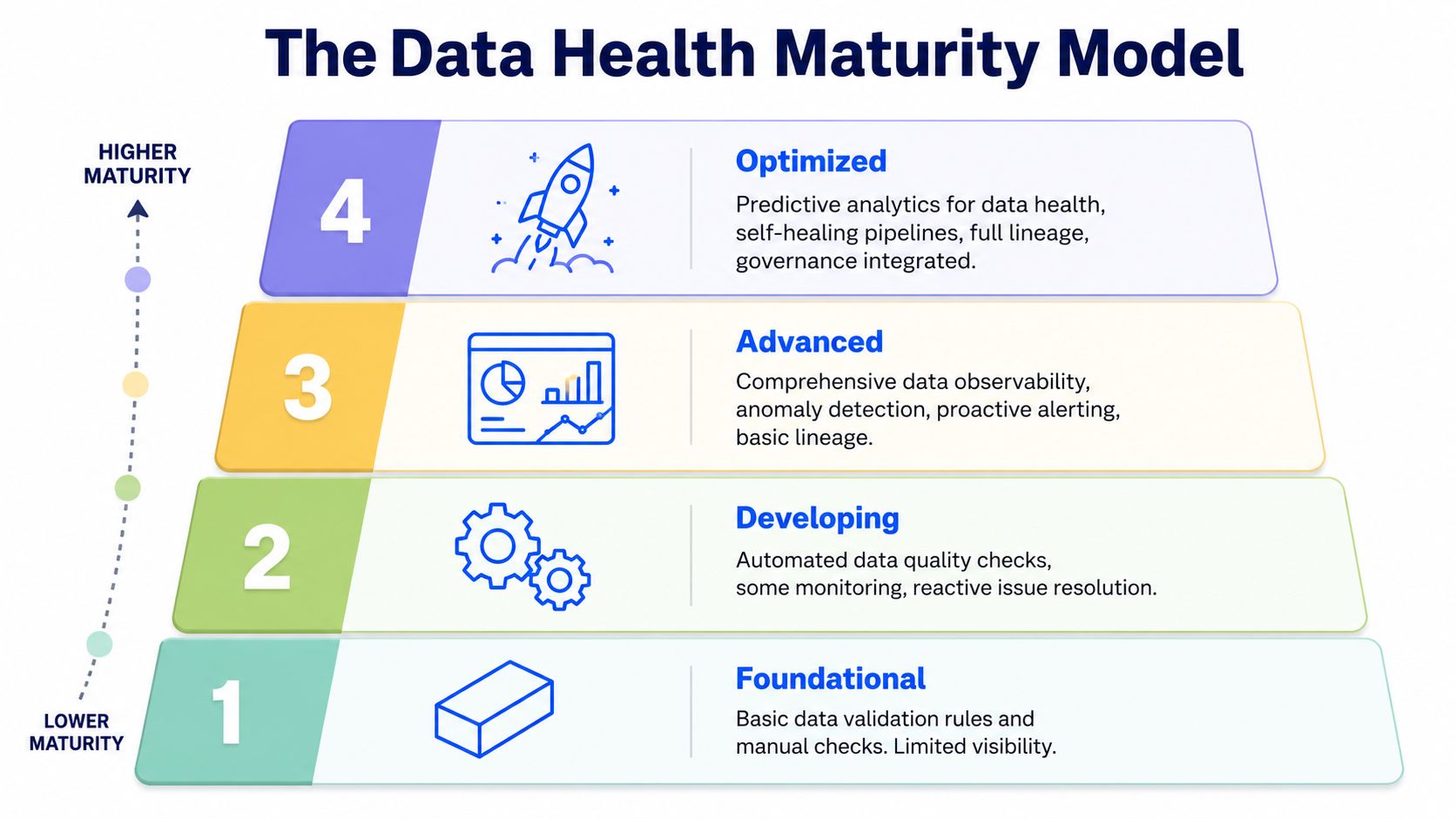
The Data Health Maturity Model
Most organizations don't move from ad hoc SQL checks to a unified data health program in one step. They climb through visible stages, and each stage solves a different bottleneck.
Level one and level two
Level one reactive
At this stage, issues are discovered by business users, analysts, or executives. The response is manual. Someone writes a one-off query, compares yesterday to today, and tries to infer what broke.
This works for small teams and stable systems. It fails when dataset count, dependency depth, or business pressure increases. The biggest problem isn't lack of effort. It's that every investigation starts from zero.
Level two proactive quality
Here, teams start codifying known business expectations. They add null checks, referential integrity tests, accepted values, format constraints, and basic pipeline assertions.
This is a major step forward because repeated failures become visible and enforceable. But it still has a ceiling. If the rule wasn't written, the issue may still pass through unnoticed. That's why many teams at this level still feel reactive even though they've automated part of validation.
Level three and level four
Level three automated observability
At this stage, teams stop relying only on predefined rules and start monitoring the behavior of data systems. They watch freshness, schema evolution, volume anomalies, and shifts in historical patterns.
The operational change is significant. Engineers no longer wait for a dashboard complaint to know where to look. They get earlier signals and clearer context. Incident response becomes faster because the system itself points toward the likely source of change.
Level four unified
The highest-maturity teams don't run quality and observability as separate programs with separate workflows. They combine them into one data health layer with shared metadata, shared ownership, and shared incident handling.
You can usually recognize this stage by a few traits:
Business rules and anomaly signals live together: Teams can see both explicit failures and behavioral deviations in one place.
Ownership is coordinated: Governance, analytics, and engineering don't hand incidents back and forth blindly.
Prevention improves over time: New quality rules are informed by recurring observability findings.
Context is preserved: Trend history, timeliness, schema changes, and validation results support the same investigation flow.
Maturity isn't having more alerts. It's reducing the gap between detection, diagnosis, and prevention.
If you're deciding where to invest next, don't ask whether you've “adopted observability” or “done data quality.” Ask what still forces your team into manual uncertainty.
How digna Unifies Data Quality and Observability
A common failure pattern shows up after teams have already invested in "better monitoring." A freshness tool says a table is late. A separate validation tool says key fields are null. The orchestration logs sit in one system, warehouse queries in another, and the business team is still asking a basic question. Is this a pipeline issue, a data issue, or both?
One operating model instead of two disconnected ones
A unified platform helps because quality and observability incidents rarely stay in separate lanes for long. digna combines rule-based validation with observability signals inside customer-controlled environments, so teams can investigate one data health problem through a single workflow.
On the quality side, digna Data Validation supports user-defined, record-level rules for business logic, policy enforcement, and audit requirements. That is the deterministic layer. Teams define what valid data must look like and test it directly.
On the observability side, the platform tracks how data behaves over time:
digna Data Anomalies detects unexpected changes against historical patterns.
digna Timeliness monitors arrival times and delay behavior.
digna Schema Tracker flags structural changes such as added, removed, or modified columns.
digna Data Analytics gives teams trend visibility across historical signals.
Where a unified platform helps most
The benefit is greatest in environments where teams cannot justify copying production data into a vendor-managed system. digna computes metrics in the customer database and supports private cloud or on-prem deployment. That matters for enterprises that need tighter control over access, residency, and operational boundaries.
The practical advantage goes beyond tool consolidation. It changes incident handling. The same alert path can start with behavioral detection, move into rule validation, and end with a shared view of business impact.
A typical investigation looks like this:
Timeliness alert appears: A key reporting table is late.
Schema context appears: An upstream source changed structure.
Validation confirms impact: Required business fields now fail record-level rules.
Teams respond with shared context: Engineering sees the system fault, and data owners see the business consequence.
That is the strategic value of treating data quality and observability as two layers of one data health program. Quality checks confirm whether the data is acceptable. Observability shows how the system is behaving before and during failure. Running both in one platform closes the gap between detection, diagnosis, and action.
Your Implementation Guide and Next Steps
Organizations don't typically need a broad transformation program to get started. They need a controlled first move that reduces uncertainty in one business-critical workflow.
Start with one critical workflow
Pick a dashboard, model, or operational dataset that people already care about. Don't start with the noisiest pipeline in the warehouse unless it also matters to the business. You want visible impact and manageable scope.
Use this checklist:
Identify critical assets
Choose the tables, pipelines, and reports that directly affect executive reporting, financial processes, customer operations, or model inputs.Assess your current maturity
Be honest about whether your team is still relying on manual checks, has decent rule coverage, or already monitors behavioral anomalies.Define business impact in plain language
Write down what happens when this data is late, wrong, or structurally changed. Focus on decisions blocked, reports delayed, and teams pulled into rework.Run a focused pilot
Add the controls that match the failure pattern. If the issue is repeated business-rule violations, prioritize quality checks. If the issue is stale or unpredictable pipelines, prioritize observability signals first.
Choose based on your failure pattern
A simple decision rule works well:
Prioritize data quality first when your biggest pain is incorrect values, compliance requirements, broken definitions, or recurring rule-based defects.
Prioritize observability first when your biggest pain is late loads, unexplained anomalies, schema drift, and hard-to-trace pipeline failures.
Implement both together when the same asset is both business-critical and operationally fragile.
Start where trust breaks most often, not where tooling looks most impressive.
Keep the rollout narrow enough that the team can tune alerts, assign owners, and document response steps. Early success depends less on feature breadth and more on having a clear action path when something fires.
The final test is simple. When the next stakeholder says, “These numbers look wrong,” your team should be able to answer three questions fast: what changed, where it changed, and whether the business can trust the output. If that still takes hours of Slack messages, dashboard screenshots, and manual SQL checks, the problem is no longer just a bad incident. It is a weak data health operating model.
The goal is not to add more alerts or more tools. It is to shorten the distance between detection, diagnosis, and confident action. The teams that get this right do not waste time arguing about whether an issue belongs to data quality or observability. They use both together to protect trust before it breaks.
If you want more reliable reporting, faster root-cause analysis, and fewer fire drills, the next step is straightforward: start with one critical workflow, put the right signals around it, and build from there.
If your team needs one layer for record-level validation and another for pipeline behavior, schedule time with digna to evaluate how a unified data quality and observability setup would fit your environment, controls, and incident workflow.