Dbt vs Airflow: Choosing the Right Data Workflow in 2026
|
7
min read

If you're evaluating dbt vs Airflow, you're probably not doing it in a vacuum. You're dealing with late upstream loads, fragile SQL jobs, analysts who want cleaner ownership of transformations, and engineers who need one place to see what failed and why. On paper, the choice looks binary. In production, it rarely is.
Teams often don't get into trouble because they picked the wrong tool. They get into trouble because they assigned the wrong responsibility to the right tool. Airflow gets stuffed with transformation logic it shouldn't own. dbt gets treated like a scheduler for workflows it can't see. Then debugging turns into archaeology.
That confusion usually shows up right when a team is trying to standardize a modern stack and streamline operations with data processing across ingestion, transformation, and downstream delivery. The useful question isn't which logo wins. It's which layer of the system each tool should control, and how those boundaries hold up when something breaks.
Table of Contents
Introduction Untangling Your Data Workflow
The biggest mistake in the dbt vs Airflow debate is treating them like substitutes. They aren't. They operate at different layers, solve different failure modes, and create value for different people on the team.
Airflow owns workflow coordination across systems. dbt owns SQL transformation inside the warehouse. Once that boundary is clear, the architecture starts to get simpler. Extraction jobs, API waits, retries, notifications, and sequencing belong in an orchestrator. Model logic, tests, documentation, and lineage belong in a transformation framework.
That sounds obvious until a real pipeline lands on your desk. A SaaS ingestion finishes late. A raw table arrives with unexpected nulls. A marketing export depends on a mart refresh. Someone asks whether the fix belongs in the DAG, the dbt project, or somewhere else. Tool choice then becomes a matter of operating model.
Practical rule: If the problem is about task order, timing, retries, or coordination across systems, start in Airflow. If the problem is about shaping warehouse data into trustworthy models, start in dbt.
Hybrid stacks work well when the boundary is strict and the handoff is explicit. They become painful when teams blur concerns. Airflow shouldn't become a SQL graveyard. dbt shouldn't become your answer for upstream dependency control.
The architecture that holds up in production usually has three characteristics:
Clear ownership: Engineers manage orchestration logic. Analytics engineers and analysts manage transformation logic.
Thin orchestration tasks: Airflow triggers work and monitors it. It doesn't become the place where business logic accumulates.
Warehouse-native transformation: dbt executes where the data already lives, which keeps the transformation layer modular and easier to reason about.
What Is Apache Airflow The General Orchestrator
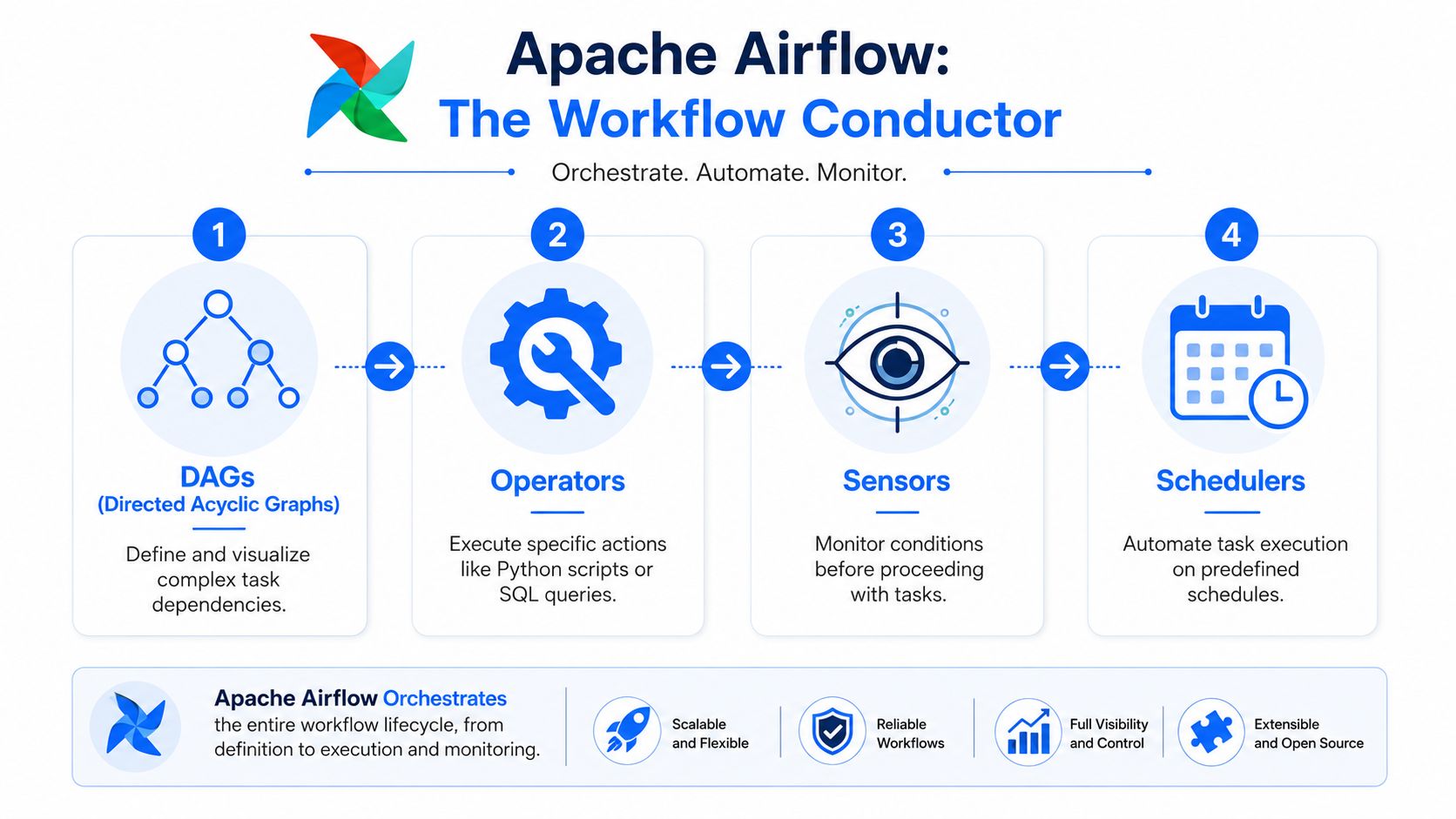
Apache Airflow is the layer you reach for when the workflow stretches beyond one system. It isn't just a scheduler. It's the operational control plane that decides what runs, in what order, under which conditions, and what happens when a step fails.
Why Airflow became the control plane
Apache Airflow is an open-source workflow orchestration platform that enables teams to programmatically author, schedule, and monitor data pipelines using Python and SQL, achieving a user satisfaction score of 8.7 out of 10 on TrustRadius according to community reviews on TrustRadius' Airflow and dbt comparison.
That definition matters less than its implication. Airflow became the dominant choice for orchestrating complex, multi-step pipelines that span systems beyond the warehouse, including ingestion, machine learning processes, and activation steps that need dependency resolution, retries, and failure notifications. In other words, it's built for environments where one job finishing successfully doesn't mean the pipeline is complete.
A good analogy is a general contractor on a construction site. The contractor doesn't pour the concrete, install the wiring, and paint the walls personally. The contractor coordinates specialists, sequencing, inspections, delays, and handoffs so the whole project finishes in the right order.
Airflow is strongest when each task has a narrow responsibility and the DAG expresses control flow clearly.
What Airflow should orchestrate
Airflow works best when you use it to coordinate specialized systems instead of recreating them inside Python tasks. That means:
Triggering ingestion tools: Start extraction from APIs, SaaS connectors, or internal services.
Managing waits and dependencies: Hold the workflow until files land, tables refresh, or upstream services finish.
Running downstream processes: Kick off warehouse loads, ML refreshes, reverse ETL, or notifications.
Providing operational visibility: Use the UI to inspect task durations, historical runs, and failure points.
Its flexibility is the advantage and the trap. Because Airflow can run almost anything, teams often put too much business logic into DAG code. That makes debugging harder, especially when orchestration code and transformation code are intertwined.
This gets even more obvious when workflows expand into autonomous systems and service interactions. The same design pressures show up in the challenges of AI agent orchestration, where coordination complexity increases long before individual task logic becomes the main problem.
What Is dbt The Transformation Specialist
dbt is what you use when raw warehouse tables need to become trusted analytical assets. It doesn't try to manage every system in the pipeline. It focuses on the transformation layer and does that job with much tighter discipline than a general orchestrator ever will.

Why dbt belongs inside the warehouse
dbt Core is an open-source framework specifically designed for analytics engineering that executes SQL-based data transformations directly inside data warehouses, handling the "T" in ELT by organizing, cleansing, denormalizing, filtering, renaming, and pre-aggregating raw data for analysis, as described in the FOSDEM presentation on translating dbt to Apache Airflow.
That in-warehouse execution model is the key architectural point. dbt doesn't pull data out to an external processing layer just to transform it. It compiles SQL and runs it where the data already resides. That keeps the transformation path closer to the warehouse engine, warehouse permissions, and warehouse performance profile.
The best analogy is a master carpenter working inside the house, taking rough materials and turning them into finished structures in the workshop where the tools already exist. dbt isn't coordinating the whole construction site. It's producing the finished interior components with repeatable craftsmanship.
What dbt is excellent at
The vendor states that dbt enables analysts to take ownership of the analytics engineering workflow, from writing transformation code to deployment, documentation, and testing. That explains why dbt tends to spread quickly once a team starts modeling seriously.
Its strengths are operational as much as technical:
SQL-first development: Analysts and analytics engineers can contribute without shifting their main language into Python-first orchestration code.
Modular models: Each model stays smaller, easier to review, and easier to test.
Built-in testing and lineage: The transformation graph becomes inspectable instead of tribal knowledge.
Shared conventions: Naming, dependencies, and documentation become part of the project itself.
dbt is usually the right place for business logic that needs to stay legible to the people who define metrics and reporting semantics.
Where teams struggle is when they expect dbt to act like a full workflow manager. That's not what it's for. It's a specialist. If your pipeline problem involves files, APIs, non-SQL compute, or cross-system timing, you're already outside dbt's natural scope.
A Core Architectural Comparison
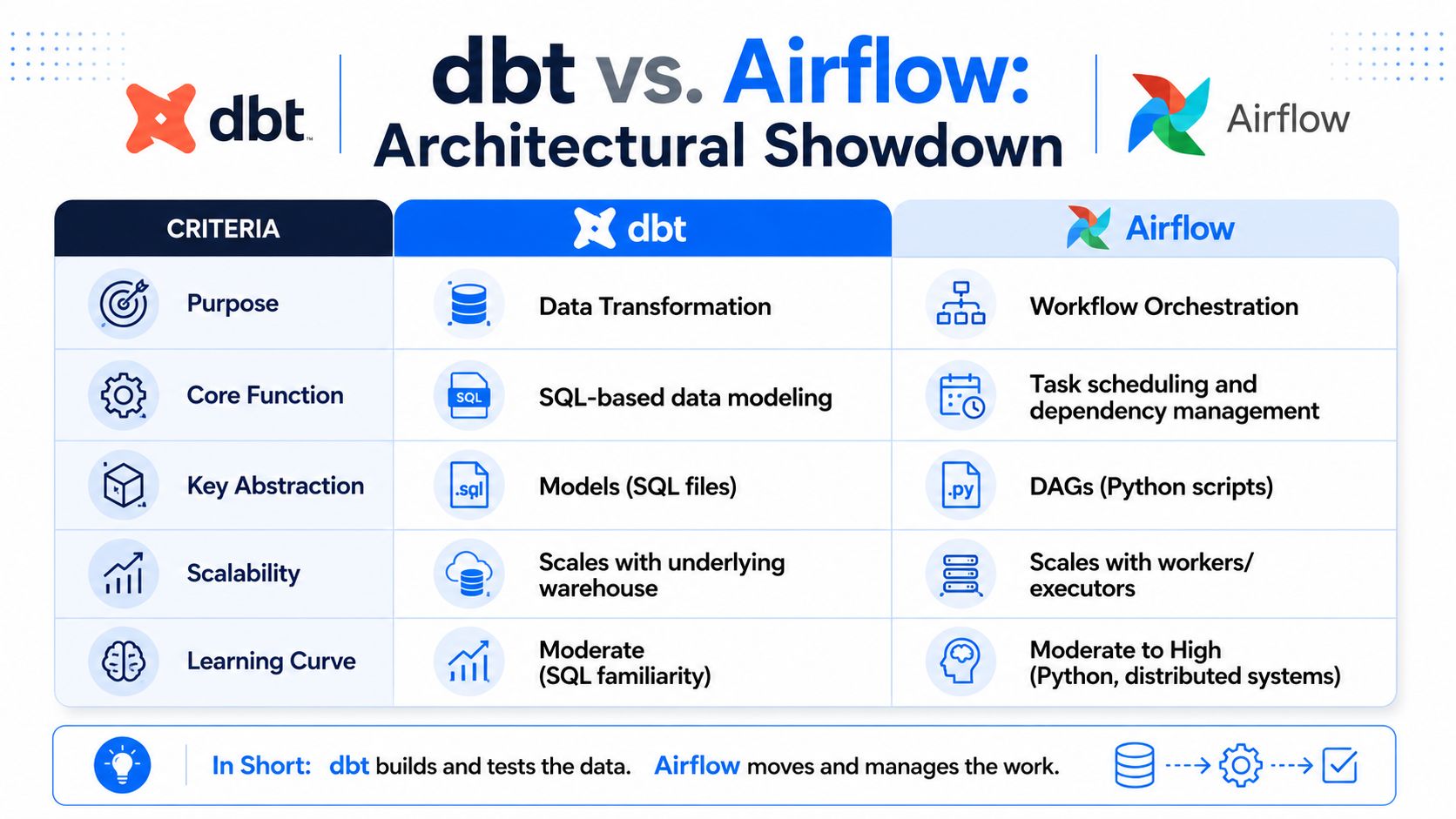
The dbt vs Airflow decision isn't about popularity. It's about execution model, failure domain, and team ownership. These tools feel compatible in production because their design philosophies are different, not because they're similar.
Quick comparison table
Dimension | dbt | Apache Airflow |
|---|---|---|
Primary role | Data transformation inside the warehouse | Workflow orchestration across systems |
Main abstraction | Models | DAGs |
Typical language | SQL and Jinja | Python and SQL |
Execution location | In-warehouse | External workers and executors |
Best at | Modeling, testing, documentation, lineage | Scheduling, dependencies, retries, coordination |
Natural owner | Analytics engineers, SQL-heavy teams | Data platform engineers, data engineers |
Weak point | Cross-system control | Maintainable in-task transformation logic |
What the architecture means in practice
A warehouse-native transformation framework and an external orchestrator produce very different operating behavior. dbt benefits from the database's compute engine and stays state-aware inside the transformation graph. Airflow benefits from broad system reach and can coordinate arbitrary tasks regardless of where they run.
That split creates practical trade-offs.
First, flexibility versus specialization. Airflow can orchestrate Python scripts, SQL statements, API calls, sensors, and machine learning steps in one workflow. dbt is narrower by design. That narrowness is a feature when you're trying to keep transformation logic readable and governed.
Second, who can safely contribute. SQL-first teams usually move faster in dbt because the mental model matches the work. Airflow requires stronger orchestration discipline, comfort with Python, and awareness of deployment behavior. That's why a hybrid stack often improves team clarity rather than increasing complexity.
Third, where testing ends. Performance benchmarks indicate that dbt's Fusion Engine delivers faster SQL parsing and intelligent build avoidance to minimize redundant execution, whereas Airflow reduces resource contention through deferrable operators that release worker slots during long-running external waits. The same analysis notes that dbt's native testing suite covers schema-shaped drift and YAML validation, but explicitly lacks capabilities for volumetrics, freshness against external sources, or cross-source contracts, which often require Airflow DAG validation and unit tests for tasks, according to Airbyte's dbt vs Airflow analysis.
That distinction matters during incident response. A green dbt run doesn't guarantee that upstream data arrived correctly. A green Airflow DAG doesn't guarantee that the transformed data still looks sane.
Architecture check: If a team says one tool will cover orchestration, transformation, and quality end to end, they're usually compressing different concerns into one layer and creating future debugging pain.
How dbt and Airflow Work Together in the Modern Data Stack
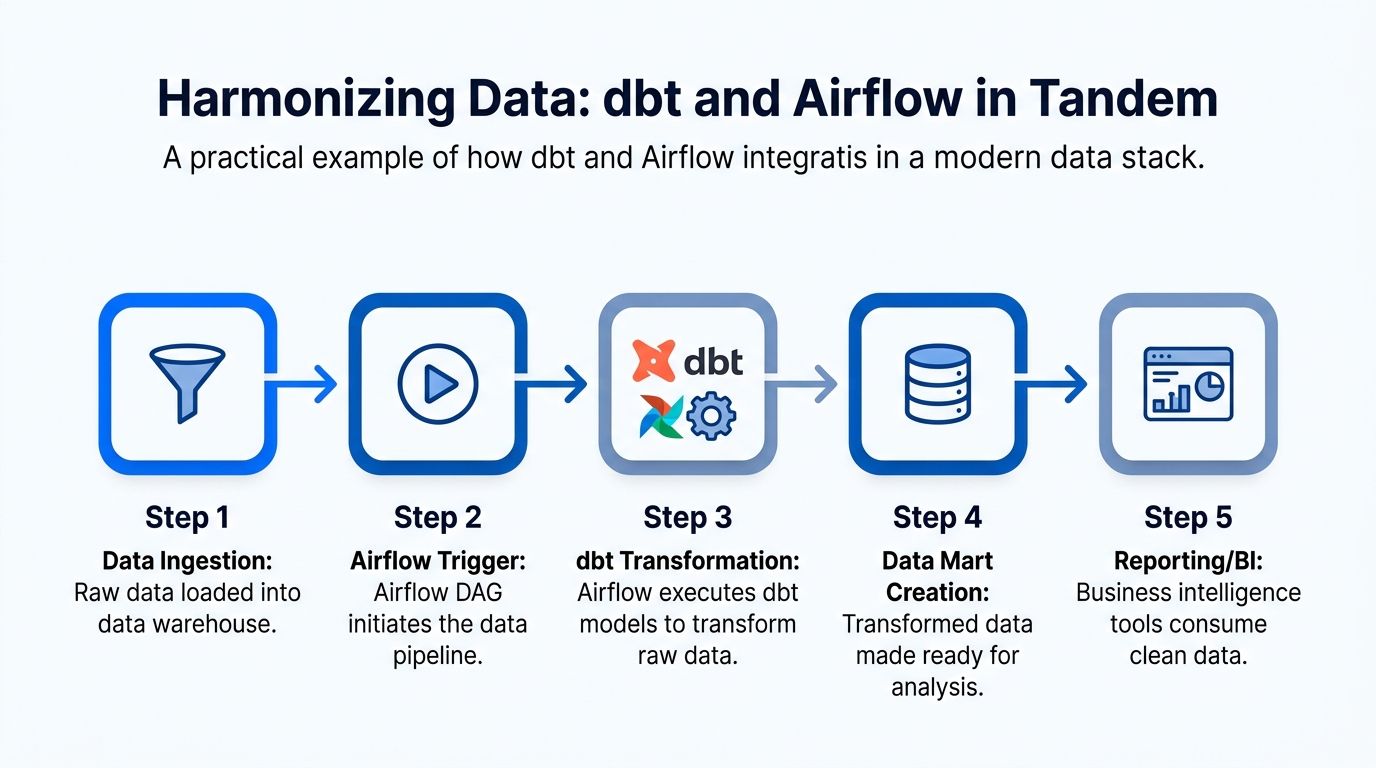
In a healthy stack, Airflow and dbt meet at a clean handoff. Airflow coordinates the workflow. dbt executes the warehouse transformation step. That division is why the combination scales operationally.
The handoff that keeps systems clean
A useful framing comes from the view that dbt handles the "WHAT" through modeling, testing, documentation, and lineage, while Airflow handles the "WHEN" and "HOW" through scheduling, dependency resolution, and retries across heterogeneous systems. The same source describes them as orthogonal components rather than competitors and presents the 2026 production pattern as Airflow or Dagster orchestrating the pipeline while dbt executes SQL models inside the warehouse, as explained in DataDriven's dbt vs Airflow article.
That's the architecture to optimize for. Let Airflow decide when the transformation should happen. Let dbt decide how the models compile and run.
A standard flow looks like this:
Extract from APIs, files, or source systems.
Load raw data into the warehouse.
Trigger dbt from Airflow once upstream conditions are satisfied.
Run tests and build marts inside the warehouse.
Continue downstream to dashboards, exports, or activation tasks.
When freshness of raw sources becomes part of the handoff, teams often need a clearer view than DAG success alone can provide. A practical reference point is dbt source freshness monitoring, because source readiness is often where orchestration assumptions and warehouse reality diverge.
A practical DAG pattern
A simple Airflow pattern is enough for many production stacks:
Task one: trigger or monitor ingestion.
Task two: confirm load completion in the warehouse.
Task three: run
dbt build,dbt run, or a dbt Cloud job.Task four: branch on test outcome or continue to downstream delivery.
The main design decision is granularity. Some teams trigger dbt as one task. Others map dbt models or groups more explicitly into the DAG. The wrong answer is usually the extreme. One opaque dbt task can hide too much detail. A DAG with hundreds of model-level tasks can become noisy and slow to reason about.
Where hybrid workflows usually fail
Most integration pain comes from one of three patterns:
Airflow owns too much SQL: Large transformation logic inside operators drifts away from dbt conventions and becomes hard to test or document.
dbt is expected to manage workflow state: Teams assume a successful model graph means the wider pipeline is healthy, even when upstream deliveries were partial or late.
The handoff lacks a contract: Raw tables are present, but not complete enough for dbt to produce valid outputs.
The best debugging approach is to separate failure questions. Did Airflow trigger the right steps in the right order? Did dbt compile and run the expected models? Did the resulting data behave normally after execution? Treat those as distinct checks, not one blended status.
Choosing Your Integration Pattern
There isn't one correct way to run dbt and Airflow together. There are patterns that fit your team better or worse depending on who writes the code, who operates the platform, and how much infrastructure work you're willing to carry.
When Airflow should stay in charge
An Airflow-native pattern fits when your pipelines span many systems and the orchestration layer already matters more than the transformation layer alone. That's common when your workflows include ingestion dependencies, file waits, custom Python jobs, reverse ETL, or machine learning steps.
In that setup, Airflow remains the primary operational interface and dbt is a well-defined task within the DAG. This works especially well when platform engineers already maintain Airflow and want one control plane for retries, alerts, and schedules.
Choose this pattern when:
Engineering owns operations: The team is comfortable maintaining DAGs, executors, and deployment processes.
The pipeline is broader than analytics: Warehouse transformation is only one stage among many.
Cross-system failure handling matters: You need a central place to inspect task coordination, not just SQL model execution.
When a dbt Cloud centric pattern fits better
A dbt Cloud-centric pattern can work if your immediate complexity is concentrated in the transformation layer and your analytics team needs faster ownership of builds, tests, and deployment workflows. In that model, dbt handles more of the transformation lifecycle experience, while Airflow still coordinates anything upstream or downstream that extends beyond dbt's boundary.
This pattern is usually easier for SQL-heavy teams to adopt because the transformation surface stays closer to where they already work. It can also reduce the friction of running dbt Core completely self-managed.
Keep the control boundary explicit. Even if dbt Cloud runs the transformation job, Airflow still belongs in the architecture when the workflow extends beyond warehouse modeling.
The selection criteria that actually matter
The right pattern usually comes down to operational fit, not ideology.
Team composition: More analysts and analytics engineers usually pushes logic toward dbt. More platform engineers usually increases comfort with Airflow-led integration.
Deployment preference: Teams that want self-hosted control often accept more Airflow and dbt Core operational overhead. Teams that want less platform maintenance tend to prefer more managed surfaces.
Debugging style: Some teams want a single orchestration console. Others prefer transformation detail to live closer to dbt artifacts and model semantics.
Pipeline shape: If your data flow starts and ends in the warehouse, dbt can sit more centrally. If it crosses services constantly, Airflow should lead.
What doesn't work well is ambiguity. If nobody can answer whether a failed freshness check, late load, or broken mart belongs to the orchestrator or the transformation layer, the architecture isn't finished.
Completing the Picture with Data Observability
Even a clean Airflow plus dbt architecture leaves one blind spot. You can know that the workflow ran and that models built successfully, yet still ship bad data. That's because orchestration status and transformation success aren't the same as ongoing confidence in the data itself.
What orchestration and transformation still miss
Airflow tells you whether tasks executed. dbt tells you whether models compiled, ran, and passed the tests you've defined. Neither one independently gives continuous, adaptive monitoring of behavioral changes across the data flowing through the system.
That gap becomes obvious with issues like drifting distributions, unusual volume changes, delayed arrivals, or silent deviations that don't violate a hardcoded dbt assertion. Those problems often surface first in dashboards, stakeholder reports, or downstream ML behavior.
A broader framing helps here, especially if your team is formalizing data observability practices as a separate operating layer rather than treating quality as a byproduct of orchestration.
Why an independent monitoring layer matters

The missing layer is continuous monitoring of the data's actual behavior. The digna platform calculates data metrics entirely in-database, learning baselines and flagging anomalies without manual setup, rule maintenance, or Python coding, with machine learning operating transparently, continuously, and at scale across configured tables. Its in-database execution keeps data resident in the customer environment, reducing data movement while supporting enterprise-scale volumes in warehouses, lakes, and complex pipelines, as described in digna's overview of in-database anomaly detection techniques.
That matters because it complements both tools without replacing either one. Airflow still orchestrates. dbt still transforms. An observability layer independently checks whether the resulting datasets continue to behave like they should.
A robust stack doesn't stop at "the job succeeded." It asks whether the data arriving at the business still matches normal behavior.
If you're designing a stack around Airflow and dbt, digna adds the layer often recognized as necessary after the first silent data incident. It monitors data behavior in-database, learns normal patterns automatically, and helps teams catch anomalies before broken outputs reach reports, models, or operations.
Frequently asked questions
What is the difference between dbt and Airflow?
Airflow is a general-purpose orchestrator that schedules and sequences tasks across systems. dbt is a transformation tool that runs SQL models inside your warehouse with testing and documentation. They solve different problems, which is why the comparison is usually a false choice.
Should you use dbt or Airflow?
Most teams use both. Airflow orchestrates the end-to-end flow including ingestion, external dependencies and downstream triggers; dbt owns the transformation layer inside the warehouse. Using Airflow to hand-write transformation DAGs recreates what dbt already does well.
What is dbt best at?
Expressing transformations as version-controlled SQL models with dependency resolution, built-in testing, documentation and lineage. Because it runs in the warehouse, it takes advantage of the compute you already pay for instead of moving data to a separate engine.
What should Airflow orchestrate?
Everything dbt cannot see: extraction from source systems, file arrivals, API calls, machine learning jobs, and the sequencing between them. Airflow is the control plane; dbt is one well-behaved task inside it.
How do dbt and Airflow fit with data quality monitoring?
dbt tests catch violations you anticipated at build time. Neither tool tells you that data arrived on time but wrong, or that a distribution shifted. That gap is what continuous monitoring and anomaly detection cover, running alongside rather than inside the transformation layer.