Data Schema vs Data Model: Key Differences Explained
|
6
min read

You're staring at a dashboard that looked fine yesterday, then one upstream rename lands and a few charts turn blank. Nobody announced a model change, the warehouse didn't crash, and yet your on-call engineer is suddenly tracing lineage through ETL jobs, BI semantic layers, and table definitions to find the break. That confusion usually starts with one simple mistake, treating the data model and the data schema like they're the same thing.
Criterion | Data Model | Data Schema |
|---|---|---|
What it describes | The abstract design of entities, relationships, and constraints | The concrete organization of one database or table set |
Typical form | ER diagrams, UML class diagrams, conceptual and logical models | DDL, table definitions, fields, types, relationships, constraints |
Best use | Reasoning, governance, communication, design | Runtime enforcement, storage, validation, execution |
Change pace | Usually slower, tied to business meaning | Often changes as columns, types, and rules evolve |
Main risk if confused | Teams debate structure without clarifying meaning | Downstream consumers break because the contract changed |
Table of Contents
Why This Distinction Trips Up Every Data Team
A warehouse engineer adds a column rename upstream, and three dashboards go to null without a loud failure. The tables still exist, the pipeline still runs, and the only visible clue is that the old field name no longer resolves where the BI tool expected it to. That's the moment when people start using “model” and “schema” interchangeably, even though the actual failure happened at the schema layer, not the abstract design layer.
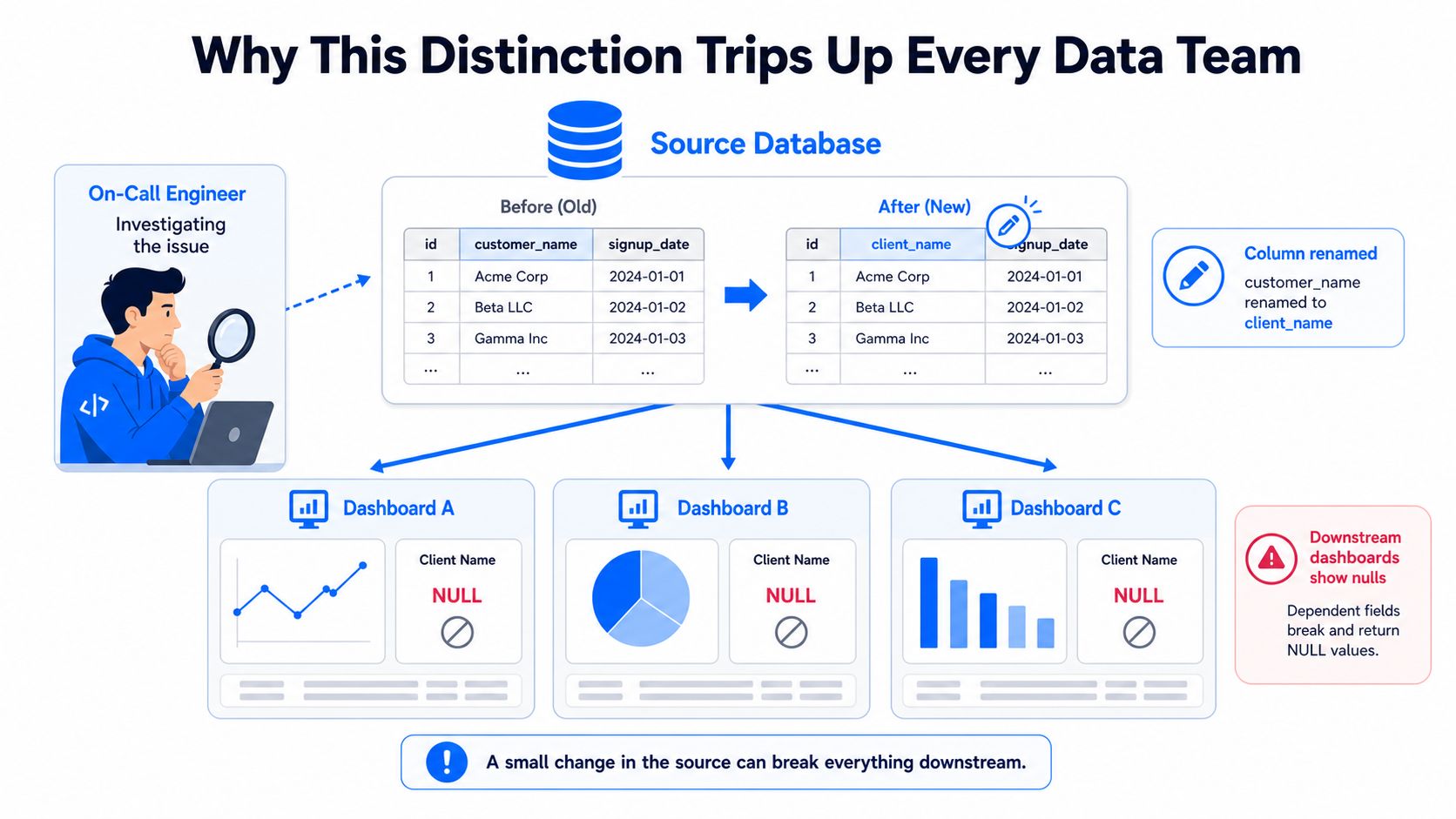
The cleanest way to debug that incident is to ask a single question. Is this change about what the data means, or about how it is physically structured right now? The first question belongs to the model. The second belongs to the schema.
A whiteboard rule that saves time
When teams keep those layers separate, they stop arguing in circles. A product analyst can talk about customers, orders, and revenue as business concepts, while a data engineer can talk about columns, types, and constraints as executable structure. Those are different conversations, and the warehouse gets healthier when the team treats them that way.
The distinction also gives observability work a sharper target. If a metric breaks because a field was removed, the issue is not a philosophical modeling problem, it's a schema contract problem. That means the right response is tracking structural drift, validating changed fields, and checking downstream dependencies before the next release window closes.
Practical rule: if a human would draw it on a whiteboard, you're probably in model territory. If the DBMS can enforce it, you're in schema territory.
That lens matters in every later decision. A design review, a warehouse migration, or an incident postmortem gets much simpler when the team can say, “this is a model question,” or “this is a schema change,” without mixing the two.
Defining the Data Model at Three Levels
A data model is the abstract description of the entities, relationships, and constraints a business cares about. It's the language you use before any database-specific decision appears on the screen, and it's the artifact that helps architects, analysts, and engineers reason about structure together. In classical database architecture, that model can be understood in levels, from business meaning down to implementation detail (Purdue's database architecture overview).
Conceptual, logical, physical
At the conceptual level, you describe the business world. A retail team might say it has customers, orders, and products, and that customers place orders that contain products.
At the logical level, you refine that into entities, attributes, keys, and relationships without choosing a database engine. The same retail domain now has attributes such as customer_id, order_date, and product_name, plus relationships that show how orders connect to customers and line items connect to products.
At the physical level, that design becomes implementation-ready. The same idea is translated into concrete data types, indexes, partitions, and table structures for a specific system. Database choices start to matter here, because the model is being expressed in a way the platform can execute.
The retail example stays the same, the form changes
That retail domain is useful because the business meaning stays stable while the representation evolves. A conceptual diagram might show the broad relationships. A logical diagram might add keys. A physical design might become Snowflake tables or PostgreSQL tables with specific types and constraints. The point is not that the model disappears. The point is that the model survives through multiple representations, which is why it's so useful for governance and communication.
Good modeling habit: keep the same domain in view as you move from conceptual to logical to physical. If the retail customer disappears from the conversation halfway through, the design usually got too abstract or too implementation-heavy.
For warehouse teams, that hierarchy is the reason an ER diagram or UML class diagram can still be valuable even before any DDL exists. The model helps humans align on meaning first, then choose the storage shape later. If you need a deeper warehouse example, the modeling workflow in mastering warehouse data modeling fits neatly into that progression.
Defining the Schema as the Operational Contract
A schema is the concrete description of how data is organized in a specific database system. In practical DBMS terms, that means tables, fields, types, constraints, views, and relationships, all expressed in a form the engine can enforce at runtime. IBM's relational framing treats schema as the blueprint that defines the database's shape, while the model remains the broader design logic underneath (schema definition reference).
From design to execution
Take the retail example again. The model says customers place orders. The schema says there is a customers table, an orders table, and maybe a foreign key that ties them together, with field types like VARCHAR or TIMESTAMP, plus NOT NULL rules and other constraints. That's the point where a conceptual idea becomes executable structure.
This is why schema changes are not just housekeeping. When a column is added, removed, renamed, or retuned, the DBMS is dealing with the operational artifact, not the abstract idea. Downstream code depends on that exact shape, so even a small edit can break dashboards, ETL jobs, or machine learning features that expect the old contract.
The schema is what consumers actually trust
A data consumer doesn't read your conceptual diagram at query time. The BI tool reads the table shape, the pipeline reads field names and types, and the warehouse enforces the rules in the schema. That makes the schema a contract, even when nobody writes the word “contract” in the architecture doc.
The contract metaphor matters because it explains why schema ownership is often more urgent than model ownership in production. The model can stay stable while the schema shifts under real workloads. In observability terms, the schema is the versioned, executable layer that needs constant attention.
The model tells you what the system means. The schema tells the database how to store and enforce it.
That's the clean handoff to keep in your head when you're reading DDL, reviewing a migration, or debugging a broken consumer. If the change can be felt by the DBMS, it's a schema issue. If the change is about business structure and meaning, it's a model issue.
Data Schema vs Data Model Side by Side
The simplest way to separate the two is to compare them by how they're used, not just by how they're defined. A model helps people think. A schema helps systems run. The model usually lasts longer. The schema changes more often.
Criterion | Data Model | Data Schema |
|---|---|---|
Primary audience | Architects, analysts, governance teams | DBAs, platform engineers, pipeline owners |
Main purpose | Describe business meaning and structure | Enforce concrete structure in a database |
Lifecycle | Long-lived design artifact | Operational artifact tied to the live system |
Mutability | Evolves as business understanding changes | Revised when tables, fields, or types change |
Enforcement | Often review-based or process-driven | Machine-enforced by the DBMS |
Failure mode | People lose a shared language for the domain | Downstream contracts break at runtime |
The key relationship is simple. The model determines the schema, and the schema is the operational contract. That's the line worth repeating in a design review when someone tries to solve a schema break by redrawing the abstract model instead of fixing the actual database shape.
How the two artifacts behave in practice
A model is the artifact you bring into a design conversation. A schema is the artifact you deploy. If a stakeholder asks whether customer and account should be separate concepts, that's a model question. If the warehouse owner asks whether a column should be nullable, that's a schema question.
That distinction also changes who should update what. Analysts and architects usually influence the model when business rules shift. Data engineers and platform owners usually change the schema when implementations need to reflect those rules. The same requirement can touch both layers, but it rarely starts in both layers at once.
Design review shortcut: if the decision changes how people understand the business, revisit the model. If the decision changes how the DBMS stores or validates rows, revise the schema.
The comparison also helps explain why teams get into trouble when they skip one layer. A beautiful model with a sloppy schema still breaks dashboards. A fast-changing schema with no stable model leaves everyone guessing what the data means. Good teams keep both visible, but they don't pretend they're interchangeable.
Where the Distinction Breaks Down in Modern Systems
Modern stacks blur the line because different platforms use the word schema differently. In a lakehouse, the model and the schema can end up living close together in files and table metadata. In a document store, the schema may be a JSON contract enforced by writers instead of the database. In event streams, the schema can live in a registry and evolve under compatibility rules.
Why the word means different things in different systems
That's where confusion gets real. In NoSQL teams, people often use schema and model interchangeably because the structure is looser and the enforcement is partly external. In schema-on-read systems, consumers may impose their own interpretation later, which makes the boundary between “design” and “execution” feel softer than it does in a classic relational warehouse.
Practitioner writing has pointed out that teams often talk past one another here, because the same term can mean physical DDL, JSON shape, or validation rules depending on the platform. That's exactly why the clean textbook definition isn't enough on its own. The operational boundary shifts with the storage and ingestion pattern.
Ask which layer is actually being enforced
The fix is to ask where enforcement lives. If a writer validates a JSON payload before publishing to Kafka, that contract behaves like schema even if the database never sees the raw structure. If a lakehouse table stores semi-structured data and only interprets fields later, the apparent schema may be thinner than what the warehouse team expects. If a registry manages compatibility rules, the operational contract lives there too.
That doesn't erase the model-versus-schema distinction. It just means the schema boundary can move across tools. The useful habit is to identify whether a conversation is about conceptual meaning, writer-side validation, or database-side enforcement before making a change.
In modern systems, the question is rarely “do we have a schema?” The real question is “where is the schema enforced, and who depends on it?”
That question prevents a lot of unnecessary cross-team friction. It also keeps governance discussions honest, because the answer changes depending on whether you're looking at a warehouse table, a JSON event, or a registry-backed stream.
Why Schema Changes Are the Real Operational Risk
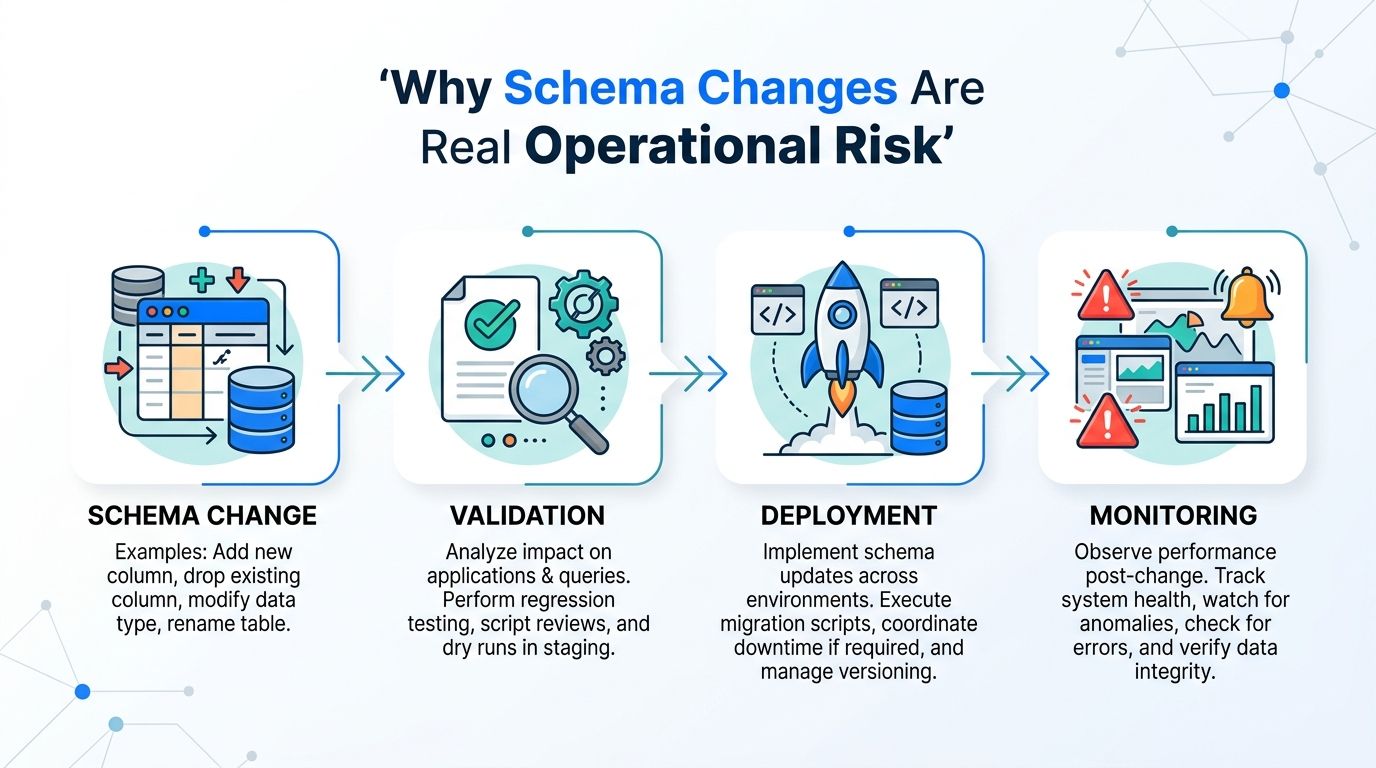
The biggest production risk isn't that a model exists. It's that the schema changes in ways downstream systems didn't expect. Added columns, removed columns, type changes, default changes, and constraint changes can all break BI or pipeline logic even when the business model is still intact. In practice, the schema is the layer where silent breakage starts.
Drift is a runtime problem, not a theory problem
When teams treat schema drift as a theoretical design issue, they usually learn about it from a failed dashboard, a stale feature set, or a broken transform. The problem is operational because the DBMS keeps running while the contract changes around it. That's why schema monitoring belongs beside timeliness checks and record-level validation in the observability stack.
The schema is also the fastest way to detect hidden coupling. A report that depends on a nullable field becoming non-null, or a downstream model that assumes a string field stays the same type, will usually fail only after the change ships. Once that happens, the incident work is no longer about design elegance. It's about restoring trust in the pipeline.
For a deeper look at that failure mode, the pipeline-focused discussion in schema drift and structural breaks maps the same idea to downstream breakage.
Monitor the shape, not just the rows
Schema observability is useful because it watches the runtime signal that consumers depend on. If a column appears, disappears, or changes type, that's a structural event worth tracking. If a constraint changes, that can alter the meaning of valid data just as much as a row-level anomaly can.
That's the right mindset for warehouses with many consumers. BI tools, feature pipelines, and reverse ETL jobs don't care that the conceptual model still looks elegant. They care whether the contract they were written against still exists.
Best Practices and How digna Fits In
A good schema program is mostly discipline, not drama. Version your DDL, review schema changes before deployment, use backward-compatible migrations, and run contract tests against downstream consumers. Then monitor structural changes, validation failures, and lateness together, because those failures often show up as a cluster rather than a single clean event.
A practical checklist
Treat DDL as code. Keep migrations in version control so every change is traceable.
Review changes before release. A rename or type shift should pass through the same review path as application code.
Prefer backward-compatible migrations. Add the new field before you remove the old one, then cut consumers over gradually.
Run contract tests. Check that expected fields, types, and required values still exist before and after deployment.
Monitor structural drift at runtime. Catch added, removed, or changed columns as soon as they appear.
Tie schema to validation and timeliness. A stable shape doesn't help if the records arrive late or violate business rules.
That playbook maps naturally to observability tooling. Schema Tracker fits the structural layer because it flags added, removed, and type-changed columns. Data Validation covers record-level business rules. Timeliness monitors expected arrival and delay detection. Data Anomalies looks for unexpected values when the shape hasn't changed. Data Analytics helps teams see historical trends and spot drift over time. In one option among several, digna combines those checks inside customer-controlled environments and keeps the data in place while running the analysis.
Match the tool to the failure mode
If the schema changed, start with structural tracking. If the data still fits the schema but violates a business rule, use validation. If records are arriving late, timeliness should alert first. If the schema is stable but the values look odd, anomaly detection is the better fit.
That separation keeps teams from overreacting to the wrong signal. A missing column and a delayed load can both break a dashboard, but they don't need the same response. Good observability makes those differences obvious before users notice them.

Common Questions About Schemas and Models
No, the database itself is not the schema. The database is the container, while the schema is the formal structure inside it. Ownership usually splits the same way, architects and analysts shape the model, while data engineers and platform teams change the schema.
An ER diagram is enough when the goal is to align on business meaning. DDL is required when you need the DBMS to enforce the structure. If you need one sentence for a non-technical stakeholder, use this, the model is what the data means, and the schema is how the database stores and enforces it.
If you're managing schema drift, validation, and timeliness in a live warehouse, digna gives you one place to watch the structural and operational signals together. It tracks schema changes, checks record-level rules, and monitors data arrival inside customer-controlled environments, which makes it easier to connect model changes to runtime risk. Visit digna to see how that fits into your own data stack.
Frequently asked questions
What is the difference between a data schema and a data model?
A data model describes what the business means and how entities relate, at conceptual, logical and physical levels. A schema is the operational contract that a database actually enforces: table names, column types, keys and constraints as they exist in the system.
What are the three levels of a data model?
Conceptual models show entities and relationships for business discussion. Logical models add attributes, keys and cardinality without committing to a platform. Physical models describe how the design is implemented in a specific database, including types, partitioning and indexes.
Why does the distinction matter in practice?
Because consumers trust the schema, not the model. A rename in the warehouse breaks dashboards even if the conceptual model is unchanged, which is why schema changes need alerting and versioning while model changes need review and communication.
Can the schema and the model drift apart?
Easily. Teams add columns for convenience, change types under deadline pressure or drop fields that the documented model still shows. The drift is invisible until somebody queries on the basis of the model and gets a result the schema never promised.
How do you keep schema and model aligned?
Treat the schema as production state: version it, alert on change, and require that structural edits reference the model they implement. Periodic reconciliation between documented model and live schema catches the drift before a consumer does.