Anomaly Detection Cyber Security Best Practices 2026
|
6
min read

You're probably dealing with one of two situations right now. Either your SIEM is full of alerts nobody has time to triage, or a real incident slipped through because it didn't match any known signature. Both problems point to the same gap. Traditional controls are good at spotting what you already understand. They struggle when an attacker behaves just differently enough to look normal.
That's where anomaly detection earns its place in cyber security. Not as a magic layer, and not as a replacement for signatures, EDR, or threat intel. It works as a practical way to detect behavior that falls outside the baseline your environment usually produces. In real enterprise environments, the hard part isn't getting a model to fire. The hard part is making sure the alerts are trustworthy, privacy-safe, and sustainable for the people who have to respond.
Table of Contents
What Is Anomaly Detection in Cyber Security
Anomaly detection in cyber security is the practice of identifying behavior that deviates from what your systems, users, workloads, or data pipelines normally do. That sounds simple. It isn't. In a live enterprise, “normal” changes by hour, team, geography, season, application release, and business cycle.
The reason teams invest in anomaly detection cyber security programs is straightforward. Signature-based tooling can only match what has already been described. If an attacker moves laterally using legitimate credentials, stages data slowly, or abuses an internal process no rule covers, a static signature may never fire.
That pressure is visible in the market. The anomaly detection market projection from Precedence Research states that the global anomaly detection market was valued at approximately $6.90 billion in 2025 and is projected to reach $28.00 billion by 2034, with a 16.83% CAGR. That growth is tied to the need for automated systems that can spot advanced threats faster than manual review or fixed-rule approaches.
What anomaly detection actually changes
Good anomaly detection changes the security question from “Do I recognize this attack?” to “Does this behavior fit the environment?” That shift matters when the signal is subtle:
A service account behaves differently than its historical access pattern.
A database workload spikes at an unusual time with no matching maintenance window.
A user sequence looks benign event by event but suspicious in aggregate.
A data pipeline drifts unnoticed and creates downstream security blind spots.
Practical rule: Treat anomaly detection as a baseline-and-deviation system, not as an all-purpose threat detector.
That distinction helps teams use it well. An anomaly isn't automatically malicious. It may be a deployment, a business event, a configuration change, or a real intrusion. The engine's job is to surface deviations. The security program's job is to rank, enrich, and investigate them.
Where teams get it wrong
The most common mistake is buying or building anomaly detection as if accuracy alone will solve the problem. It won't. A model can be technically impressive and still fail operationally if it floods analysts, requires too much data movement, or can't adapt when normal business activity changes.
A strong program starts with narrow, high-value use cases. Privileged access changes, unusual outbound data movement, workload anomalies in core systems, and deviations in authentication behavior usually pay back earlier than broad “detect anything strange” projects. That's because teams can define baselines more clearly, validate results faster, and route alerts to owners who understand the system.
Understanding the Three Core Types of Anomalies
Security teams often talk about anomalies as if they're one thing. They aren't. The classification matters because the detection logic, triage path, and likely business impact differ depending on what kind of deviation you're dealing with.
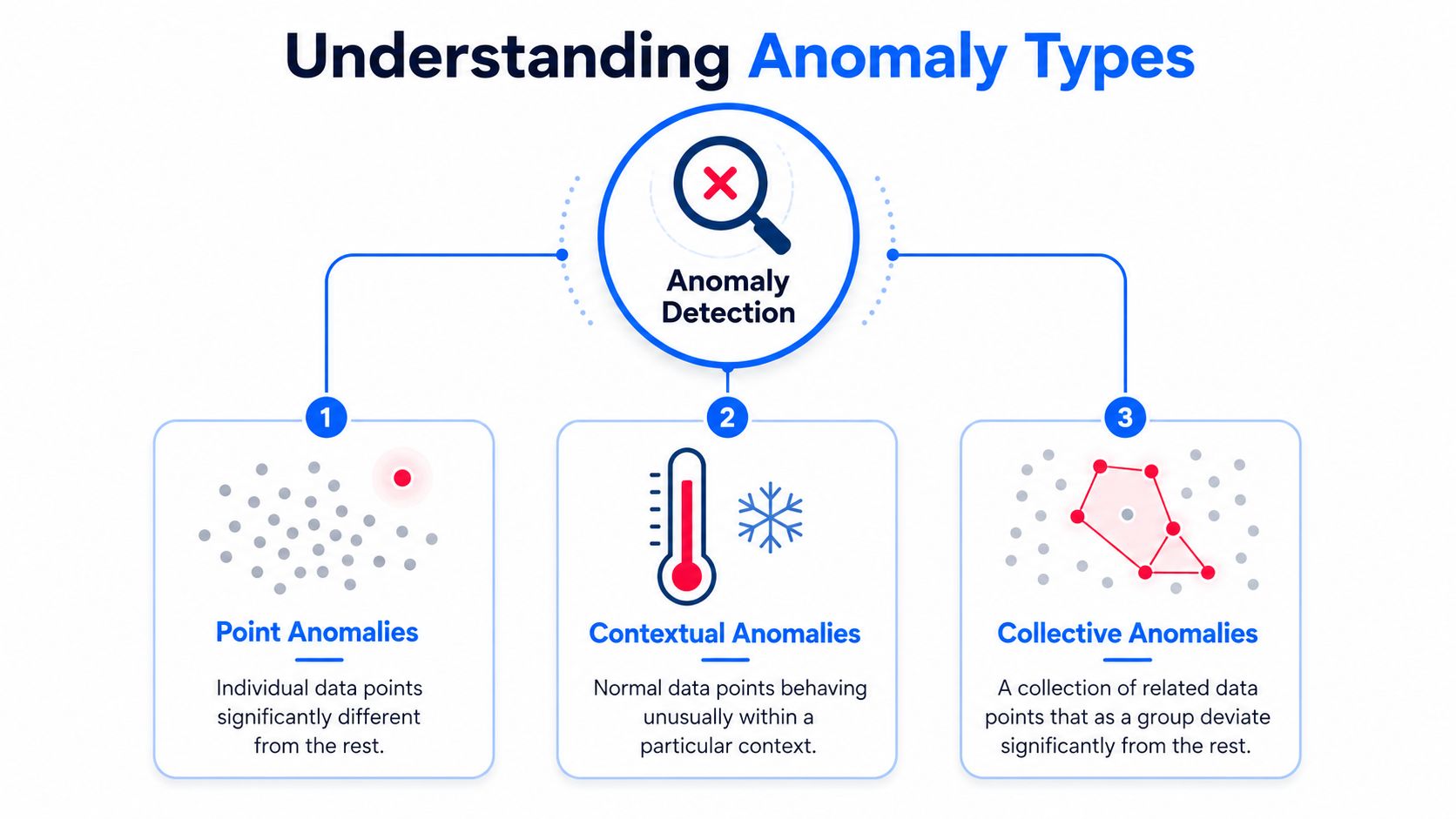
The core model is well established. This cybersecurity anomaly taxonomy identifies three classes: point anomalies, contextual anomalies, and collective anomalies. In practice, those categories help analysts ask the right questions faster.
Why the classification matters
A point anomaly is a single event that stands out on its own. Think of a sudden spike in outbound traffic from a system that is usually quiet. One event is enough to trigger concern.
A contextual anomaly depends on surrounding conditions. A login from a location, time, device state, or business context that makes the event abnormal even if the event itself is valid. Logging in at noon may be normal. Logging in during an unusual maintenance freeze from a role that never accesses that resource may not be.
A collective anomaly appears only when you view a sequence together. Each event may look ordinary. The full pattern does not. Slow reconnaissance, staged privilege use, and low-volume exfiltration often live here.
How analysts use the categories
The easiest way to think about them is to map each to an investigation style.
Anomaly type | What it looks like | How to investigate |
|---|---|---|
Point | One obvious outlier | Validate the event, confirm ownership, check immediate blast radius |
Contextual | An event that is only strange in context | Compare against user, system, time, and business context |
Collective | A suspicious sequence built from normal-looking events | Reconstruct the timeline and look for intent across steps |
Many detection programs improve by changing triage playbooks. If a detection rule says “anomaly,” but doesn't tell the analyst what kind, the analyst wastes time deciding how to think. If the rule already frames the alert as point, contextual, or collective, the path gets shorter.
An alert that says “unusual behavior detected” is weak. An alert that says “collective anomaly involving authentication, privilege change, and data access within one session chain” is actionable.
For enterprise teams, collective anomalies usually deserve special attention. Attackers know how to stay under fixed thresholds. They spread activity over time, across systems, and through valid identities. That's why sequence-aware detection often finds things threshold-only systems miss.
Core Detection Methods Statistical vs Machine Learning
Some detection methods behave like a security guard with a checklist. Others behave more like a detective learning patterns from a neighborhood over time. You usually need both.

Where statistical methods still work well
Statistical detection is the older and simpler family. You establish a baseline and alert when activity falls outside expected bounds. That can mean tracking rate changes, variance, missing values, unexpected drops, or threshold breaches.
These methods are useful because they're fast, explainable, and cheap to operate. Analysts usually understand why a statistical rule fired. If outbound transfer volume exceeds an expected range, or if a job runtime deviates sharply from its normal window, the reason is visible.
They also fail in predictable ways. Fixed thresholds get noisy in dynamic environments. Baselines go stale. Human-maintained rules multiply until nobody wants to touch them.
Why machine learning became necessary
Machine learning earns its keep when the environment is too complex for fixed rules to describe cleanly. Fidelis notes in its overview of anomaly detection methods that unsupervised machine learning algorithms dominate enterprise anomaly detection because they discover outliers without predefined labels, which is especially beneficial when labeled attack data is scarce. The same source also emphasizes rigorous feature engineering and dynamic thresholding to reduce false alerts.
That's an important operational point. In cyber security, labeled examples are often incomplete, biased toward old attacks, or expensive to maintain. Unsupervised approaches can detect behavior that doesn't fit learned normal patterns, even when nobody has tagged it in advance.
A few practical patterns matter here:
Supervised models are useful when you have good labeled history and a narrow problem.
Unsupervised models fit dynamic enterprise environments better because they can surface novel outliers.
Hybrid approaches usually perform best because statistical controls provide guardrails while ML handles subtle deviations.
If you want a useful parallel outside classic intrusion detection, this guide on preventing workplace integrity violations shows how machine learning can surface behavior patterns that rigid rules often miss.
What works in practice
Teams get better results when they stop debating statistics versus ML as if one must win. Mature programs combine them.
Use statistics for things that should be easy to explain and expensive to miss. Use ML where the pattern is multivariate, high-volume, or shifting. Then add suppression, enrichment, and adaptive thresholds so analysts don't drown.
A practical architecture often looks like this:
Statistical baseline first. Catch gross deviations, missing data, workload spikes, and timing abnormalities.
Unsupervised ML second. Score user, host, network, or pipeline behavior that doesn't fit the learned profile.
Context layer third. Add identity, asset criticality, and recent change activity before alerting.
Feedback loop last. Mark false positives, retrain, and adjust thresholds based on operations.
For teams working on temporal behavior, time-series anomaly detection patterns are especially useful because many cyber signals are really sequence and timing problems, not just single-event outliers.
Fueling Detection with the Right Data Sources
A weak model with good data often beats a clever model with bad data. That's especially true in anomaly detection cyber security work, where the quality of telemetry decides whether the system learns meaningful baselines or memorizes noise.
What to collect first
Many organizations begin with too many feeds and too little structure. A better approach is to prioritize data sources that explain behavior from different angles.
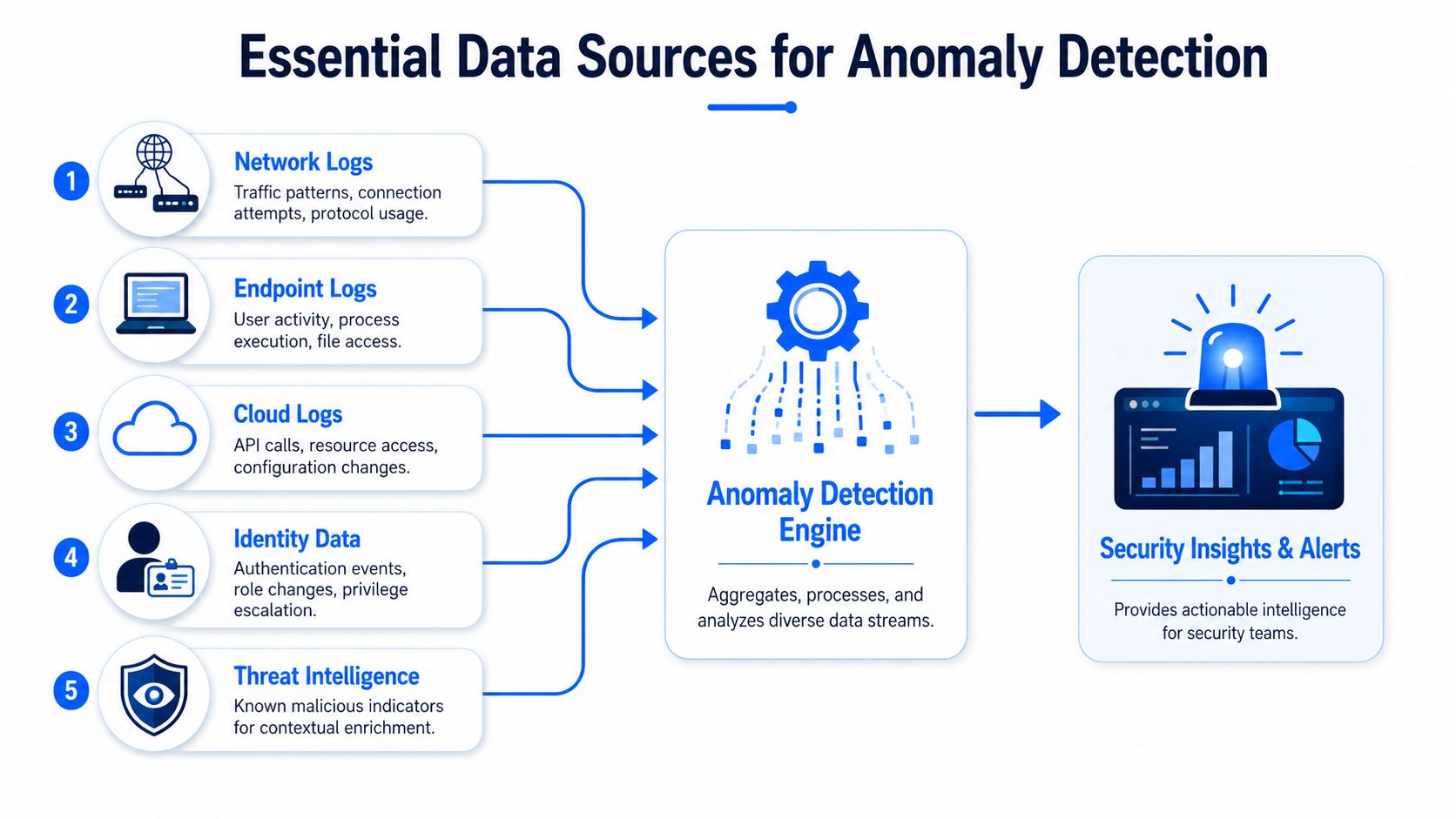
The usual starting set is:
Network logs for connection patterns, traffic shifts, and unusual movement between systems.
Endpoint telemetry for process behavior, file access, and user activity.
Cloud and platform logs for API use, resource changes, and control-plane actions.
Identity events for authentication, role changes, and privilege escalation.
Threat context for enrichment, not primary detection.
What matters isn't just volume. It's coverage across actions, identities, and assets.
Why feature engineering matters more than model choice
Raw logs rarely make good anomaly features. Analysts need operational metrics the model can learn from, such as access frequency, failed login bursts, transfer patterns, job duration changes, unusual joins between user and asset behavior, and missing or duplicated records in telemetry.
That's where metric generation becomes a core engineering task. This overview of in-database anomaly metrics explains that anomaly detection can calculate key statistics like sum, minimum, and value counts over three specific data types within each column, allowing systems to learn baselines without manual rule configuration or constant threshold upkeep.
That approach is useful beyond data quality. In security operations, the same principle helps you build stable monitoring features close to the data source instead of shipping raw events everywhere and hoping the SIEM figures it out later.
A good feature set should answer questions like these:
Behavioral stability. Does this entity usually behave this way?
Change velocity. Did this metric move sharply or gradually?
Context sensitivity. Is the behavior unusual for this time, role, workload, or workflow?
Data integrity. Are the supporting records complete enough to trust the alert?
Why in-database processing changes the operating model
Moving large volumes of security-relevant telemetry across systems creates two problems. Privacy risk goes up, and operational complexity goes up with it. When teams can compute metrics closer to where the data already lives, they reduce both.
Keep raw data movement to a minimum. Ship findings and context, not every underlying event, unless you need them for investigation.
That architecture also helps when security teams work with data engineering or platform teams that won't approve broad data export. If anomaly features can be computed in place, the detection program becomes easier to deploy in regulated or sensitive environments.
How to Operationalize Anomaly Detection in Your Stack
The model is rarely the first decision that matters. The architecture is. If you get the deployment model wrong, the program becomes expensive, slow, or politically impossible long before the detection logic matures.
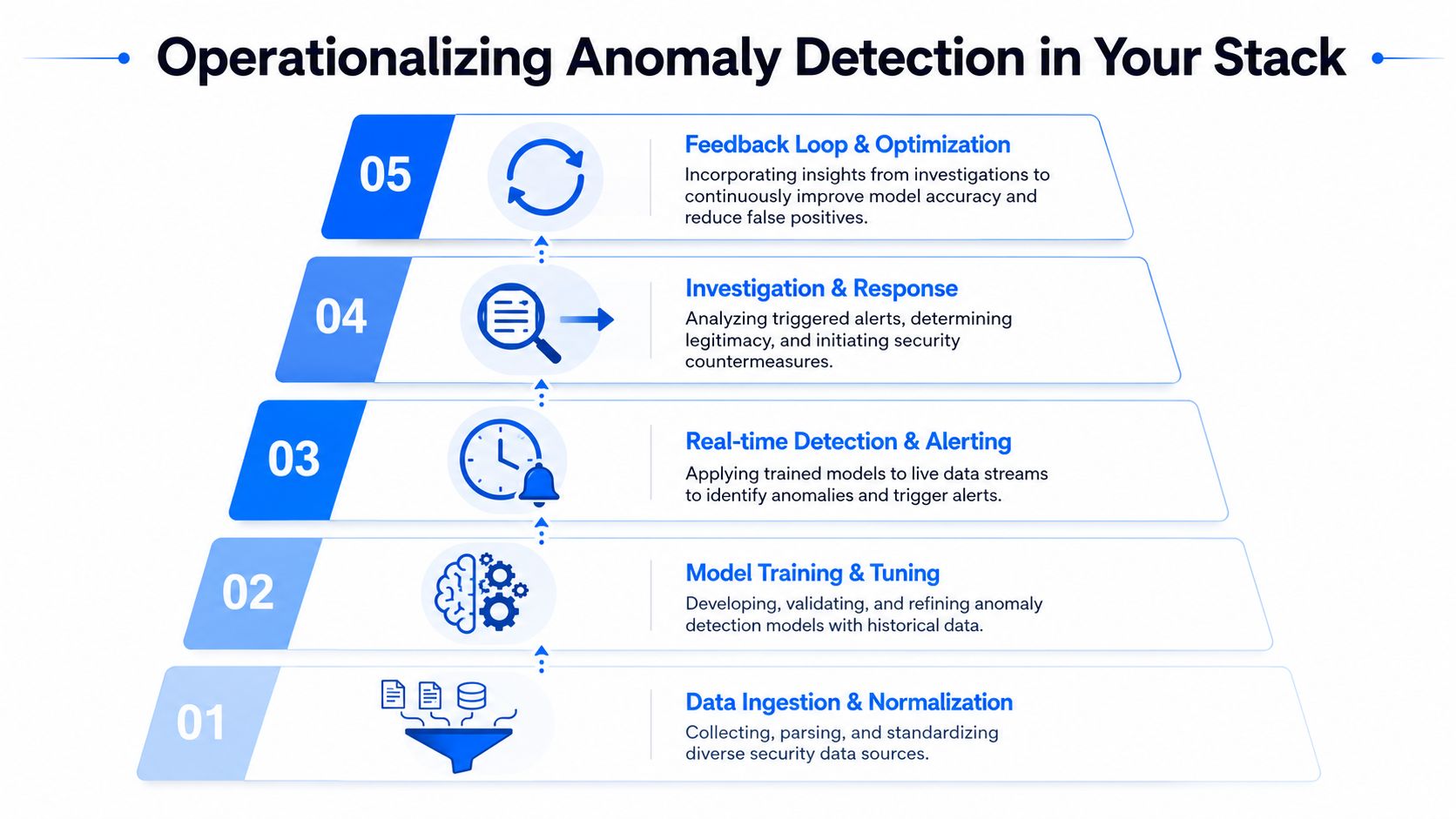
Choose the architecture before the model
Enterprise teams usually choose among three broad patterns:
Deployment model | Strength | Trade-off |
|---|---|---|
Cloud SaaS | Fast rollout and simpler operations | More concern about data movement and residency |
On-prem or private cloud | Tighter control and policy alignment | More internal ownership and maintenance |
In-database or in-place execution | Strong privacy posture and lower data movement | Requires thoughtful integration with existing platforms |
For security-sensitive environments, in-place analysis is often the most practical compromise. This description of privacy-first in-database monitoring highlights an architecture that keeps data resident in the customer environment by reading system tables directly and applying AI-based anomaly detection without exporting data, enabling real-time workload monitoring as deviations occur.
That matters when the telemetry includes sensitive operational details, regulated datasets, or internal system behavior that teams don't want copied into yet another platform.
Alert design decides whether the program survives
The biggest operational mistake is sending raw anomaly scores directly into the SOC queue. Analysts don't respond to scores. They respond to evidence and context.
A working alert should include:
What changed in plain language
Why it matters to this user, host, workload, or dataset
How unusual it is relative to the learned baseline
What related changes occurred nearby in time or sequence
What response path applies inside the organization
This is also where SIEM and SOAR integration needs restraint. Don't automate every anomaly. Automate the predictable enrichment and routing first. Triggering containment on weak anomaly signals is how teams lose confidence in the entire program.
If you're building runbooks around these alerts, legal and executive response planning matters too. A practical companion resource is this Washington business incident response guide, especially for organizations that need incident handling aligned with formal business obligations.
Evaluation has to match operations
In engineering discussions, people love precision and recall. In production, the better question is simpler. Does this alert help the team act faster without creating more work than it saves?
That means you should evaluate detections against operational criteria, not just offline model metrics:
Investigability. Can an analyst understand why this fired?
Ownership. Is there a team that can validate or remediate it?
Latency. Did the alert arrive early enough to matter?
Actionability. Does it map to a playbook, escalation path, or control?
Sustainability. Can the team live with the volume?
An anomaly program succeeds when analysts trust it enough to act on alerts quickly, not when a model looks elegant in a notebook.
Managing False Positives and Model Drift
The hardest part of anomaly detection isn't discovering unusual behavior. It's keeping the signal usable after the environment changes and the alert stream starts piling up.

The false positive paradox is an operations problem
A lot of vendors still frame false positives as a minor tuning issue. In live enterprise operations, they're a staffing and trust issue. This discussion of alert fatigue in anomaly systems notes that up to 60% of security alerts are ignored because volume overwhelms teams.
That number should change how you think about “good detection.” If analysts ignore the queue, even technically accurate alerts lose value. A noisy anomaly engine doesn't just waste time. It can teach the organization to discount abnormal behavior altogether.
Model drift shows up as business change
Model drift usually doesn't announce itself as a machine learning problem. It looks like ordinary company change.
A new SaaS rollout changes authentication patterns. A merger changes user behavior. A migration shifts workload timing. A product launch changes traffic shape. If the detection system still thinks last quarter's baseline is normal, alert quality drops fast.
Common drift triggers include:
Organizational change such as new teams, role moves, or acquisitions
Platform change like cloud migrations, new endpoint tooling, or architecture redesign
Business seasonality from finance cycles, support peaks, or regional demand changes
Telemetry change when logging formats, field availability, or pipeline quality shift
How to keep the signal usable
The fix isn't to loosen everything until the alerts stop. That creates blind spots. The better approach is controlled adaptation.
Use a mix of methods:
Adaptive thresholds so normal daily and seasonal variation doesn't trigger noise
Scheduled retraining tied to environment change, not just a calendar
Analyst feedback loops to label persistent false positives and tune features
Tiered alerting so low-confidence anomalies enrich cases instead of paging analysts
Change-aware suppression during approved maintenance, rollout, or migration windows
A mature team treats tuning as part of security operations, not as cleanup work after deployment. If drift management has no owner, the anomaly program decays unnoticed.
Enterprise Use Cases and Best Practices for 2026
Anomaly detection pays off most when it supports decisions humans already need to make under time pressure. That's why the strongest use cases usually involve subtle threats, sensitive systems, or failure modes that don't leave obvious signatures.
Where anomaly detection adds the most value
Three enterprise patterns stand out.
Insider threat detection benefits from contextual baselining. A valid user doing an invalid thing is hard to catch with signatures alone. Changes in access habits, timing, data handling, or privilege use are often more revealing than any single event.
Advanced persistent threat activity often shows up as collective anomalies. The early steps can look harmless. The pattern across authentication, movement, and staged access is what matters.
Zero-day or unknown technique detection is where baseline deviation earns its budget. If the behavior is novel, the signature won't help. An anomaly engine can still surface the mismatch between expected and observed behavior.
The business case is strong when the program is run well. This research summary on AI-powered security outcomes reports that organizations deploying AI-powered security identify breaches 108 days faster and reduce average breach costs by 43%, from $4.44 million to $2.54 million.
For teams that want to see how in-database monitoring supports earlier detection, this walkthrough on detecting cyber attacks early in your database is a useful reference point.

Best practices that hold up in production
Start with one operational pain point. Privileged access, workload anomalies, or suspicious data movement are better first targets than broad anomaly hunting.
Require explainability at the alert level. Analysts need enough context to investigate quickly.
Keep data where policy says it should stay. Privacy and residency constraints should shape architecture early.
Design for drift from day one. Retraining, threshold adaptation, and feedback loops aren't optional.
Measure outcomes in workflow terms. Faster triage, fewer wasted investigations, and earlier containment matter more than abstract model elegance.
digna helps teams detect anomalies where their data already lives, with a privacy-first approach that runs inside customer-controlled environments instead of exporting sensitive datasets. If you need anomaly detection that supports real operational workflows across data quality, observability, and security-relevant change detection, take a look at digna.