Mastering Detecting Anomalies in Time Series: 2026 Guide
|
0
min. czyt.

A dashboard rarely fails with a dramatic spike or a blank chart. More often, it keeps showing plausible numbers while an upstream job drops records, a schema change shifts a metric, or a late load lands just after the reporting cutoff. The graph looks normal enough. The business makes decisions anyway.
That's why detecting anomalies in time series matters far beyond data science. In enterprise pipelines, time series are the operational pulse of your platform: row counts by hour, event volumes by source, freshness by table, null rates by partition, revenue by market, claims by provider, transactions by channel. If those signals drift, the problem isn't just bad monitoring. It's bad governance, bad forecasts, and bad decisions.
Teams used to handle this with static rules. Alert if volume drops below a fixed threshold. Alert if a job runs longer than usual. Alert if yesterday differs too much from last week. Those checks help, but they break down when systems grow, seasonality changes, and normal behavior varies across products, regions, or weekdays. Modern anomaly detection works differently. It learns a baseline, accounts for context, and flags deviations without forcing engineers to hand-maintain every rule.
Table of Contents
The Hidden Failures in Your Data Pipeline
The hardest pipeline failures to catch are the ones that don't look broken. A late batch still arrives. A transformation still runs. A BI tile still renders. But the underlying signal has shifted enough to mislead everyone downstream.
This is a key benefit of anomaly detection. It catches deviations before they become accepted truth. As FirstEigen's overview of anomaly detection puts it, anomaly detection algorithms improve data quality by isolating outliers that signal errors, unexpected events, or opportunities, so teams can address issues before they compromise analysis and decision-making.
In regulated environments, silent data failures can become more than an analytics problem. They turn into audit findings, reporting gaps, or control weaknesses. A useful example is Visbanking on regulatory data failures, which shows how operational failures around data handling can have very real consequences.
Reliability starts below the dashboard
Organizations often invest heavily in dashboards, semantic models, and self-service access. Fewer invest the same energy in observing whether the source signals still behave like they should. That imbalance creates a blind spot.
Common failure patterns include:
Late-arriving data: A table lands after the expected delivery window, but no one notices until a morning report looks thin.
Partial loads: Pipelines succeed technically while dropping one partition, one tenant, or one upstream source.
Behavioral drift: A metric changes shape gradually enough that static threshold checks never fire.
Schema side effects: A column type changes, a join cardinality shifts, and aggregate values stay plausible while being wrong.
Practical rule: If a metric can affect a business decision, monitor its behavior as a time series, not just the success state of the job that produces it.
Observability needs to move from binary checks to behavioral checks. Instead of asking only whether a task succeeded, ask whether the resulting data still looks like itself. That's the mindset behind production-focused monitoring, and it's also the reason teams invest in early warning systems such as guidance on why data pipelines fail in production and how to detect issues early.
Understanding the Types of Time Series Anomalies
Before you can detect an anomaly, you need to define what kind of abnormality you're looking for. In time series, that isn't one thing. The same metric can fail in several different ways, and each failure pattern calls for a different response.
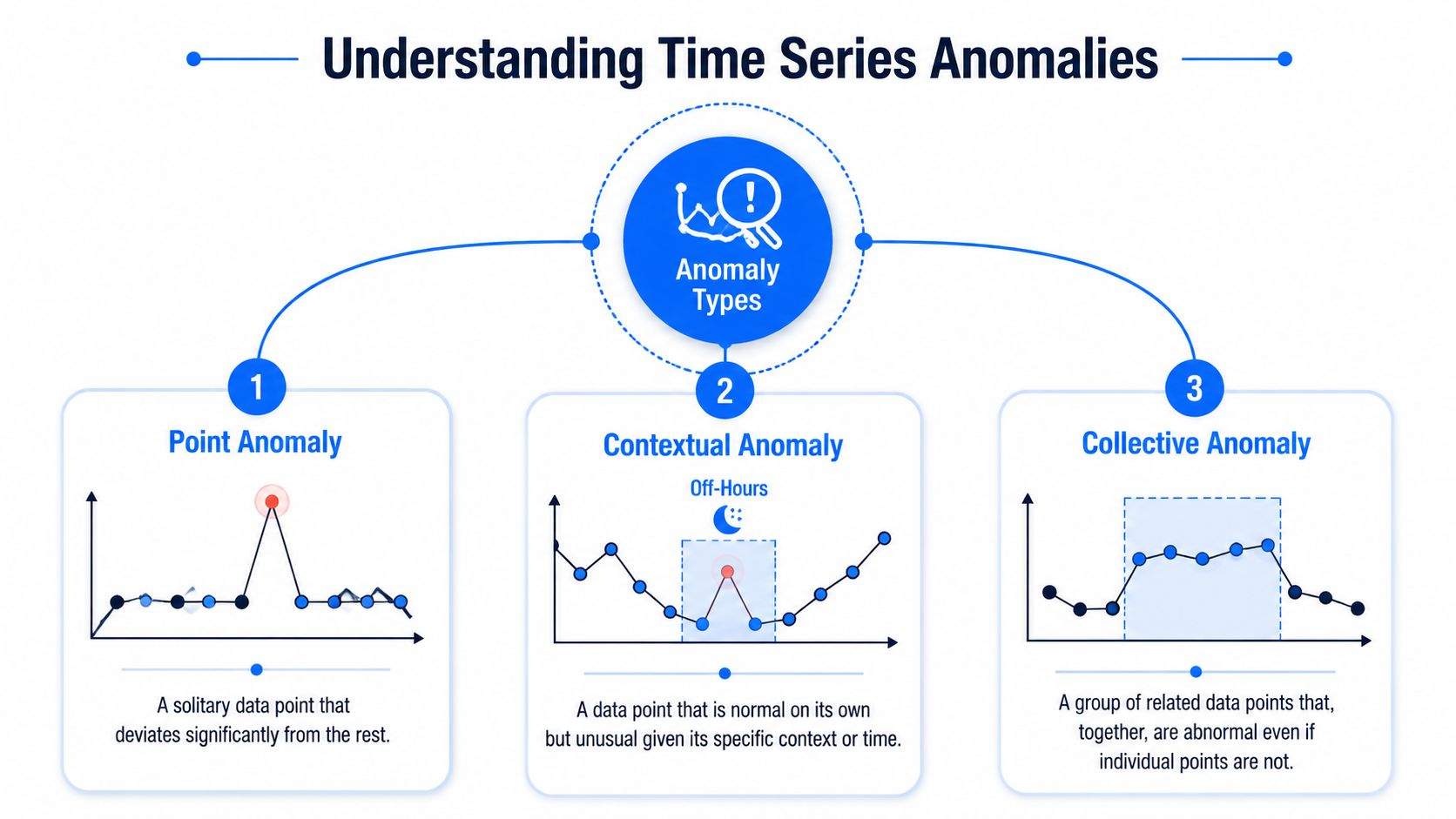
Research generally separates time series anomalies into point, contextual, and collective anomalies, where point anomalies are isolated deviations, contextual anomalies depend on timing or conditions, and collective anomalies emerge across a sequence rather than a single value, as summarized in this recent survey on anomaly categories and detector combinations.
Point anomalies
A point anomaly is the simplest case. One value stands far away from the surrounding pattern.
Think of hourly payment transactions that usually move in a narrow band, then one hour suddenly spikes because a source duplicated events. Or a sensor that emits a single impossible reading because of a collection glitch. These are the easiest anomalies to explain and often the easiest to detect.
They still matter operationally because one bad point can distort rollups, trigger downstream automation, or pollute a model feature.
Contextual anomalies
A contextual anomaly is trickier. The value may be normal in isolation but wrong for the moment in which it appears.
A good example is traffic or order volume at an unusual time. High checkout activity at midday might be expected. The same value during off-hours could indicate replayed events, timezone errors, or delayed ingestion landing in a lump. In infrastructure data, high CPU may be expected during a batch window but suspicious overnight.
Many static rules frequently fail. They don't understand that normal behavior changes by hour, weekday, season, market, or product line.
A number can be valid and still be anomalous if it arrived in the wrong context.
Collective anomalies
A collective anomaly appears when a sequence of points forms an abnormal pattern, even if each point on its own looks acceptable.
A classic pipeline example is a job that starts delivering records in a flattened pattern. Each hourly count might stay within a reasonable range, but the sequence lacks the normal peaks and troughs you'd expect. Another example is latency creeping upward for several intervals without any single interval crossing a hard threshold.
These cases are dangerous because operational teams often review charts point by point. The pattern only becomes obvious when you look at the shape of the series.
A simple way to think about the three categories is this:
Type | What looks wrong | Enterprise example |
|---|---|---|
Point | One isolated value | Duplicate event burst in one interval |
Contextual | A value is wrong for its timing | High order volume during off-hours |
Collective | The sequence shape is wrong | Sustained flatline in hourly ingest counts |
If your monitoring only catches point anomalies, you'll miss many of the issues that hurt data reliability.
A Practical Anomaly Detection Workflow
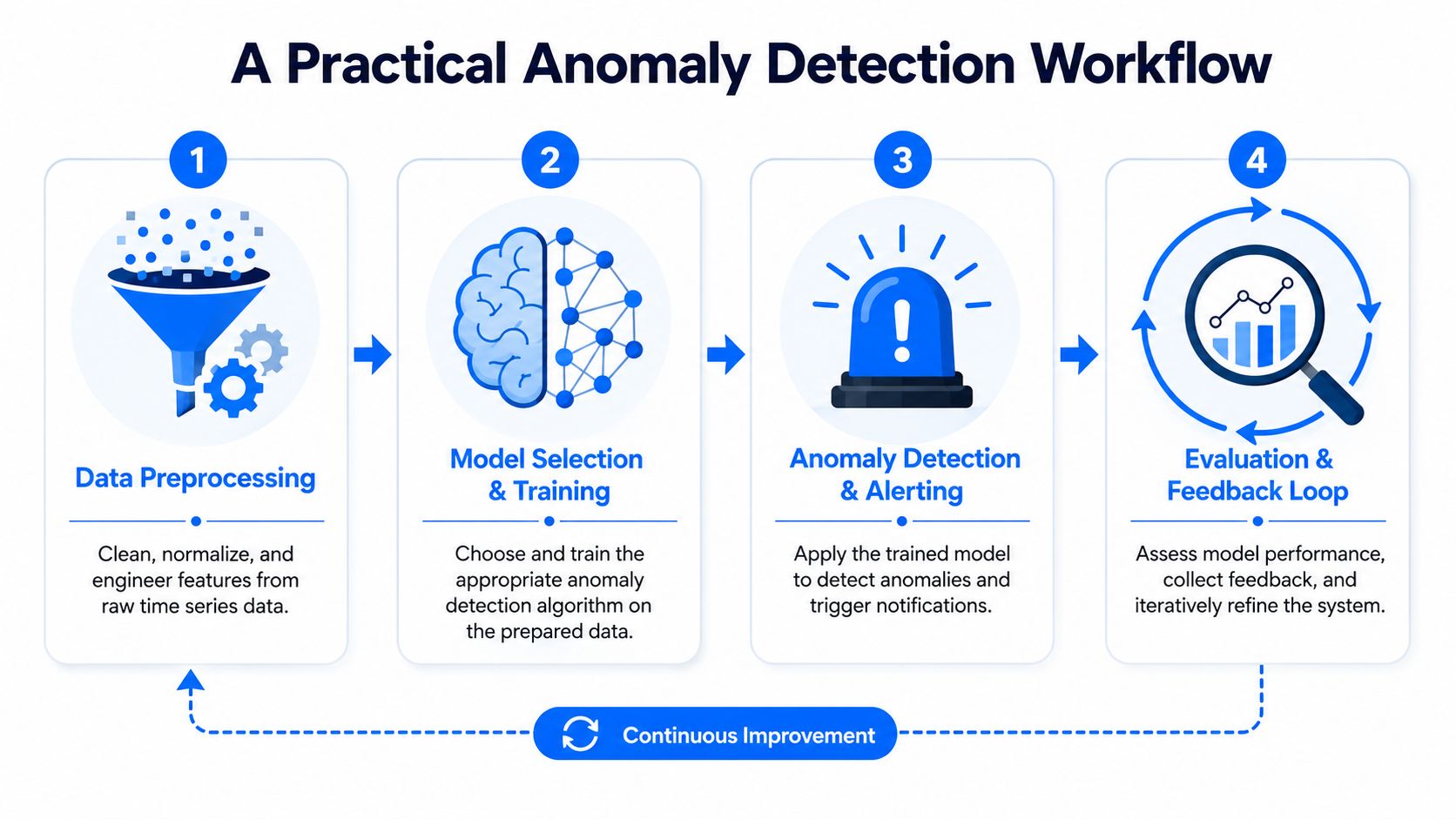
Production systems need a repeatable workflow, not a bag of algorithms. The field has moved from ad hoc statistical checks toward a more standardized pipeline with data pre-processing, detection method, scoring, and post-processing, as described in the time-series anomaly detection survey.
A good mental model is a factory line. Raw signals come in messy. Each stage removes ambiguity before the next stage adds judgment.
Near the start of that line, this visual helps align the process:
Preprocessing before modeling
Most anomaly projects fail before modeling because the baseline is dirty. Missing timestamps, inconsistent granularity, stale partitions, and duplicated events all distort what the model learns as normal.
Preprocessing usually includes:
Resampling: Bring the series to a consistent grain such as minute, hour, or day.
Gap handling: Decide whether to impute, leave missing values explicit, or segment the series.
Normalization: Make signals comparable when one metric operates at a very different scale from another.
Outlier removal from baseline windows: If you're using baseline statistics, exclude obvious outliers first so the anomalies don't poison the mean and spread.
For teams that want a practical implementation view, this guide to automating anomaly detection is useful because it frames automation as an operational workflow rather than a notebook exercise.
Feature engineering and scoring
Raw values often aren't enough. You usually need derived signals that expose trend, seasonality, and local change.
Useful features include:
Lag features: Prior values that show what the metric recently did.
Rolling statistics: Moving means and standard deviations that make local behavior visible.
Frequency features: Fourier-based transformations when periodicity matters.
Those techniques are highlighted in Decube's summary of time-series best practices, which also notes that production systems commonly evaluate results with precision, recall, and F1.
Later in the pipeline, you don't just output “anomaly” or “not anomaly.” You produce a score. That score can come from a forecast error, a reconstruction error, a distance from expected behavior, or a deviation from a statistical baseline.
Here's a useful implementation explainer before teams start wiring alerts:
Detection and post-processing
The detector itself is only one stage. Post-processing decides whether the score becomes an alert, a low-priority event, or just historical evidence.
That last stage usually does the following:
Filters noise so one-off blips don't page people unnecessarily.
Groups related anomalies into one incident instead of creating alert storms.
Routes incidents based on ownership, severity, and likely root cause.
Detection finds suspicious behavior. Post-processing determines whether the team can act on it.
This distinction matters in enterprise environments. A mathematically correct detector can still be operationally useless if it creates a flood of alerts with no triage logic.
Choosing Your Anomaly Detection Method
A method that looks strong in a notebook can fail fast in a production pipeline. The usual problem is not raw model accuracy. It is fit. Fit to the signal, fit to the latency budget, fit to the volume of metrics you need to score, and fit to the way incidents are triaged after detection.
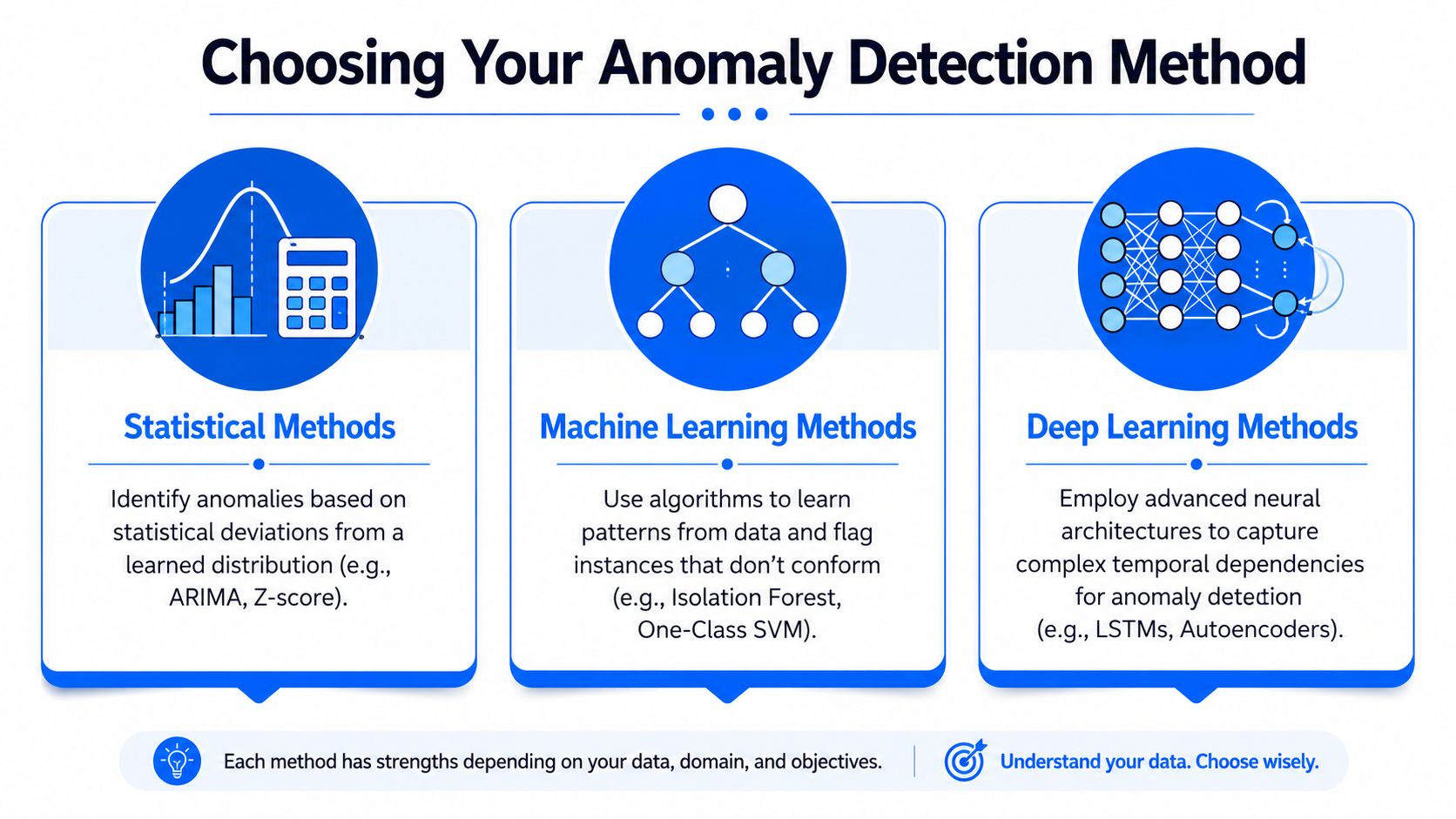
For enterprise time series, I usually sort the options into three groups: statistical methods, classical machine learning, and deep learning. That framing is useful because each group carries a different operational cost. Some are easy to explain and cheap to run across thousands of streams. Others catch subtler behavior but require tighter feature management, retraining discipline, and better monitoring around the detector itself.
The comparison below helps frame those trade-offs:
Statistical methods for stable signals
Statistical methods are still the right default for many pipeline metrics. Queue depth, row counts, null rates, API latency, and job duration often respond well to a baseline-plus-threshold approach, as long as the metric has a stable pattern and the team understands what “normal” means.
One common implementation is a Z-score threshold, using (x - avg) / stddev. Tinybird's anomaly detection guide gives practical advice that maps well to production use: compute the baseline over a relevant context window, remove extreme outliers before calculating mean and standard deviation, and score aggregated groups instead of raw points when you want fewer false alarms. That guidance matters because bad baselines create more operational pain than bad math.
Statistical methods fit when:
The signal is interpretable. Engineers can explain the threshold and defend it during incident review.
The metric has regular behavior. Trend and seasonality exist, but they are not changing every week.
You need scale. These models are cheap enough to run across large metric inventories without building dedicated model infrastructure.
They break down when context drives the anomaly. A 20 percent drop in records may be normal at one hour of day, severe for a specific tenant, and irrelevant during a scheduled backfill.
STL decomposition is often a better choice than a plain threshold for recurring patterns. It separates trend, seasonality, and residual noise, then flags unusual residual behavior. In practice, that works well for metrics tied to daily or weekly operating cycles, especially when teams need a detector they can inspect during root-cause analysis.
Classical machine learning when rules stop scaling
As pipelines grow, a simple threshold per metric becomes expensive to maintain. You start seeing interactions across features: volume drops only matter if freshness also slips, error rates matter more for one source system than another, and “normal” differs sharply by customer segment or workload class.
That is where unsupervised and semi-supervised models help.
MindBridge's overview of anomaly detection techniques points to Isolation Forest and Local Outlier Factor as practical choices when labeled anomaly data is limited. That matches what works in many enterprise settings. Labels are sparse, delayed, or trapped in ticket notes, so models that learn normal structure from mostly clean data are often the only realistic option.
Use them selectively:
Situation | Better fit |
|---|---|
Sparse labels | Isolation Forest, LOF, One-Class SVM |
Feature-rich normal behavior | One-Class SVM |
Moderate complexity without deep learning overhead | Unsupervised models with engineered time features |
These models can catch patterns that a single-series threshold misses, but they are not maintenance-free. They depend on feature design, sampling strategy, retraining cadence, and sensible score calibration. If time-of-day, day-of-week, source system, or tenant context is missing from the feature set, the model will often flag expected variation and miss the incidents operators care about.
For teams that want a broader grounding in how model choice affects deployment and maintenance, Nexus IT Group's ML insights are a useful high-level refresher before narrowing to anomaly-specific design decisions.
Deep learning for hard sequence problems
Deep learning starts to make sense when the series contains long-range dependencies, many interacting inputs, or behavior that changes in ways manual features cannot capture well. This shows up in sensor fleets, application telemetry, and high-volume event streams where the anomaly depends on sequence shape rather than a single point crossing a threshold.
Two common options are LSTMs and Autoencoders. LSTMs forecast expected sequence behavior and flag large prediction errors. Autoencoders learn to reconstruct normal patterns and treat high reconstruction error as suspicious.
These approaches can detect subtle failure modes, but they raise the operational bar:
Training and tuning are heavier. You need more compute, more experiments, and stricter version control around data and models.
Inference costs more. That matters when you score many streams at short intervals.
Failure analysis gets harder. Explaining why a model fired is more difficult than showing a residual spike or a threshold breach.
Drift hurts faster. If the upstream system changes, the model can decay subtly until alert quality drops.
For many enterprise teams, the best answer is not one detector. It is a layered design. A cheap statistical screen handles broad coverage, a classical model scores richer context on the streams that matter most, and a deeper sequence model is reserved for the small set of signals where simpler methods have already failed.
Start with the simplest method that your operators will trust and your platform can support. Add complexity only when it buys better incident detection, fewer wasted alerts, or faster root-cause isolation.
Evaluating Performance and Labeling Anomalies
A detector that produces scores every minute isn't automatically useful. It might merely be generating confident noise. That problem gets worse in enterprise data work because real labeled anomalies are usually scarce, inconsistent, or buried in incident tickets rather than structured training data.
Research has called this out directly. The NeurIPS 2024 poster on validating anomaly scores describes a critical gap in validating distribution-based anomaly scores when labeled anomalies are scarce. It also notes that unsupervised and semi-supervised methods dominate under those conditions, while rigorous benchmarks against ground truth are largely absent.
Why running in production does not prove accuracy
Teams often assume a model is “working” because it's online, integrated, and occasionally catches something real. That bar is too low.
You need to ask harder questions:
Are alerts actionable? A technically valid deviation may still be operationally irrelevant.
What's the false positive pattern? If the model keeps flagging normal seasonal shifts, engineers will mute it.
What's the miss pattern? Quiet failures matter more than flashy detections.
Does score drift reflect risk or just baseline change? Without that distinction, thresholds decay over time.
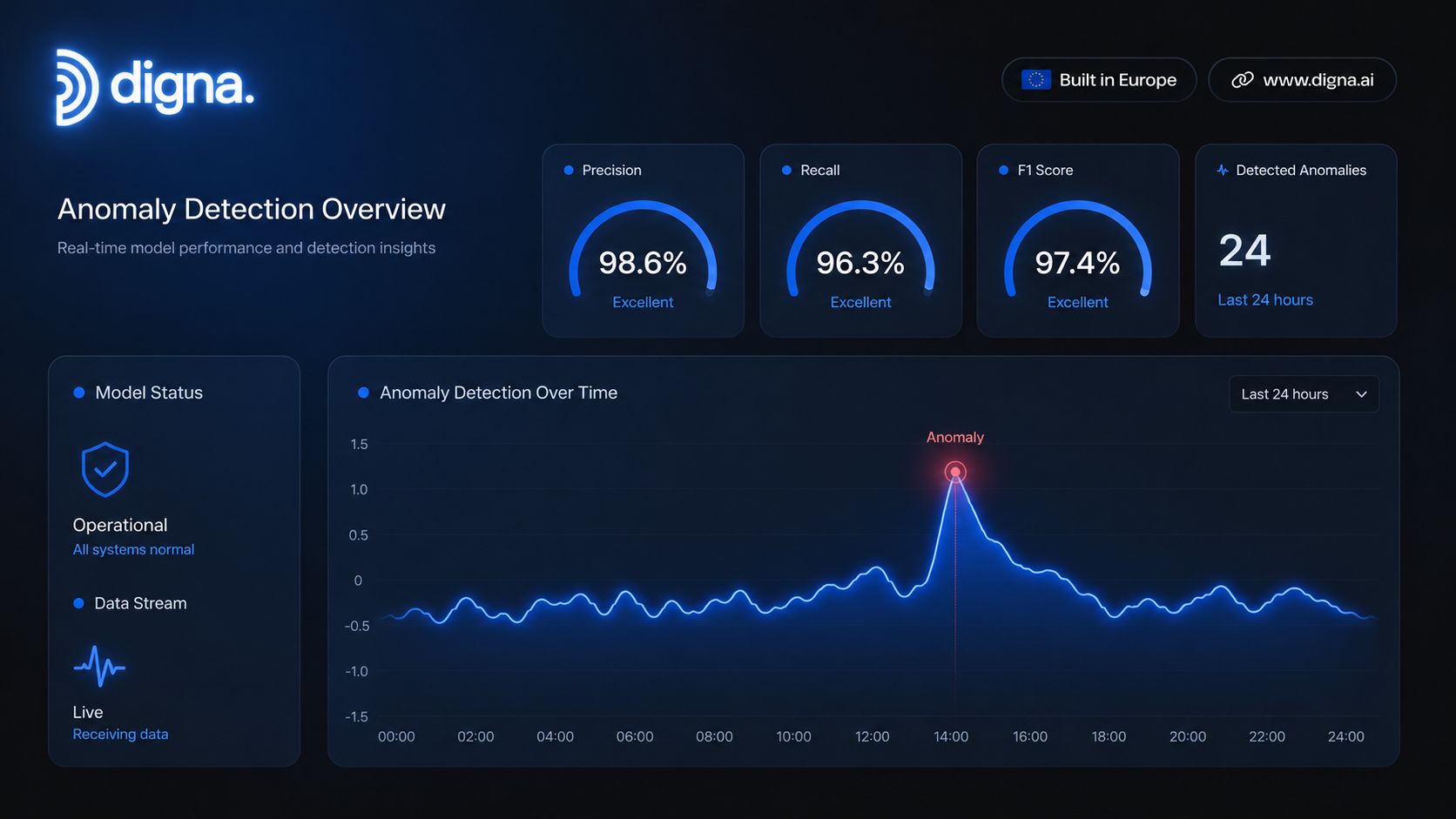
A useful evaluation frame is precision, recall, and F1. But numbers alone won't rescue you if your labels are weak.
How teams build trust anyway
In practice, trust comes from a feedback loop, not just a metric.
Strong teams usually do some mix of the following:
Semi-supervised training: Train on known normal periods and treat deviations from that learned baseline as suspicious.
Human review queues: Let analysts classify alerts as useful, noisy, expected, or tied to upstream events.
Incident correlation: Compare anomaly timestamps against deployment logs, schema changes, vendor outages, and batch delays.
Threshold reviews: Revisit thresholding logic after major seasonality shifts, product launches, or policy changes.
The hard part isn't building a score. It's building confidence that the score maps to something worth investigating.
A low reconstruction error or a neat anomaly score distribution doesn't prove the model understands your system. It only proves the model has learned a pattern.
That's why labeling should be treated as an operational process. Engineers, analysts, and domain owners all need a way to feed outcomes back into the system.
From Model to Production Pipeline
A model in a notebook detects anomalies. A production pipeline has to explain them, route them, and stay reliable while data behavior changes.
Most projects get harder at this stage. The challenge shifts from choosing algorithms to building operational machinery around them.

Operational requirements that matter
The first requirement is dynamic baselining. Static thresholds don't survive changing business cycles, seasonal demand, or gradual growth. AI-based systems are useful here because they establish a dynamic baseline of normal behavior and continuously evaluate new data against it, rather than relying on fixed rules, as outlined in Plixer's explanation of AI-powered anomaly detection.
The second requirement is drift monitoring. Your model can stay online while becoming less trustworthy. That usually shows up as more noisy alerts, more unexplained misses, or increased dependence on manual override.
The third is alert integration. Detection alone doesn't close incidents. The signal has to land where operators already work, whether that's Slack, PagerDuty, ticketing systems, or internal runbooks.
A practical production checklist looks like this:
Baseline governance: Decide how often baselines refresh and who approves major changes.
Alert ownership: Every anomaly class needs a clear team and escalation path.
Root-cause context: Attach lineage, freshness, schema, and deployment context to each alert.
Auditability: Preserve detection history, model changes, and alert outcomes for review.
Tools and deployment choices
Some teams build the full stack themselves. That can work when the environment is narrow and the observability surface is small. It gets expensive when you need in-database computation, multi-signal baselining, trend inspection, timeliness monitoring, and a shared UI for engineers and stakeholders.
One option in that category is real-time data monitoring from digna, which combines anomaly detection, timeliness monitoring, validation, and schema tracking while running analyses inside the customer environment. That architecture matters for enterprises that can't move production data into external monitoring systems.
The main trade-off is straightforward:
Approach | Advantage | Constraint |
|---|---|---|
DIY pipeline | Full control over logic and infrastructure | Higher engineering burden and maintenance |
Platform approach | Faster operationalization and unified workflows | Less custom control in some edge cases |
If you're serious about detecting anomalies in time series at scale, treat it as an observability capability, not a model artifact.
The Future of Proactive Data Observability
The direction is clear. Data teams are moving away from brittle rule sets and toward systems that learn normal behavior, adapt as the environment changes, and support root-cause analysis instead of just generating alerts.
That doesn't mean statistical methods are obsolete. They still matter, especially when you need speed, clarity, and low operational overhead. It also doesn't mean every team needs deep learning. Many don't. What matters is building a complete operating model around anomaly detection: good baselines, useful scoring, sensible alerting, and a feedback loop that improves trust over time.
The next step for mature teams is tighter integration between detection and explanation. Not just “this metric is abnormal,” but “this anomaly aligns with a delayed upstream load, a schema shift, and a changed delivery pattern.” That's where observability starts becoming diagnostic rather than reactive.
A few ideas are likely to shape the next wave:
Better score validation: Teams need more confidence in anomaly scores when labeled events are rare.
Cycle-aware models: Periodic business processes don't always follow perfectly regular cycles, so detection needs to handle changing cadence.
Operational explainability: Engineers need alerts that point toward likely causes, not just mathematical deviation.
Unified monitoring surfaces: Freshness, anomalies, validation, and schema changes work better together than as isolated tools.
The practical takeaway is simple. Detecting anomalies in time series isn't a one-time model selection exercise. It's a continuous discipline for keeping pipelines trustworthy under real production conditions.
If your team wants anomaly detection that fits enterprise data operations instead of living in a notebook, digna is worth evaluating. It focuses on in-database anomaly detection, timeliness monitoring, validation, and schema tracking so data teams can monitor pipelines and investigate issues without moving production data outside their controlled environment.



Poznaj zespół tworzący platformę
Zespół z Wiednia, składający się z ekspertów od AI, danych i oprogramowania, wspierany rygorem akademickim i doświadczeniem korporacyjnym.