What Is Referential Data: A Practical Guide for Data Teams
|
6
min di lettura

A dashboard can fail without a pipeline ever turning red. The load completes, the warehouse accepts every row, and the BI tool refreshes on schedule. Yet country names disappear, revenue gets assigned to the wrong region, or a compliance report excludes records that were present the day before.
The transaction records may be perfectly valid. The failure often sits in the smaller tables that tell systems what those records mean. A changed country code, an outdated currency mapping, or an unsynchronized classification hierarchy can break joins and distort reports across an entire data estate. That's why understanding what is referential data matters to anyone responsible for reliable analytics, operational systems, or AI pipelines.
Table of Contents
When Your Dashboards Break Silently
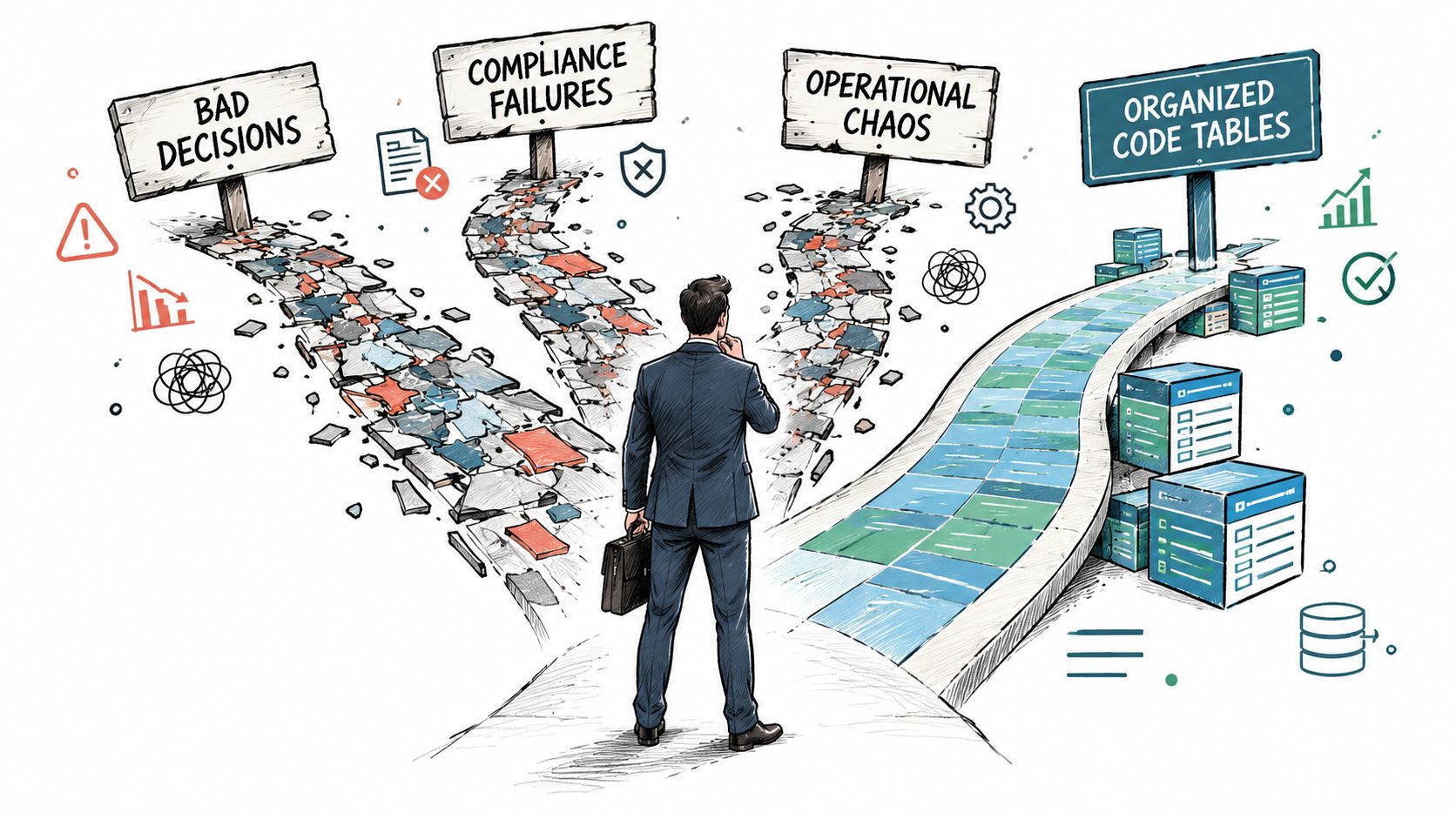
The incident usually starts with a familiar message from the business. “The dashboard refreshed, but the numbers don't look right.” A data engineer checks the orchestration tool and finds no failed jobs. The source tables contain recent transactions. Row counts appear normal. The problem only becomes visible when someone notices blank classifications, unexpected groupings, or a regional total that no longer reconciles.
A reference table may have changed without the consuming systems receiving the same version. One application might still recognize an older country code, while the warehouse has loaded a revised value. A currency mapping may point to a different reporting category. A product hierarchy may have been reorganized in one system but not in the semantic layer used by finance.
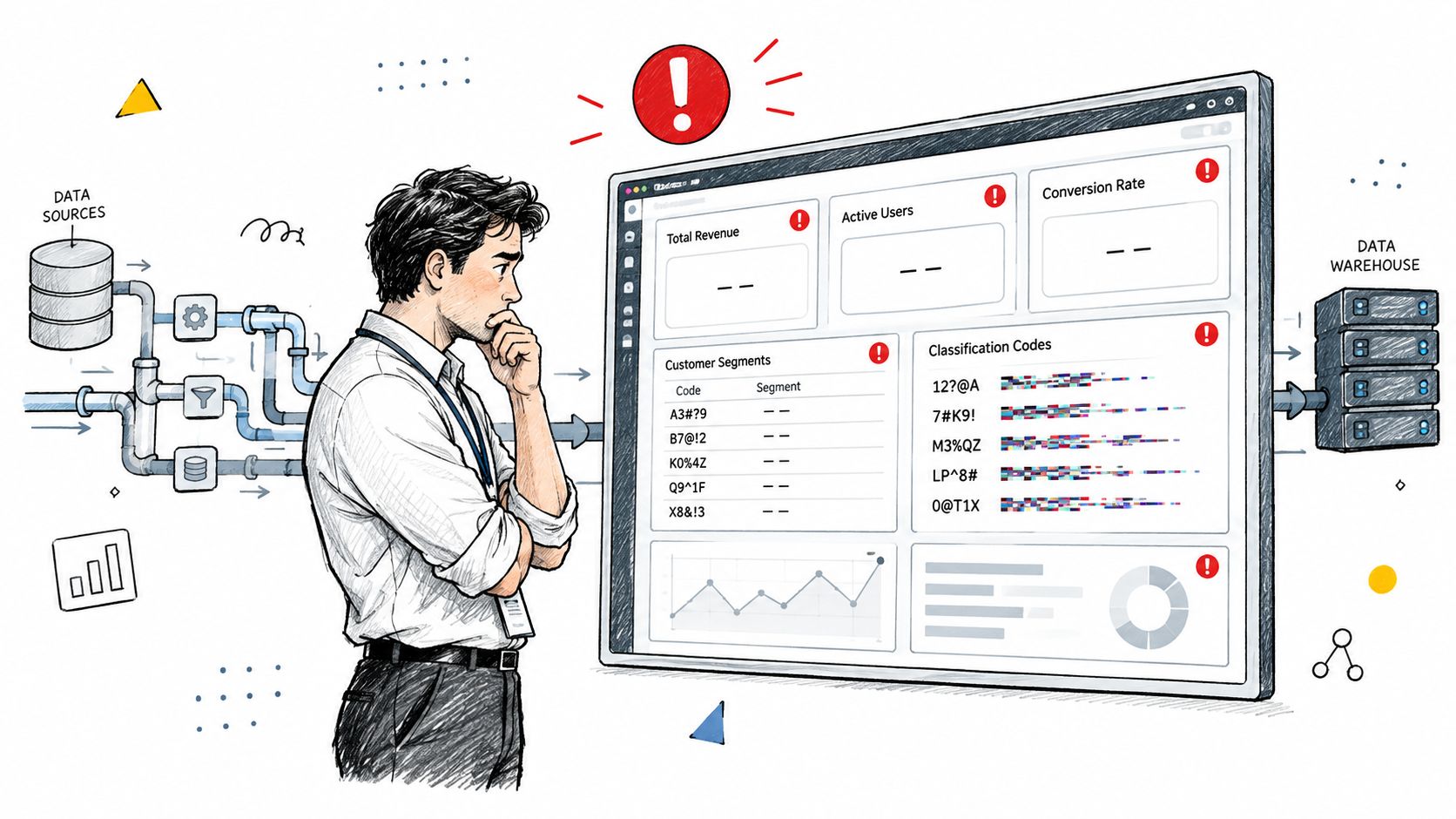
Practical rule: Treat every shared code set as production data, not as harmless configuration.
The operational consequences spread quickly:
Broken joins: A valid transaction no longer matches the reference value expected by a dimension or lookup table.
Inconsistent reporting: Two departments group the same records under different labels because they consume different reference versions.
Compliance gaps: A regulatory classification or jurisdiction code fails validation, leaving an otherwise complete record outside the required report.
Silent model drift: An analytics or AI feature receives categories with changed meanings, while the pipeline continues to run successfully.
Teams often discover these issues through a business complaint rather than a data-quality alert. That's an expensive way to operate. A KPI monitoring dashboard can help teams watch business outputs, but the underlying control must also observe the reference datasets that shape those outputs.
Referential data is the control layer between raw records and their interpretation. It deserves ownership, change tracking, validation, and distribution controls because small edits can alter the behavior of many downstream systems at once.
What Referential Data Actually Is
Referential data is a governed set of permitted values, codes, classifications, hierarchies, and mappings that gives consistent meaning to other data. It acts as a shared vocabulary. A country code tells systems how to classify a location. A currency code establishes the meaning of a monetary value. A product category, industry classification, language code, or unit of measure provides context that transactional data usually doesn't carry on its own.
Calling it a lookup table is technically convenient but architecturally incomplete. Reference data appears throughout operational databases, analytical models, integration pipelines, and reporting layers. One industry source estimates that reference data accounts for about 25% to 50% of tables, despite representing only a small share of total data volume. The same source states that country codes are updated an average of 3 to 5 times per year, while currency codes change approximately 5 to 10 times per year. These figures are documented in the reference data analysis from Heidelberg University Library.
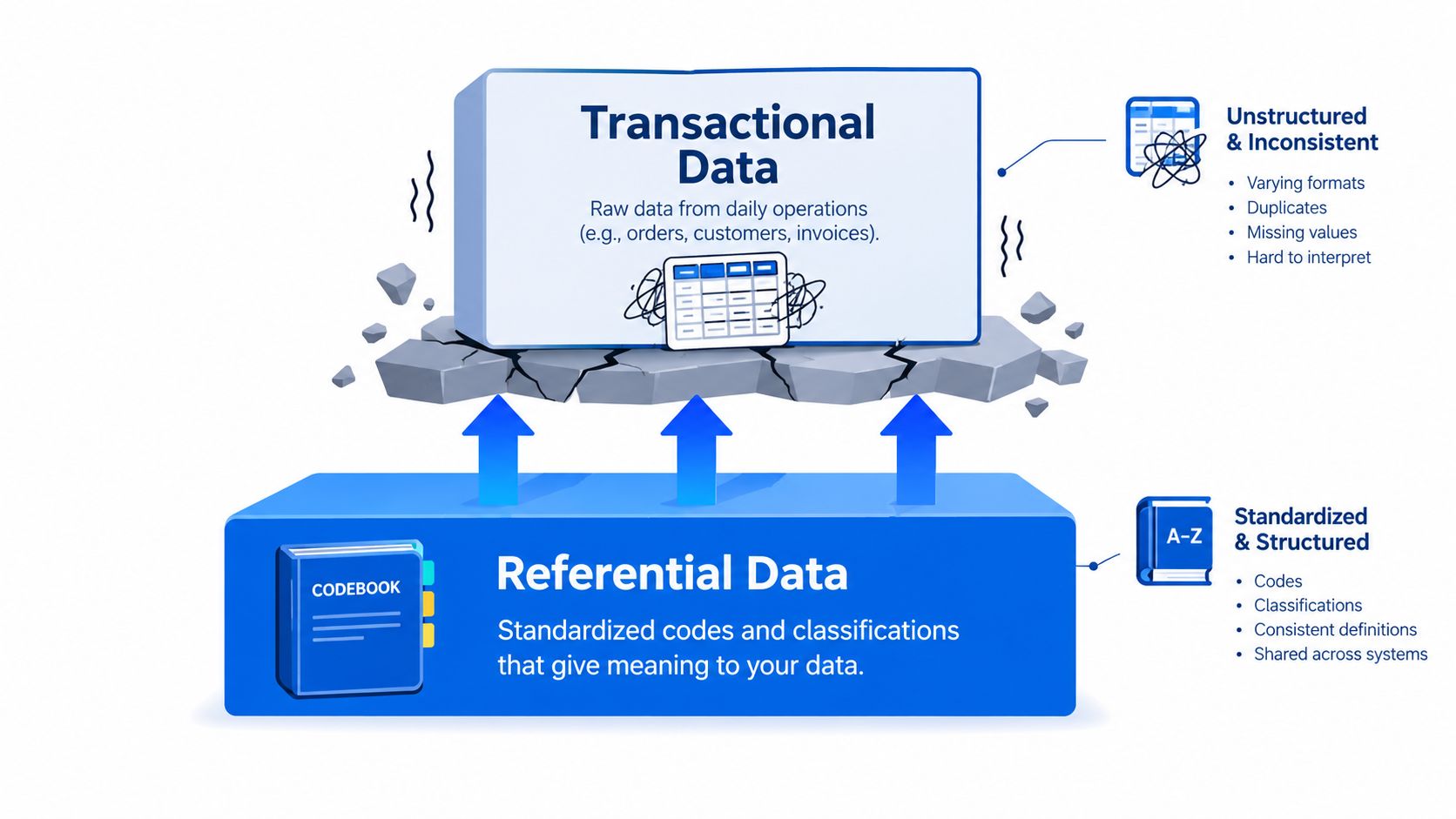
The important point isn't the size of an individual code list. It's the number of systems that depend on the list and the number of records that carry its values. A single permitted value can appear in customer records, invoices, events, contracts, regulatory submissions, and aggregated metrics. If the value changes without a controlled migration, every consumer must either understand both versions or receive a synchronized update.
The production role of a shared vocabulary
A complete reference set normally includes more than a code and a label. It may also contain descriptions, parent-child relationships, valid-from and valid-to dates, status flags, source identifiers, mappings to external standards, and a history of approved changes.
That structure supports practical controls:
Version control preserves the exact value set used to produce a report.
Stewardship gives a named person or team authority over additions, changes, and retirements.
Controlled distribution ensures subscribers receive compatible updates.
Lineage shows which systems and reports depend on each code or classification.
A database schema description is useful alongside this work because engineers need to know where reference values live, which columns consume them, and how dependencies are represented. Without that structural context, teams can update a code list while missing an embedded copy in a transformation, application, or downstream warehouse.
Referential Data Versus Master Data and Metadata
The terms overlap in conversation, but they describe different responsibilities in a working data architecture. Master data represents business entities, while referential data defines the values used to classify, constrain, or describe those entities. Metadata describes the data itself, including structure, lineage, ownership, and technical properties.
Data type | What it represents | Production example | Main control |
|---|---|---|---|
Referential data | Permitted meanings and classifications | Country codes, currencies, units, status values | Versioning and controlled distribution |
Master data | Core entities used across processes | Customers, products, suppliers, employees | Identity, deduplication, and lifecycle management |
Metadata | Information about data structure and use | Column definitions, lineage, owners, refresh context | Cataloging and change tracking |
A customer is master data. The customer's country code, segment, legal status, or preferred language comes from referential domains. An order is a transaction. Its status value, currency, sales channel, and tax jurisdiction typically depend on governed reference sets. Metadata tells you where those fields are stored, how they were transformed, and which reports consume them.
The distinction affects governance design. A customer record may require survivorship rules, duplicate detection, matching, and an entity lifecycle. A currency code needs an approved domain, an effective date, mappings, and a process for distributing changes. A column definition needs ownership and lineage, but it doesn't become a reference value just because it documents one.
Referential integrity is a related but different concern
Referential integrity is a relationship rule. It checks whether a value in one table correctly points to an existing value in another table, such as whether every order's customer identifier has a corresponding customer record. Referential data supplies the controlled values that systems may accept, while referential integrity verifies that relationships remain valid.
The distinction matters during incidents. A database can enforce a foreign-key relationship and still contain the wrong business classification. It can also contain an approved country code that fails to join because another system has not received the latest reference version. Database constraints protect relationships. Reference data management protects shared meaning.
Modern reference management therefore needs more than a static spreadsheet. A useful customer master data management approach separates entity ownership from the reference domains that classify those entities. The most reliable architectures connect both through clear stewardship, history, approval workflows, and traceable distribution.
Validation Practices That Keep Reference Data Reliable
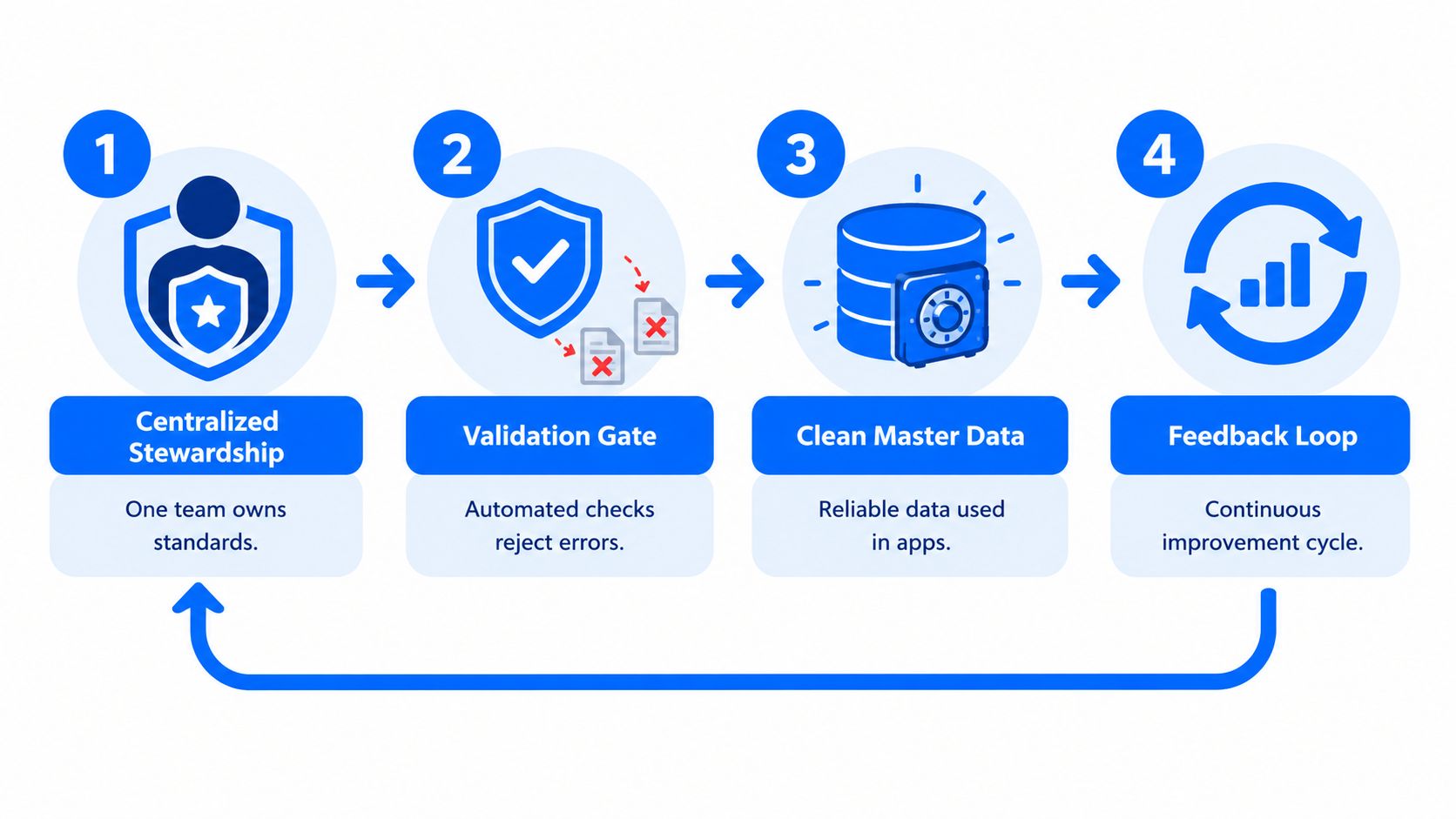
Reference data stays reliable when an organization treats it as a managed domain with an owner, a lifecycle, and observable delivery behavior. A central repository alone won't solve the problem. Teams must also control who can propose a change, who approves it, how the change is versioned, and how each subscriber confirms successful adoption.
Establish ownership before writing rules
Assign a steward for each domain, such as geography, currency, product classification, or customer status. That person or team should define the accepted values, document the business meaning, coordinate changes with affected stakeholders, and approve retirement or replacement of values.
A practical workflow looks like this:
Propose the change. Capture the business reason, source authority, affected values, effective date, and expected consumers.
Review dependencies. Identify tables, pipelines, applications, dashboards, and regulatory outputs that use the domain.
Approve and version. Store the new state alongside its history instead of overwriting the old value without traceability.
Distribute deliberately. Publish the version to subscribers and record whether each system loaded it successfully.
Validate adoption. Check that downstream records use permitted values and that reports interpret them consistently.
Validate at more than one layer
Record-level validation should reject or quarantine values that don't resolve to an approved reference record. Structural monitoring should detect added or removed columns and data type changes that could alter how codes are loaded. Timeliness checks should identify a reference update that arrived late, arrived early, or never reached a subscriber.
Teams should also test distribution behavior. A reference set may be correct in its source repository but stale in a downstream application. Compare versions, monitor load completion, and alert when a consumer falls behind. These checks are especially important when different regions or business units use separate pipelines.
For broader context on protecting the reliability of customer records, this data integrity guide from CapyScout discusses the relationship between validation, consistency, and dependable database operations.
Prefer prevention over incident cleanup
Manual checks can work for a small domain, but they become brittle as reference sets spread across warehouses, lakes, applications, and reporting tools. Teams that only investigate after a dashboard breaks usually spend their time reconstructing what changed and which systems consumed it.
Continuous anomaly detection adds another layer. A monitoring system can learn the normal behavior of a reference dataset, then flag unusual volume, distribution, timing, or value changes before those changes reach critical outputs. Deterministic rules still matter for known business constraints, but statistical monitoring helps surface changes that nobody thought to encode in advance.
Use data validation rules, checks, and continuous data quality as part of an operating process, not as a one-time cleanup project. The objective is a reference domain that remains explainable, current, and consistent wherever teams consume it.
How Reference Data Impacts Real Business Outcomes
Reference data becomes visible to leadership when its failure changes a business outcome. A missing classification can alter a management report. A stale jurisdiction value can undermine a compliance submission. An incorrect identity mapping can cause one person's records to appear as several people, or several people's records to be combined.
Healthcare identity resolution provides a concrete example. Before applying external referential data, one health information exchange had 51.1 million medical record numbers mapped to 25.4 million actual individuals. After four months of applying referential data, it had 54.1 million MRNs resolved to 21.9 million identities. The matching algorithm reported 99.96% positive predictive value and 95.78% sensitivity, while the study identified 15.1 million unique patients and 159 million matched record pairs, as described in the healthcare identity-resolution study.
The lesson is broader than healthcare. External reference sets can provide trusted context when local identifiers are incomplete or inconsistent. They can support matching, enrichment, deduplication, and relationship resolution across organizations and jurisdictions. Guidance on entity resolution with external reference data describes this role as a way to improve the consistency of entity definitions and relationships.
The same failure pattern crosses industries
In financial services, a changed product, jurisdiction, or risk classification can affect calculations and regulatory reporting. In telecommunications, inconsistent service or customer categories can distort segmentation and operational analysis. In the public sector, mismatched administrative codes can weaken traceability between source records, programs, and reports.
The source records in each case may pass basic completeness checks. They contain values, timestamps, and identifiers. The failure occurs because a consuming system no longer interprets those values in the same way as the system that created them.
Reliable analytics depends on reliable meaning. A complete record with an unresolved classification is not decision-ready data.
Observability connects the reference layer to the outcome layer. Monitoring code distributions, join success, classification coverage, report metrics, and delivery timing gives engineers an earlier signal than waiting for users to discover a broken dashboard. That approach also helps teams distinguish a transaction problem from a reference problem, which shortens diagnosis and prevents unnecessary reprocessing.
Building Reference Data Resilience with Modern Observability
Periodic audits are useful, but they leave long gaps between checks. A reference table can drift, fail to arrive, or change shape shortly after an audit finishes. Resilient teams monitor behavior continuously and combine explicit validation with anomaly detection.
Consider a regional classification pipeline. A steward approves a new value and publishes a version. The central repository contains the change, but one subscriber fails during its load. A schema check catches an unexpected structural change, a timeliness monitor flags the missing delivery, and a referential validation check identifies records that don't resolve in the subscriber's copy. The engineer can repair the distribution path before the next report uses incomplete classifications.

A platform such as digna can run inside a customer's private cloud, VPC, or data center, execute checks in the database, monitor timeliness and schema behavior, validate records, and use statistical methods with machine learning to detect dataset-specific anomalies. Its published platform information states that initial insights can be available in under two hours, with the exact result depending on the deployment and selected data sources. The data observability solution is relevant when teams need one operating view across warehouses, lakes, and pipelines without moving production data outside their environment.
Observability doesn't replace stewardship. It tells stewards and engineers when the controls they designed aren't holding in production. It also provides evidence for incident review, helping teams answer which version was active, where distribution failed, when the anomaly began, and which outputs were exposed.
For teams working with catalogs and product hierarchies, this resource on managing product data quality offers useful context on monitoring quality across product information workflows. The same principle applies to geographic, financial, regulatory, and operational domains.
The practical target is straightforward: approve changes deliberately, distribute them consistently, validate every dependent record, and monitor the behavior that indicates drift. When reference data becomes observable, engineers can address a failed update as an operational event instead of discovering its consequences in a board report or compliance review.
digna provides in-environment data observability for referential data, including record validation, anomaly detection, timeliness monitoring, and schema tracking across critical pipelines. Visit digna to see how your team can detect code drift and distribution failures before they damage dashboards, analytics, or compliance reporting.
Once your reference domains have owners and versions, the next control is the relationship rule itself. For a hands-on walkthrough, see how to set up a referential integrity check step by step.
Frequently asked questions
What is referential data?
Referential data is a governed set of permitted values, codes, classifications, hierarchies and mappings that gives consistent meaning to other data. Country codes, currency codes, units of measure and product categories are typical examples, acting as a shared vocabulary that transactional records rarely carry on their own.
What is the difference between reference data and master data?
Master data represents business entities such as customers, products, suppliers and employees, while reference data defines the values used to classify them. A customer is master data, but that customer's country code, segment and preferred language come from governed reference domains managed through versioning and controlled distribution.
Is referential data the same as referential integrity?
No. Referential integrity is a relationship rule that checks whether a value in one table points to an existing record in another, such as an order's customer ID. Referential data supplies the approved values themselves, so a foreign key can hold while the business classification is still wrong.
How often does reference data change?
More often than most teams expect. An industry source cited in the article reports that country codes are updated 3 to 5 times per year and currency codes 5 to 10 times per year, even though reference data accounts for about 25% to 50% of all tables.
How do you keep reference data reliable across systems?
Give each domain a named steward, then version every approved change and distribute it deliberately to subscribers. Validate at several layers: reject records that do not resolve to an approved value, track schema changes, catch late or missing deliveries, and add anomaly detection for changes nobody encoded as a rule.