Modern Data Quality with Teradata Vantage | AI-Powered Reliability for Enterprise Analytics
|
4
min di lettura

Teradata VantageCloud has long been the gold standard for high-performance, complex enterprise analytics at massive scales. Enterprise data teams across the world rely on it for mission-critical analytics, high-performance workloads, and large-scale AI. As organizations accelerate their AI adoption, the effectiveness of these AI initiatives hinges on one foundational element:
Modern, automated, and continuous data quality.
Today, Teradata’s innovation roadmap is centered on maximizing this foundation through Autonomous Customer Intelligence, Agentic AI, and the groundbreaking Enterprise Vector Store for unstructured data. This means enterprises need data that is clean, trusted, observable, and governed. Traditional rule-based monitoring cannot keep up with the scale, diversity, and speed of modern cloud-scale workloads.
This strategic direction—the journey from predictive analytics to autonomous, real-time action—elevates Data Quality (DQ) and Data Observability (DO) from a technical concern to an absolute business mandate. Teradata can promise high performance and robust scale, but that promise is only as reliable as the data flowing through its engine. This is where digna specializes: providing the intelligent, zero-maintenance, and modular layer of data trust essential for the next generation of Teradata-powered applications.
The challenge is clear: how do data teams responsible for Teradata’s massive, mission-critical systems ensure data is clean, fresh, and compliant without drowning in manual monitoring rules and firefighting escalations? This is where modern data quality comes in. And this is where digna, an AI-powered data quality and observability platform, becomes a direct enabler of Teradata Vantage environments.
In this article, we explore how modern data quality principles intersect with the capabilities of Teradata Vantage — and how digna’s AI-driven modules strengthen performance, improve reliability, and deliver readiness for enterprise AI at scale.
The Shift to Modern Data Quality: Why Teradata Environments Need More Than Rules
Teradata’s evolution into a hybrid, autonomous AI and knowledge platform creates an environment where:
Data volumes constantly grow
Operational workloads run 24/7
Unstructured data (80% of enterprise data) is now first-class via the Enterprise Vector Store
AI agents depend on fresh, accurate signals
Business applications consume data in real time
This introduces significant challenges:
1. Classic data quality frameworks cannot adapt fast enough
Manually defining rules for thousands of tables is slow and reactive.
2. Complex pipelines produce subtle shifts that rules never catch
Seasonal fluctuations, workload variations, or unexpected spikes are invisible to static thresholds.
3. AI workloads magnify data issues
Small quality problems propagate quickly into poor model predictions, incorrect insights, or escalated operational costs.
4. Hybrid environments increase complexity
As analytics span on-prem, cloud, and multiple data consumers, maintaining a global view of data health becomes difficult.
Modern Data Quality (MDQ) solves this with:
AI-driven behavior monitoring
Automatic anomaly detection
Predictive trend modeling
Schema tracking for fast-breaking pipelines
Real-time time-series analytics
Teradata Vantage provides the compute foundation. digna provides the intelligence layer.
Together, they enable enterprise-grade reliability for AI and analytics.
How digna Enhances Modern Data Quality in Teradata Vantage
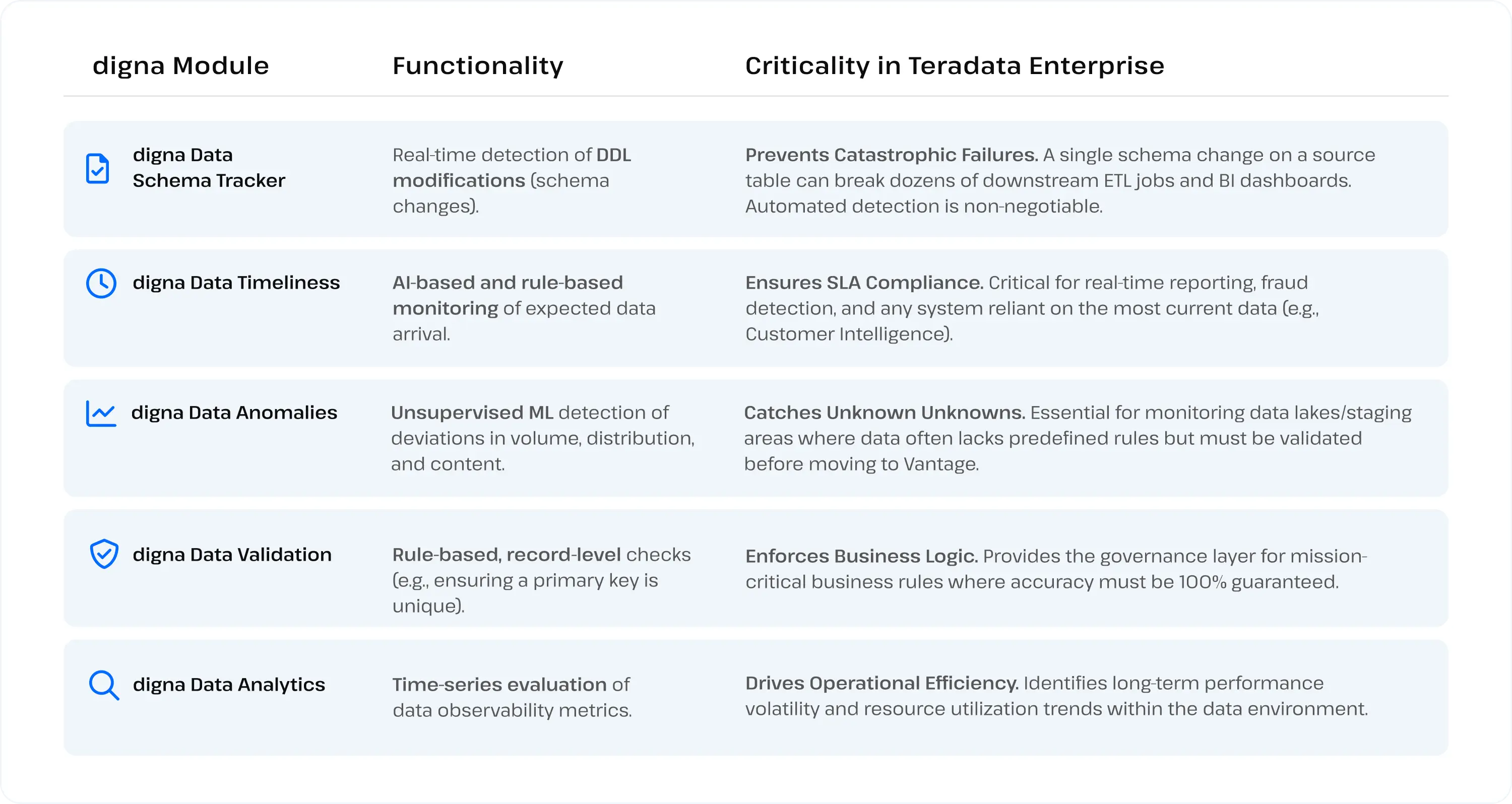
digna introduces a fully modular, AI-powered approach that complements Teradata’s architecture without extracting customer data.
Only metrics are exported — processing happens inside your Teradata system.
Below are the modules most relevant for enterprise Teradata workloads.
1. digna Data Anomalies
AI-powered anomaly detection for volumes, distributions, outliers & missing data
As workloads scale, Teradata tables can shift subtly over time — and without visibility, these issues reach end users or models too late.
digna Data Anomalies automatically learns:
Typical data volumes
Natural fluctuations in distributions
Expected patterns in missing values
Normal business cycles (daily, weekly, monthly)
Operational rhythms of batch workloads
When something deviates beyond AI-learned expectations, digna notifies teams before problems escalate.
Perfect for Teradata environments that:
Run large overnight workloads
Support multiple business units
Depend on stable data marts and aggregated layers
Execute time-critical ETL pipelines
This replaces hundreds of static rules with a single AI-powered monitoring layer.
2. digna Data Analytics
Long-term trend analysis for observability metrics
Teradata’s workload patterns evolve over months and quarters. digna Data Analytics evaluates trends over time to detect:
Gradual performance degradation
Slow drifts in data volumes
Increasing volatility in pipeline outputs
Long-term shifts that precede failures
These insights help platform teams:
Proactively prevent escalations
Plan capacity effectively
Anticipate workload shifts
Improve stakeholder reliability
This is especially impactful in Teradata’s massive, multitenant data environments.
3. digna Data Timeliness
AI-driven and rule-based monitoring of data arrival times
SLA breaches are a common pain point in Teradata-powered analytics.
digna monitors:
Expected arrival times of batch processes
Delayed or missing data
Early arrivals (which can break downstream logic)
Variability in data ingestion patterns
Its AI model learns normal behavior instead of relying purely on a static SLA definition.
4. digna Data Validation
A rule-based layer for strict compliance and audit requirements
Some industries (finance, insurance, telecommunications, healthcare) require explicit, enforceable rules.
digna Data Validation provides:
Record-level validation
Business rule enforcement
Data type and pattern checks
Audit trails for regulatory reviews
Row-level access controls for sensitive environments
This complements the AI modules by ensuring that every record meets defined business expectations.
5. digna Data Schema Tracker
Protecting pipelines from schema drift
Teradata environments often support hundreds of pipelines. A single schema change can break dozens of downstream jobs.
digna automatically tracks:
Added/removed columns
Renamed fields
Data type changes
Table structure changes
DDL modifications
When drift occurs, teams are alerted immediately, preventing silent pipeline failures.
Why digna + Teradata Vantage Is a Next-Generation Foundation for Enterprise AI
Teradata’s new innovations — including the Enterprise Vector Store, hybrid cloud platform, and agentic AI infrastructure — require clean, consistent, and predictable data.
digna enables this by giving enterprises:
✔ Predictability
AI learns the data’s behavior and alerts proactively.
✔ Stability
Operational issues can be prevented before they reach escalation.
✔ Clarity
Teams understand long-term trends and workload shifts.
✔ Trust
Regulated industries can validate every record and generate audit evidence.
✔ Security
Data never leaves the customer’s infrastructure.
✔ Modularity
Only activate the specific modules your Teradata environment needs.
The Future: Agentic AI Requires Modern Data Quality
Teradata’s roadmaps emphasize:
Autonomous customer intelligence
Signal-driven decision systems
Hybrid AI + analytics infrastructure
Agent builders and AI-ready data products
Real-time activation pipelines
All these systems depend on trusted data.
Modern data quality is no longer optional — it is the backbone of the AI-driven enterprise.
And digna is engineered from the ground up to provide that foundation. Book a demo today .
See how digna does this in practice: Teradata data quality monitoring.
Frequently asked questions
Why do Teradata Vantage environments need more than rule-based data quality?
Static rules cannot keep pace with growing volumes, 24/7 workloads and real-time consumers. The article names four challenges: rules for thousands of tables are slow to define, subtle seasonal shifts escape thresholds, AI workloads magnify small issues, and hybrid on-prem and cloud setups make a global view of data health difficult.
Does digna extract data from Teradata?
No. digna complements Teradata's architecture without extracting customer data: processing happens inside the Teradata system and only metrics are exported. The article lists security among the combined benefits, stating that data never leaves the customer's infrastructure, and modularity means only the modules a Teradata environment needs are activated.
What does digna Data Anomalies learn in Teradata tables?
It automatically learns typical data volumes, natural fluctuations in distributions, expected patterns in missing values, normal daily, weekly and monthly business cycles, and the operational rhythms of batch workloads. When behaviour deviates beyond these AI-learned expectations, digna notifies teams, replacing hundreds of static rules with one monitoring layer.
How is digna Data Analytics different from anomaly detection?
Data Analytics looks at long-term trends rather than single deviations. It evaluates observability metrics over months and quarters to detect gradual performance degradation, slow drifts in data volumes and rising volatility in pipeline outputs, helping Teradata platform teams plan capacity and prevent escalations before failures occur.
What schema changes does digna Schema Tracker detect in Teradata?
digna Schema Tracker detects added or removed columns, renamed fields, data type changes, table structure changes and DDL modifications. Because a Teradata environment can support hundreds of pipelines, where one schema change can break dozens of downstream jobs, teams are alerted immediately to prevent silent pipeline failures.