10 Big Data Validation Tools Compared
|
10
min di lettura

The best big data validation tools aren't the ones with the longest feature lists. A platform can offer profiling, alerts, lineage, and dozens of connectors yet still leave a finance team unable to prove whether a critical transaction rule ran, where a failed check executed, or who owns the exception.
Large-scale validation covers different problems. Record-level business rules test whether values and relationships make sense. Statistical anomaly detection identifies unusual distributions. Freshness monitoring catches late or missing loads. Schema tracking detects structural changes. Migration testing compares outputs across systems, while lineage and platform-health monitoring explain impact and operational context. These controls overlap, but they aren't interchangeable. That distinction is central to why validation testing matters.
This comparison evaluates ten tools by validation scope, execution model, deployment, operational ownership, implementation effort, governance, pricing transparency, and use-case fit. It also treats rule-based testing and automated observability as complementary rather than competing approaches. digna is one relevant option for teams that need in-database validation and observability inside their own infrastructure, but it isn't the universal winner for every data estate.
Table of Contents
1. Data Validation
Where digna fits operationally
Strengths and trade-offs
2. Great Expectations, GX Cloud and Open Source
3. Soda, Soda Core and Soda Cloud
4. Monte Carlo
5. Anomalo
6. Bigeye
7. Datafold
8. AWS Deequ
9. Acceldata
10. Talend Data Quality, now within Qlik Talend Cloud and Talend Data Fabric
Top 10 Big Data Validation Tools Comparison
Match the Tool to the Failure You Need to Prevent
1. Data Validation
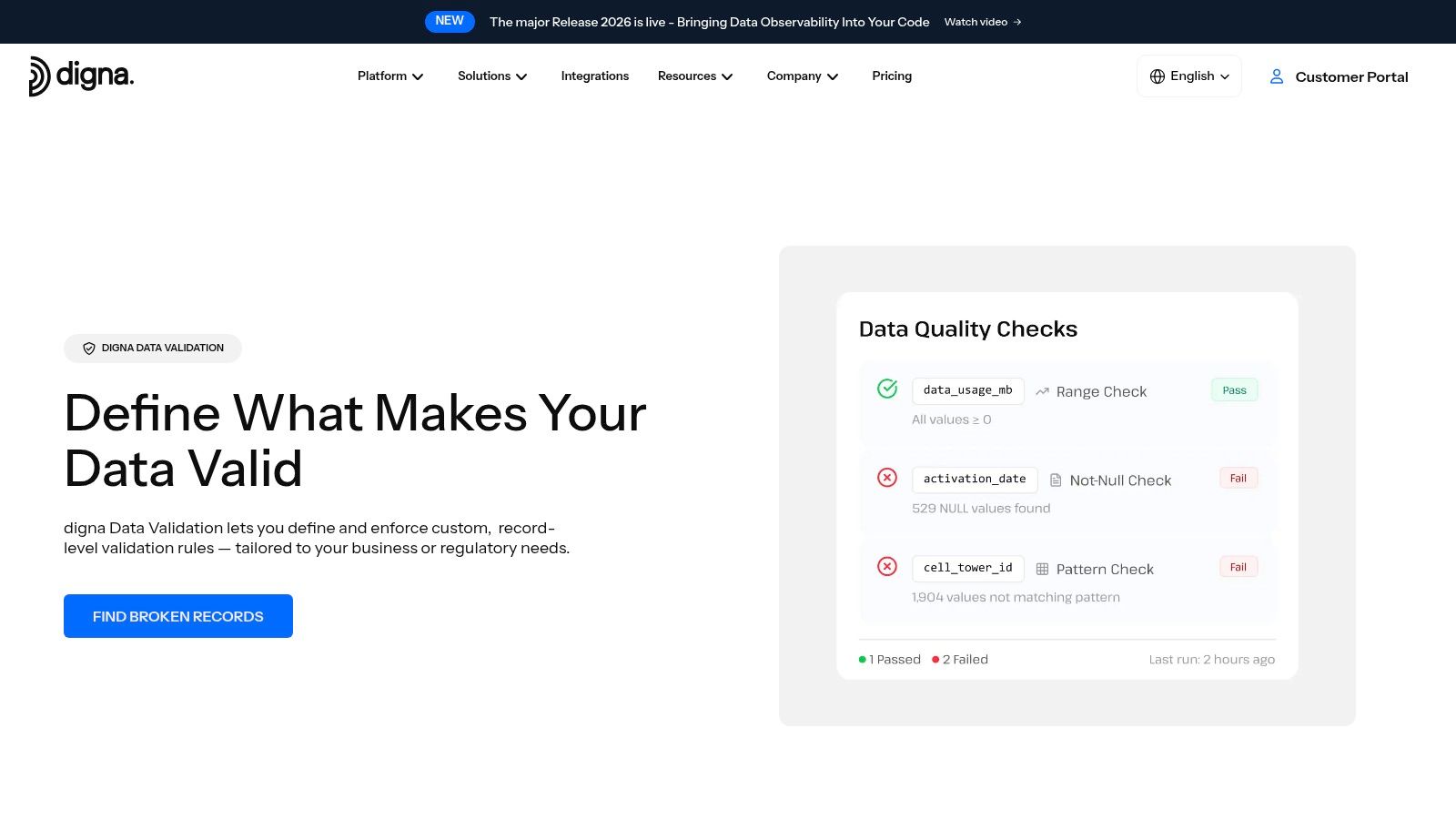
digna's Data Validation module is built for the problem that anomaly scores can't solve alone: proving that individual records comply with explicit business logic. Teams can define checks for exact values, thresholds, ranges, null handling, reference lists, and cross-column consistency, then use the results to support analytics, reporting, operational workflows, and regulatory review. The distinction matters because a dataset can follow a familiar statistical pattern while still violating a critical business rule.
Where digna fits operationally
digna performs validation and metric computation inside the customer's databases, rather than moving production data to an external processing environment. It runs inside a customer's cloud, VPC, or data center, which makes the deployment model relevant to organizations with strict residency, access, or governance requirements. Its product material describes execution across databases such as Teradata, Snowflake, Databricks, and PostgreSQL, with logged pass and fail results and audit trails.
The module also connects record-level failures with AI-driven anomaly detection, timeliness monitoring, and schema tracking. That correlation can be more useful than an isolated alert. A failed rule accompanied by a late load or a recent structural change gives an investigator a stronger starting point than a failed rule without context.
Practical rule: Choose digna when the evidence behind a failed check matters as much as the alert itself.
Strengths and trade-offs
In-database execution: Production data remains in place, reducing data movement and aligning validation with private deployment requirements.
Audit-ready checks: Row-level results provide evidence for business rules, exception handling, and compliance reviews.
Correlated incidents: Anomalies, delivery delays, and schema changes can be reviewed alongside validation failures.
Modular expansion: Teams can start with priority tables and add monitoring modules as coverage grows.
The trade-off is implementation ownership. digna requires deployment and integration with customer databases, so it can demand more infrastructure work than a SaaS-only service. Rule authoring and maintenance also remain necessary, and per-active-table pricing means cost and operational effort can expand as coverage expands. Teams evaluating it should define table ownership, rule owners, exception expiry, and remediation service levels before broad rollout.
For a deeper view of implementation patterns, see digna's guide to data validation rules, checks, and continuous data quality. Visit the digna Data Validation product page for current deployment and licensing details.
2. Great Expectations, GX Cloud and Open Source
Great Expectations is a strong fit when a team wants declarative, rule-based validation with an open-source foundation. Its Expectations model lets engineers define assertions about datasets, columns, distributions, and values, then run those suites against SQL warehouses, data lakes, files, or dataframes. The separation between test authoring and run management is useful for teams that want code-reviewed checks but also need a shared operational view.
Open-source GX is the better fit for teams comfortable maintaining Python-based workflows, repositories, and execution infrastructure. GX Cloud adds hosted collaboration, validation history, alerting, and governance workflows. That makes the product less a single deployment choice than a path from code-first testing toward managed operations.
The main limitation is coverage effort. A rich expectation catalog doesn't remove the need to decide which rules are business-critical, how exceptions work, and where suites run in production. Rule authoring can become labor-intensive when a large estate needs explicit coverage across many tables. GX also isn't primarily an automated observability platform, so teams seeking baseline learning, freshness intelligence, or broad incident correlation may need complementary capabilities.
For practical context on the open-source data-quality space, compare the framework with digna's review of open-source data-quality tool features. Review the current product options at Great Expectations, especially if pricing, hosted limits, or cloud packaging will influence procurement.
3. Soda, Soda Core and Soda Cloud
Soda separates the execution engine from the operational control plane. Soda Core and Soda Library let developers express checks in SodaCL, a YAML-based syntax designed for pipeline integration. Soda Cloud adds a shared interface for results, alerts, trends, role-based access, and triage.
That division suits teams that want validation close to the warehouse while giving analysts and data owners a cloud interface for review. Soda's integrations with platforms such as Snowflake and Databricks, together with CI/CD connections, support checks that run as part of delivery workflows rather than only as scheduled dashboard scans.
The useful distinction is accessibility. YAML can lower the barrier for engineers who don't want every check embedded in application code, while profiling and automatic suggestions can help teams establish an initial quality baseline. The product still requires decisions about severity, ownership, and escalation. A check that runs successfully but has no accountable owner is only a technical event, not an operating control.
The execution location matters more than the alert screen. A polished cloud interface doesn't automatically mean that production data has left the warehouse.
Soda's strongest use case is a warehouse-centered quality program that combines developer-authored checks with collaborative triage. Its limitation is packaging. Some advanced capabilities are available only in the Cloud SKU, and public pricing isn't listed, so buyers need to confirm current feature boundaries and quote assumptions directly. Teams comparing it with digna should focus on whether they need a SaaS control plane, private installation, or broader correlated monitoring. The Soda platform provides the current product scope, deployment details, and commercial information. For alternatives oriented toward in-place validation and observability, see digna alternatives to Soda.
4. Monte Carlo
Monte Carlo addresses a different failure pattern from a rule library. Its core proposition is data observability across freshness, volume, schema, lineage, and BI, supported by machine-learning-driven monitors and incident workflows. This makes it a natural choice for larger data teams that need to identify unexpected behavior without writing a rule for every table and metric.
The platform's lineage and impact analysis are particularly important during investigation. A freshness issue becomes more actionable when a team can see affected downstream assets, dashboards, or workflows. Incident triage and runbook capabilities also shift the product toward operational response rather than test authoring alone.
Monte Carlo is often evaluated through enterprise procurement channels, including AWS Marketplace. Its credit-based consumption model can simplify purchasing for organizations already using that route, but it introduces variable-cost questions. Teams should model how monitored assets, scan frequency, historical retention, and incident volume affect consumption instead of treating the marketplace path as a complete pricing answer.
The limitation is deterministic coverage. Observability can identify that a distribution changed or a load arrived late, but it won't replace an explicit rule for a legally or operationally meaningful condition. A strong implementation pairs Monte Carlo's automated monitors with targeted tests owned by the relevant domain team.
Review current scope and procurement options through Monte Carlo. Buyers should ask for a cost model based on their actual monitored estate, then compare the answer with tools that execute checks in their own infrastructure. For a contrasting product perspective, see digna's analysis of Monte Carlo alternatives.
5. Anomalo
Anomalo is designed for teams that want automated anomaly detection to establish broad coverage quickly. It analyzes table, column, metric, and distribution behavior, then supports configurable validation at table, column, and row level. That combination addresses a common implementation tension: teams need explicit controls, but they often can't hand-author every useful baseline before monitoring begins.
The interface emphasizes review at scale. Native connections to modern warehouses and catalogs such as Alation help surface data health where consumers and stewards already work. Automated detection can expose unusual shifts that a manually chosen threshold would miss, particularly in wide warehouse environments where the relevant baseline isn't obvious at design time.
The trade-off is alert calibration. Machine-learning-driven monitors still need triage policies, suppression decisions, and ownership. If teams accept every deviation as a defect, they create noise. If they suppress too aggressively, the system loses coverage. The right operating model classifies issues by business consequence and keeps deterministic checks for conditions that must never be ambiguous.
Automated coverage reduces rule-authoring effort, but it doesn't eliminate the need for accountable decisions.
Anomalo fits organizations prioritizing fast observability across large warehouse estates and a visual workflow for issue review. It may be less suitable when private deployment, in-database evidence, or strict record-level audit trails are the primary selection criteria. Pricing is sales-led and isn't publicly listed, so buyers should validate connector scope, data access boundaries, and tuning support during evaluation. See the current offering at Anomalo, and compare its anomaly-first approach with digna's guide to spotting data issues early through anomaly detection.
6. Bigeye
Bigeye positions observability as part of an AI Trust operating model. Its monitoring covers freshness, volume, schema, and distributions, while lineage and impact analysis connect an abnormal dataset to downstream consumers. That emphasis makes it relevant where governance teams need more than a notification. They need context about what changed and which workloads might be affected.
The product's practical strength is lineage-aware triage. Investigators can use upstream and downstream relationships to narrow the search for a root cause, while enterprise security capabilities and a broad connector portfolio support heterogeneous estates. Bigeye also provides guides and documentation that can help teams standardize rollout rather than letting each domain invent its own monitoring process.
Its broader scope is also a potential disadvantage. A team seeking a small library of deterministic checks may find an AI Trust platform larger than the immediate requirement. More capability means more decisions about ownership, integration, incident severity, and operating procedures. The buying team should separate the need for observability from the need for model-governance controls and confirm which product components are required.
Bigeye is a good candidate when lineage is central to investigation and the organization wants a structured enterprise implementation. It isn't the obvious first choice for a Spark-native developer library or a migration-diff workflow. Pricing isn't published and procurement is primarily demo-led, so evaluation should include deployment boundaries, sensitive-data handling, and evidence retention. The current product information is available from Bigeye.
7. Datafold
Datafold solves a narrower problem exceptionally well: value-level comparison and regression testing. Its Data Diff capability compares outputs across large datasets, while column-level lineage connects changes across warehouses, dbt projects, and BI assets. That makes it useful before a pull request merges, during a warehouse migration, or when a transformation has been rewritten and the team needs to see actual data impact.
This is not the same as continuous observability. Datafold is strongest when someone has a known change and needs evidence that the new result matches, improves, or intentionally differs from the old result. CI integrations make that comparison part of the development workflow, where engineers can catch regressions before production consumers encounter them.
A VPC deployment option supports organizations that need private execution. The key implementation question is comparison design. Teams must define which rows, columns, aggregates, tolerances, and exclusions make a meaningful parity test. A mechanically complete diff can still produce an operationally useless result if business-approved changes aren't represented in the test.
Datafold fits migration-heavy, dbt-centered, and regression-sensitive environments. It won't replace freshness monitoring, anomaly baselines, or record-level compliance rules. Full-platform pricing is customized and sales-led, and the open-source data-diff project has been sunset in favor of the cloud product, so buyers should confirm the current commercial path. Explore the latest capabilities at Datafold.
8. AWS Deequ
AWS Deequ is a Scala and Apache Spark library, not a full observability platform. That distinction determines both its appeal and its operating cost. Data teams working directly in the JVM and Spark ecosystem can express constraints for completeness, uniqueness, distributions, and related metrics, then execute them alongside large-scale ETL or ELT jobs.
Deequ's Metrics Repository pattern lets teams persist profiles over time. That creates a foundation for trend analysis, but the surrounding experience remains the customer's responsibility. Engineers must build scheduling, alerting, result presentation, ownership workflows, and incident retention if those functions aren't supplied by the existing platform.
The library is attractive when avoiding vendor lock-in matters and Spark is already the execution environment. It can be embedded into ETL jobs and CI workflows, and community Python bindings exist for teams that need a Python-facing interface. Its flexibility comes with an expertise requirement. Teams without strong Scala or Spark operating knowledge may spend more effort maintaining the validation layer than authoring the constraints themselves.
Deequ is a component you assemble into a validation system. It isn't a ready-made governance workflow.
Use Deequ for Spark-native constraint testing where engineering control and open-source licensing outweigh the need for a built-in UI. Choose a platform instead when analysts, stewards, or auditors need shared incident context without custom development. The project's current code and documentation are available in the AWS Deequ repository.
9. Acceldata
Acceldata combines data reliability with cost optimization and platform health. That makes it a candidate for complex estates where teams don't want data-quality alerts isolated from workload behavior, performance signals, and consumption changes. Its scope extends beyond row checks into the operational conditions that determine whether data platforms remain usable and economically controlled.
The platform supports reliability monitors, alerts, and data-contract-style controls across heterogeneous stacks. Enterprise deployment and security capabilities are relevant to organizations operating both on-premises and in the cloud, especially when platform engineers and governance teams share responsibility for service levels.
Breadth can be valuable, but it also expands implementation scope. A team looking only for null checks, reference-list validation, or a small set of schema controls may end up evaluating capabilities it won't operationalize. The selection process should identify the failure that justifies the platform, then test whether cost and health signals will be owned by the same team or by separate platform functions.
Acceldata suits estates where quality, reliability, and platform economics need to be reviewed together. Pricing is sales-led and quote-based, so buyers should request a clear breakdown of modules, monitored assets, deployment, and support. The product's current positioning and platform details are available at Acceldata.
10. Talend Data Quality, now within Qlik Talend Cloud and Talend Data Fabric
Talend Data Quality is the established enterprise option in this list, with capabilities spanning profiling, cleansing, standardization, enrichment, stewardship, and trust scoring. It makes the most sense for organizations already standardizing on Qlik or Talend for integration, governance, and data management, because the value comes from the surrounding ecosystem as much as from individual validation rules.
The toolset supports quality rules and profiling alongside stewardship workflows. Subscription plans are available through Qlik Talend Cloud, while on-premises and client-managed options exist within the broader Data Fabric family. That range can help organizations with mixed deployment requirements, but it also makes product packaging important to verify.
Talend is less about a lightweight developer library and more about institutionalizing quality workflows across roles. Data stewards can participate in remediation, while integration teams connect quality processes to broader data movement and governance. The trade-off is complexity. Public list pricing isn't posted, tiering and SKUs can be difficult to compare, and rebranding under Qlik means buyers should confirm which capabilities belong to which current package.
Talend is a strong fit for enterprises already invested in the Qlik and Talend ecosystem. It may be excessive for a focused migration diff, Spark constraint library, or anomaly-only rollout. Confirm current packaging, deployment, support, and licensing through Qlik Talend Data Fabric.
Top 10 Big Data Validation Tools Comparison
Tool | Core capabilities | UX & quality (★) | Unique selling points (✨ / 🏆) | Target audience (👥) | Price / value (💰) |
|---|---|---|---|---|---|
Data Validation (digna) | In‑database record‑level validation, integrated with anomaly, timeliness & schema | ★★★★★ Shared UI, enterprise-grade | ✨ Runs inside customer infra; correlated incidents → faster RCA 🏆 | 👥 Regulated enterprises (Finance, Healthcare, Telco, Public) | 💰 Modular license + per‑active‑table; transparent, usage‑stable |
Great Expectations (GX) | Declarative expectation suites, profiling, multi‑backend support | ★★★★ Code‑first UX; GX Cloud adds managed UI | ✨ Rich expectation library, docs & test lineage 🏆 | 👥 Data engineers, code‑first teams | 💰 OSS free; GX Cloud paid tiers (varies) |
Soda (Core + Cloud) | YAML checks (SodaCL), profiling, cloud UI, runs data‑local | ★★★★ Developer‑friendly; Cloud for triage & RBAC | ✨ YAML + easy pipeline embed, auto suggestions 🏆 | 👥 Dev teams who want CI/CD + cloud UX | 💰 Core OSS free; Cloud = sales/quote |
Monte Carlo | ML monitors (freshness, volume, schema), lineage, BI monitoring | ★★★★★ Mature incident triage & runbooks | ✨ Enterprise ML monitoring + rich triage workflows 🏆 | 👥 Large orgs with mature data ops | 💰 Sales‑led; credit/consumption model (variable) |
Anomalo | AI anomaly detection, declarative validations, catalog integrations | ★★★★ Fast coverage; issue‑review UI | ✨ Automated checks for quick coverage 🏆 | 👥 Teams needing rapid anomaly detection at scale | 💰 Sales‑led enterprise pricing |
Bigeye | Automated monitoring (freshness/volume/schema), deep lineage | ★★★★ Lineage‑aware triage & governance UX | ✨ Lineage + observability for governance 🏆 | 👥 Governance/compliance‑focused teams | 💰 Demo/quote based (enterprise) |
Datafold | Value‑level data diffing, CI regression testing, column lineage | ★★★★ Strong pre‑merge validation UX | ✨ Data diff + CI integration for PRs & migrations 🏆 | 👥 Engineering teams, dbt & migration workflows | 💰 Sales‑led; VPC deploy option |
AWS Deequ (OSS) | Declarative Spark constraints, metrics repo, Spark‑scale checks | ★★★ Library (no built‑in UI), code/native | ✨ Free, Spark‑native at scale for JVM teams 🏆 | 👥 JVM/Spark big‑data engineers | 💰 Open‑source (free); infra/dev cost only |
Acceldata | Reliability monitors, cost optimization, platform health | ★★★★ Enterprise dashboards & SLO tooling | ✨ Combines data quality with cost/platform insights 🏆 | 👥 Complex, multi‑platform enterprises | 💰 Quote‑based enterprise pricing |
Talend Data Quality (Qlik) | Profiling, cleansing, stewardship, trust scoring | ★★★★ Mature governance & stewardship UX | ✨ Long heritage in data quality + integration 🏆 | 👥 Enterprises standardizing on Talend/Qlik | 💰 Subscription tiers (sales‑led) |
Match the Tool to the Failure You Need to Prevent
Tool selection becomes clearer when the team names the failure before comparing features. If the primary risk is an invalid amount, prohibited status, missing reference value, or inconsistent pair of fields, start with deterministic record validation. digna, Great Expectations, Soda, Talend, and Deequ can all support rule-based controls, but they differ in execution, interfaces, deployment, and the amount of surrounding workflow the team must build.
If the concern is an unexpected shift across a broad estate, prioritize automated anomaly detection. Monte Carlo, Anomalo, Bigeye, Acceldata, and digna approach that problem through monitoring and behavioral context. The important question isn't whether a tool uses machine learning. Ask how teams tune alerts, assign owners, explain a deviation, and connect the event to downstream impact.
Freshness and schema failures need their own evaluation. A rule suite may pass while a load arrives late, or a schema change may be technically accepted by a table format while breaking a downstream assumption. Apache Iceberg's documentation shows why schema evolution needs active tracking: fields can be added, dropped, updated, or renamed as metadata changes, and older data can remain under earlier partition specifications. A structurally valid change still needs an operational record of what changed, when it became effective, and which consumers depend on it.
Migration and transformation changes call for diffing and regression evidence, where Datafold has a clearer fit than a general observability platform. Spark-centered teams may prefer Deequ because checks execute in the same processing environment. Organizations that need lineage-led triage should assess Monte Carlo, Bigeye, Acceldata, or Talend based on the depth of impact analysis and the roles involved in remediation.
Use this sequence during evaluation:
Define the failure: Separate record violations, abnormal behavior, late delivery, structural drift, migration mismatch, and platform degradation.
Locate execution: Confirm whether checks run in the warehouse, Spark environment, VPC, private cloud, on-premises infrastructure, or a vendor-controlled service.
Assign ownership: Identify who authors rules, investigates alerts, approves exceptions, and confirms remediation.
Test evidence: Require reproducible results, affected records or metrics, timestamps, lineage context, and an auditable exception history.
Model operating cost: Compare active tables, scan behavior, compute consumption, credits, modules, support, and implementation effort rather than relying on license counts.
Run a representative pilot: Include a critical table, a late load, a schema change, a known business-rule violation, and a deliberate transformation change.
Poor data quality is a material business risk. In a 2025 IBM Institute for Business Value report, 43% of chief operating officers identified data-quality problems as their most significant data priority. The same report found that more than 25% of organizations estimated annual losses above USD 5 million, while 7% reported losses of at least USD 25 million. Those are survey-based estimates, not a universal accounting measure, but they explain why validation should be treated as a governance and operational control.
A 2025 survey of more than 200 data professionals found that 23.4% used dedicated data-observability tools, compared with 39.2% using automated testing and 22.6% using validation tools such as Great Expectations. The adoption pattern supports a layered approach. Teams shouldn't choose between rules and observability when critical data needs both explicit business constraints and early warning of behavioral change. Measure production coverage, investigation time, false-positive burden, remediation ownership, and retained evidence.
digna is especially relevant when in-database execution, private deployment, correlated monitoring, and modular expansion are central requirements. It gives teams a path to combine record-level validation with anomaly, timeliness, and schema controls inside their own environment. For other priorities, Great Expectations, Soda, Monte Carlo, Anomalo, Bigeye, Datafold, Deequ, Acceldata, or Talend may be the more direct fit.
digna combines in-database record validation with anomaly detection, timeliness monitoring, and schema tracking inside your cloud, VPC, or data center. If your team needs audit-ready checks without moving production data, explore digna and assess the platform against a representative critical dataset.
If budget rules out a commercial platform for now, our roundup of free data validation tools covers the open-source options worth piloting before you commit to one of the products above.
Frequently asked questions
What is a big data validation tool?
Software that tests whether large datasets meet the rules and behaviour you expect. Some tools check record-level business rules such as ranges, nulls and reference values, others detect anomalies in freshness, volume or distributions, and a few compare outputs across versions to catch regressions before a change merges.
Which big data validation tools are open source?
Great Expectations, Soda Core and AWS Deequ all have open-source foundations. Great Expectations uses declarative Expectations, Soda Core uses the YAML-based SodaCL syntax, and Deequ is a Scala and Apache Spark library. Each has a paid or managed layer, such as GX Cloud or Soda Cloud, for shared results and alerting.
What is the difference between data validation and data observability?
Validation proves that individual records comply with explicit business logic, such as an allowed status or a valid amount. Observability watches freshness, volume, schema and distributions to spot unexpected behaviour without a rule for every table. Monte Carlo and Bigeye lean towards observability, while Great Expectations and Soda lean towards rules.
Can data validation run without moving data out of the warehouse?
Yes. digna computes metrics and runs validation inside the customer's own databases, in their cloud, VPC or data center, so production data stays in place. Deequ also runs alongside Spark jobs where the data already lives, while several SaaS platforms process results in a vendor-hosted environment.
How do I choose the right big data validation tool?
Name the failure you need to prevent before comparing features. Invalid values and broken field relationships call for deterministic record validation, unexpected volume or distribution shifts call for anomaly detection, and risky code changes call for value-level diffing such as Datafold before a pull request merges.