Database Reliability Engineering a Practical Guide for 2026
|
0
min. Lesezeit

The dashboard is late again. Finance is asking why yesterday's revenue numbers look wrong, the on-call engineer is staring at healthy CPU graphs, and someone in Slack says, “The database must be fine, nothing's red.” That gap between a clean infrastructure view and broken business data is exactly where Database Reliability Engineering starts to matter. It treats the database as a production service with reliability targets, not just a storage engine with backups.
That shift matters because the old model breaks under pressure. Reactive DBA work can fix individual incidents, but it doesn't create a repeatable operating model for change, recovery, or visibility. Database Reliability Engineering comes from the same reliability discipline that shaped SRE, and its core job is to keep databases available, performant, and operable under change and failure (O'Reilly, Database Reliability Engineering). If your team is trying to reduce firefighting, tighten recovery, and make data trustable for analytics and AI, this is the operating model that gets you there.
Table of Contents
From Downtime to Data Trust The Shift to DBRE
Why the title change matters
Understanding the Core Principles of DBRE
SLIs define what you measure
SLOs turn reliability into a contract
Error budgets keep trade-offs honest
Implementing Essential Database Reliability Patterns
High availability protects against zone failures
Recovery design has to be proved, not assumed
Managing Change Safely in Production
Change needs a safety rail before it needs speed
Automation removes the repetitive failure points
Release process and reliability have to merge
Building Deep Observability for Databases
Infrastructure signals are necessary but not sufficient
Observability has to include the data itself
Mastering Incident Response and Postmortems
Start with recovery objectives and a playbook
Blameless review turns pain into operating change
Scaling DBRE with Data Observability
Reliability has to follow the data path
Trust comes from joining platform health and data behavior
From Downtime to Data Trust The Shift to DBRE
A broken dashboard often looks like a reporting issue at first. The chart will not load, a freshness check fires, or the numbers do not match the operational system. In production, the root cause is often a database problem that basic monitoring missed, because the database can be technically “up” while still serving stale, slow, or incomplete data.
That shift in failure mode is why Database Reliability Engineering matters. DBRE starts by defining reliability as a measurable service contract, then manages the database the same way teams manage other production services. The discipline treats database operations as an SRE-adjacent practice with a repeatable operating model built to keep services reliable through change and failure.

Why the title change matters
Calling someone a DBA does not say much about how they work. A DBRE team defines what good looks like, measures it continuously, and designs for failure before users feel it. That is a different job from waiting for tickets, then restoring service under pressure.
The practical payoff is clearer ownership. Instead of asking, “What broke?”, teams ask, “Which service-level expectation did we violate, and what control should have prevented it?” That question changes how engineering, analytics, and platform teams work together, because the conversation moves from blame to controls, thresholds, and recovery paths.
If you are hiring for that mindset, screen for people who can connect application behavior, storage behavior, and recovery design without hand-waving. A useful starting point is recruiting Infrastructure Cloud DBREs, because the role sits at the intersection of database operations, automation, and service ownership.
The shift is straightforward in practice. Traditional database work often protects the system after an incident. DBRE protects the system before, during, and after change, so it belongs in planning conversations as well as incident reviews.
For a more business-facing view of this reliability shift, the internal overview on database reliability and data trust is a useful companion. It lines up with the operational view here, especially if your team owns reporting or downstream analytics.
Understanding the Core Principles of DBRE
A DBRE program should feel like a performance contract, because reliability only becomes useful when the team can say what is being promised and what counts as a miss. A pizza service promise makes that idea easy to see. If the order arrives hot and on time, the contract is met. If it shows up late, cold, or wrong, the contract is broken. Databases need the same clarity, with signals that reflect how the service behaves.
SLIs define what you measure
Service Level Indicators, or SLIs, are the measurements that show whether the service is behaving the way users need. For databases, that usually includes query latency, availability, call rates, and utilization. A foundational DBRE framing says teams should manage database services with those indicators, along with the observability needed to see data behavior directly, while DBRE PDF ties those ideas to service-level thinking.
A common mistake is choosing easy metrics instead of meaningful ones. CPU and disk are useful, but they do not tell you whether the critical query path is still usable. A good SLI should match what your users feel, even if another metric is easier to graph.
SLOs turn reliability into a contract
Service Level Objectives, or SLOs, define the target. One DBRE example sets 99th-percentile request latency over a one-minute window to stay between 25 ms and 100 ms. That kind of objective changes the conversation from “the database seems okay” to “did the service meet the agreed threshold?”
Practical rule: If a database SLO cannot be stated in one sentence, it is probably too vague to operate against.
The useful part is not the exact number, it is the discipline. SLOs force product teams, data engineers, and platform owners to agree on what “good” means before the incident. That reduces the usual post-incident argument where everyone uses a different definition of failure, and it gives observability tools a concrete target instead of a vague health check.
Error budgets keep trade-offs honest
An error budget is the slack between perfect reliability and acceptable reality. If the service is still within its contract, teams can move faster. If the budget is being burned too quickly, reliability work has to take priority. That trade-off is the point of the model.
DBRE's role expands beyond mere monitoring. It gives teams a way to decide when to ship and when to stabilize, using the same logic every time. Without that budget, every release turns into a debate, and every outage becomes a surprise.
A practical way to adopt the model is to start with one critical query path, define its SLI, write the SLO, then decide what should happen when the budget is breached. Do not try to cover every table on day one. Start where users feel pain, then expand the contract as the team gets better at operating it. For teams that want to verify those assumptions against real database behavior, database integrity testing gives a concrete way to check whether the service still matches the reliability model.
Implementing Essential Database Reliability Patterns
Reliable databases are the result of deliberate patterns that limit failure impact and make recovery predictable under load. The trade-off is clear, more redundancy and automation usually mean more design work up front, but they reduce chaos when the system is under pressure.
High availability protects against zone failures
For high-traffic systems, DBRE guidance points to multi-AZ deployment, automated point-in-time backups, routine restore testing, and connection pooling to keep client session spikes from collapsing throughput (Medium). The logic is simple. Redundancy shrinks the blast radius of a zone failure, while pooling limits how many clients can overwhelm the backend at once.
The operational cost is real. Multi-AZ setups take more effort to reason about than a single instance, and failover paths need to be exercised before anyone relies on them. The alternative is worse, because one failure domain can turn a local fault into a full outage.
Connection pooling deserves careful attention. A proxy like PgBouncer in transaction pooling mode, or managed options such as RDS Proxy and Cloud SQL Proxy, can reduce the number of active backend connections and protect the database from storm conditions. That does not fix poor query design, but it does keep a traffic spike from becoming a capacity collapse.
Recovery design has to be proved, not assumed
Backups are only useful if restores work. Restore drills matter more than backup job success messages. One DBRE guide recommends defining RTO and RPO first, then choosing the strategy, with monthly restore drills and quarterly failover tests as routine practice (Lawzava).
Recovery objectives should drive architecture from the start, rather than being an afterthought.
That order matters because different business systems tolerate different kinds of loss. A consumer app might accept a short recovery window, while a regulated workload may need much tighter controls. The point is to make recovery promises explicit and testable, not to copy someone else's design.
For teams that want a practical checklist for this layer, the internal guide on database integrity testing pairs well with this approach. It reinforces the same operational idea, prove that your data can be recovered cleanly, not just that backups exist.
The strongest DBRE architectures are boring in the best way. They fail over predictably, restore cleanly, and keep client pressure from taking down the whole service. That is the standard to aim for.
Managing Change Safely in Production
Most database incidents aren't dramatic hardware failures. They're changes that looked harmless until they met production traffic. Schema edits, index updates, migration scripts, and deployment order can all create outages when they aren't treated as reliability work.
Change needs a safety rail before it needs speed
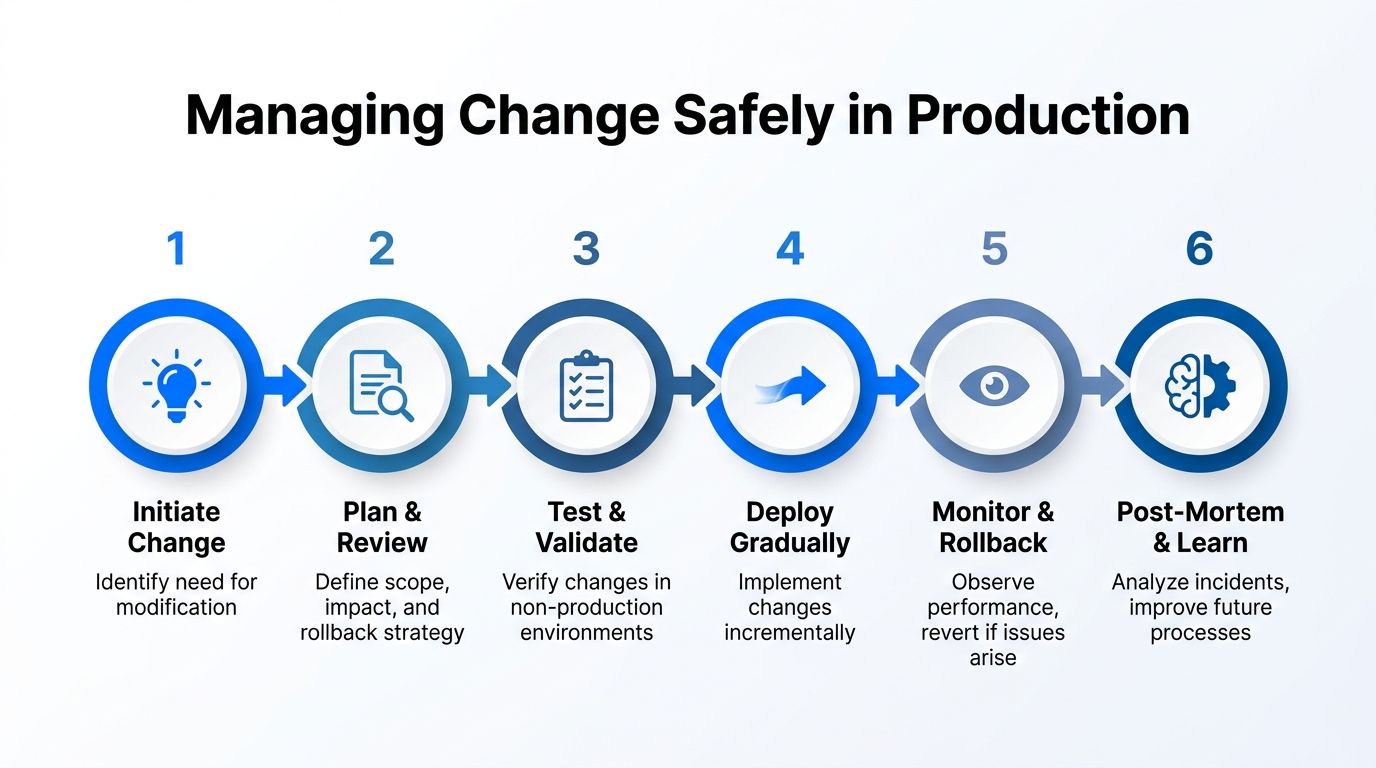
The safest teams don't ask whether a migration is clever. They ask whether it can be rolled forward, rolled back, and observed without guessing. That means planning the scope, validating in non-production, deploying gradually, and monitoring the result with a rollback path already prepared.
Zero-downtime schema work is a good example. If a change requires exclusive locks at the wrong moment, the release might be fine in staging and disastrous under real concurrency. That's why the rollout strategy matters as much as the SQL itself.
Automation removes the repetitive failure points
A central DBRE principle is eliminating toil by automating repetitive, error-prone manual work like backups and recovery (Optimadata). That same logic applies to deployments. If the team still copies scripts by hand, edits them live, or relies on tribal memory for rollback, the process is already fragile.
A simple operational rule helps here.
Standardize deployment steps: Use the same promotion path for every release so engineers aren't inventing procedure under pressure.
Automate the boring parts: Backups, restores, and failovers should be routine actions, not heroics.
Keep runbooks current: Every alert should point to a runbook that matches the current system, not last quarter's architecture.
Test migrations in sequence: Validate schema changes, data backfills, and cutover timing before production sees them.
The benefit is not just fewer mistakes. Automation also frees senior engineers to focus on reliability improvements that require judgment, like reducing lock contention, redesigning cutover steps, or tightening safe rollout windows.
Release process and reliability have to merge
Application teams already expect safe rollouts, canaries, and observable deploys. Databases deserve the same treatment. If the database change process still depends on a single expert staying awake, the process isn't reliable yet.
That's the DBRE mindset in practice. Treat the database like code, but don't pretend the database behaves like code. It has state, side effects, and recovery constraints that need their own controls. The teams that respect those constraints ship faster because they stop paying for preventable incidents.
Building Deep Observability for Databases
A dashboard can tell you a database is up. Deep observability tells you whether the service is still trustworthy. That matters because a healthy host can still return slow queries, stale results, or downstream datasets that look correct on the surface and fail in production.

Infrastructure signals are necessary but not sufficient
CPU, memory, disk, and network still matter. They are usually the first clues that a system is under pressure. They do not explain why a report is late, why a join slowed down, or why the same workload behaves differently after a data change.
Data-level observability closes that gap. Research on database stability highlights “surprises on the data level”, including heavy hitters in joins, non-uniform or correlated data, and sheer data size, all of which can destabilize performance even when the infrastructure looks healthy (Dagstuhl report). The server can look fine while the workload becomes harder to serve.
Healthy hardware does not guarantee predictable query behavior.
Observability has to include the data itself
A practical monitoring stack should include query latency percentiles, replication lag, transaction throughput, and connection pool saturation. That provides a view of service behavior that goes beyond simple host condition metrics. It also helps teams spot shifts before users notice an incident.
For teams that want a platform-oriented view, digna is one option that monitors data behavior, validates records, tracks timeliness, detects schema changes, and watches business and platform metrics inside the customer's environment. For a closer look at those patterns, see database monitoring and auditing techniques every company should implement. In-database execution keeps the data in place while still surfacing reliability signals that infrastructure tools miss.
That approach also helps with schema drift and freshness issues. If a table changes shape or a pipeline arrives late, the first warning may show up in the database layer, before the warehouse dashboard makes the problem obvious. Teams that watch those signals early can stop chasing symptoms after the business has already felt the impact.
The goal is not to drown the team in charts. It is to give on-call engineers enough context to answer three questions quickly, what changed, where did it change, and what user-facing behavior did it affect? Once those answers are available, the database stops being a black box.
Mastering Incident Response and Postmortems
Incidents still happen in well-run systems. The question is whether the team reacts in a panic or follows a playbook that gets mitigation started quickly. DBRE treats incidents as operational events with a lifecycle, which helps the team stay focused on restoring service instead of getting lost in the noise.
Start with recovery objectives and a playbook
A practical DBRE habit is to define RTO and RPO before the outage, then choose the recovery strategy around those targets. One guide recommends regular restore drills and failover tests to make recovery a repeatable practice (Lawzava). The exact cadence matters less than the discipline it builds, because rehearsed recovery is much easier to execute under pressure than a plan that only exists on paper.
When an alert fires, the first step is to confirm impact. Is the service unavailable, degraded, or only generating noisy alerts? After the scope is clear, the on-call engineer follows the runbook, checks whether the failure is data-related or infrastructure-related, and chooses the least risky mitigation path. The priority is to restore service first, then examine the root cause with a clear head.
Blameless review turns pain into operating change
A postmortem should answer what happened, why it happened, and what the system needs to do differently next time. It should stay away from blame. If human error appears in the chain, that usually means the system made the wrong action too easy or made the safe action too hard.
A useful postmortem format stays simple.
Timeline: Record the alert, mitigation steps, and recovery point.
Contributing factors: Capture the technical and process gaps that made the incident possible.
Systemic cause: Identify the missing guardrail, alert, automation step, or test.
Action items: Assign owners and deadlines for controls that reduce recurrence.
That structure keeps the discussion honest without making it personal. It also makes the result useful for engineering leadership, because the actions are tied to reliability mechanics instead of vague improvement language.
The strongest teams use incidents to harden their operating model. They close tickets, update the runbook, improve the restore path, or remove the manual step that caused the delay. That is how DBRE turns an outage into resilience.
Scaling DBRE with Data Observability
Once a team gets DBRE working for one database, the next challenge is scale. Enterprise data platforms include operational stores, analytical systems, pipelines, and reporting layers. Reliability has to stretch across all of them, or data trust breaks somewhere in the chain.
Reliability has to follow the data path
Modern DBRE aims for very high reliability bars, with industry examples citing 99.9995% uptime, which is under 2.6 minutes of downtime per year, and failover response in 2.7 seconds, achieved through automation and reliability-centered operations (iCEDQ). Those figures are a reminder that the operational target is no longer “mostly available.” It's near-continuous service.
The interesting part is how those goals connect to data observability. If a warehouse table is late, a schema changes unexpectedly, or a business metric drifts, the issue may not be a classic database outage at all. It may be a reliability failure somewhere upstream or downstream. DBRE gives you the operational discipline, while data observability supplies the evidence across the pipeline.
Trust comes from joining platform health and data behavior
At scale, teams need to see more than host uptime. They need to know whether the data is fresh, whether schemas are stable, and whether usage patterns are becoming risky. That's why DBRE works best when it's paired with data observability tooling that monitors behavior inside the customer environment, rather than only looking at external service health.
digna fits into that model as a platform that watches anomalies, timeliness, validation, schema changes, and business metrics inside the customer's own infrastructure. That makes it useful for teams that want to connect database reliability with downstream data quality and governance without shipping sensitive data out of place. In practice, that kind of visibility helps teams spot a broken feed before a dashboard meeting turns into damage control.
The broader lesson is simple. Database reliability engineering is no longer just about keeping an instance online. It's about making sure the data underneath analytics, operations, and AI is timely, consistent, and safe to depend on. If your platform team, governance group, and analytics engineers all see the same reliability signals, the organization stops arguing over whose metric is right and starts fixing the actual problem.
If you're ready to move from reactive database firefighting to a measurable reliability model, visit digna and see how in-database observability can help your team track data behavior, schema changes, and timeliness inside your own environment. It's a practical way to connect DBRE principles to the data systems your business depends on every day.