Introducing digna Release 2026.04 — Bringing Time-Series Analytics and Scalable Data Validation to Every Team
|
5
min di lettura
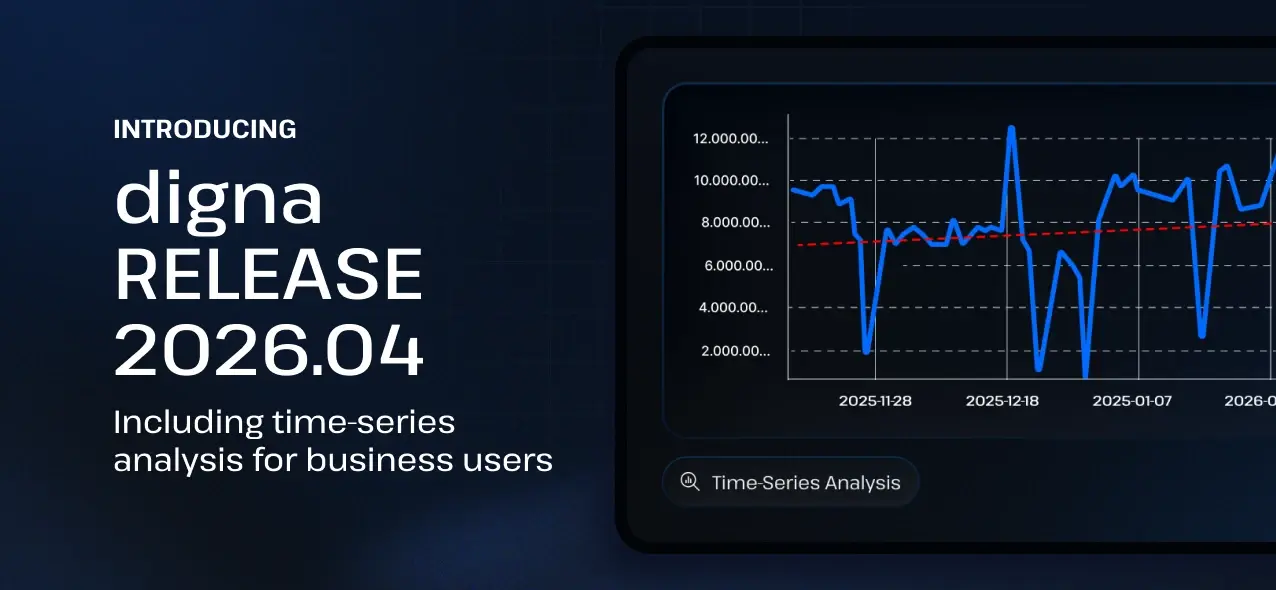
The digna Release 2026.04 takes a major step forward in making data understanding and data quality truly accessible across the enterprise.
This release significantly expands digna’s capabilities in data analytics and validation, introducing advanced time-series analysis, reusable validation components, and centralized data standardization — all designed to help teams not only detect issues, but understand and control their data with greater precision.
Making Advanced Data Analysis Accessible
One of the biggest challenges in modern data environments is not collecting data, it’s understanding how that data behaves over time.
With Release 2026.04, digna introduces a powerful new Analytics Chart, enabling interactive time-series analysis directly within the platform - without the need for data science tools or programming expertise.
This allows business users, analysts, and engineers alike to explore data behavior in a structured, intuitive way.
The New Analytics Capabilities
At the core of this release is a new set of built-in analytical methods designed to help teams uncover patterns, trends, and deviations in their data:
Linear, quadratic, and cubic regression for trend analysis
Piecewise regression with configurable breakpoints
Smoothing techniques for noise reduction
Quantile analysis for distribution insights
Residual analysis for deeper anomaly investigation
In addition, digna automatically generates time-series for every dataset, enabling continuous visibility into how data evolves over time.
This brings advanced analytical capabilities directly into everyday workflows without requiring external tools or specialized expertise.
From Monitoring Data to Understanding It
Traditional data monitoring answers one question: Is something wrong?
With the new analytics capabilities, digna helps answer a much more important one:
👉 Why is it happening — and is it expected?
The platform now automatically identifies:
Trends and long-term changes
Seasonal patterns and recurring behaviors
Structural shifts in data behavior
Deviations from expected patterns
This shift from static monitoring to behavioral understanding enables faster, more confident decision-making across teams.
Scalable Data Validation Through Reuse and Standardization
Alongside analytics, Release 2026.04 introduces major improvements in how data validation is defined, reused, and managed across the organization.
Enumerations — Central Definition of Allowed Values
Teams can now define reusable sets of allowed values (such as country codes, status values, or categories) and apply them consistently across datasets.
Reusable across projects and data sources
Defined once, applied everywhere
Referenced easily via #ENUM:MY_ENUM#
All checks are executed directly inside the source database, ensuring performance and zero data movement.
Validation Rule Templates — Reusable Data Quality Logic
Validation rules can now be defined as reusable templates and applied across multiple datasets.
This enables:
Consistent validation logic across projects
Reduced duplication and manual configuration
Faster implementation of data quality checks
As with all validation in digna, these checks run directly within the source database, supporting scalable and high-performance validation.
More Precise Monitoring with Relevance Conditions
Release 2026.04 also extends the concept of anomaly relevance with statistic-level relevance conditions.
This allows teams to define when a specific metric should be considered relevant for evaluation.
The result:
Reduced alert noise
More meaningful signals
Monitoring that reflects real business context
Who Benefits from This Release
Release 2026.04 brings value across multiple roles:
Data Engineers gain reusable validation logic and improved control over monitoring behavior
Data Quality & Governance Teams benefit from standardized rules and consistent validation
Analytics & BI Teams can now explore trends and deviations without relying on external tools
Platform Owners enable broader adoption through simplified analytics and scalable validation
Built for Modern Data Environments
With this release, digna continues its focus on in-database processing, ensuring that:
Data never needs to be moved for analysis or validation
Performance remains high at scale
Security and compliance requirements are preserved
By combining advanced analytics with scalable validation, digna enables organizations to move beyond reactive monitoring toward proactive data understanding and control.
Explore the Full Release
Read the full changelog and documentation here 👉
https://docs.digna.ai/changelog/Release_202604/
Release 2026.04 represents another step in digna’s mission to make enterprise data reliable, understandable, and actionable.
By bringing time-series analytics and reusable validation directly into the platform, we’re helping organizations turn data into insight — without complexity.
Frequently asked questions
What is new in digna Release 2026.04?
Release 2026.04 adds a new Analytics Chart for interactive time-series analysis, reusable Enumerations for allowed values, Validation Rule Templates, and statistic-level relevance conditions for anomaly monitoring. Together these extend Data Analytics and Data Validation so business users, analysts and engineers can understand data behavior without programming expertise.
Which analysis methods are in the new digna Analytics Chart?
The chart includes linear, quadratic and cubic regression for trends, piecewise regression with configurable breakpoints, smoothing for noise reduction, quantile analysis for distribution insights, and residual analysis for deeper anomaly investigation. digna also generates time series for every dataset automatically, giving continuous visibility into how data evolves.
How do Enumerations work in digna Data Validation?
Enumerations let teams define a set of allowed values once, such as country codes, status values or categories, and reuse it across projects and data sources. A check references the set with the placeholder #ENUM:MY_ENUM#, and like all digna validation it runs inside the source database with no data movement.
What are validation rule templates in digna?
Validation rule templates are reusable definitions of data quality logic that can be applied across many datasets instead of being rebuilt each time. According to the release, they bring consistent validation across projects, less duplication and manual configuration, and faster rollout of checks, all executed directly within the source database.
How do relevance conditions reduce alert noise in digna?
Statistic-level relevance conditions, new in Release 2026.04, let teams define when a specific metric should count as relevant for evaluation. Metrics outside that context are not assessed, so monitoring produces fewer noisy alerts and more meaningful signals that reflect the real business situation, extending digna's existing concept of anomaly relevance.