Combining Human Expertise with AI: The Dream Team for Data Quality
|
5
min di lettura
Inaccurate or incomplete data is like building a house on sand – destined to crumble when the tide of decision-making rolls in. Data quality is the cornerstone of any data-driven organization and maintaining high data quality is both crucial and challenging. Its importance is undeniable, which is why organizations deploy specialists to manually ensure data is clean and trustworthy despite it being tedious. If you ask these specialists about their experience, it is one they never wished to go back to.
Traditionally, data quality relied on the keen eyes and tireless efforts of data specialists. Hours were spent meticulously combing through datasets, hunting for inconsistencies and anomalies. But here's the catch: this manual approach, while valiant, is time-consuming, prone to human error, and simply unsustainable in today's ever-growing data landscape.
In the age of AI which seems to be the messiah - These intelligent tools have emerged as champions for data quality, offering automation, pattern recognition, and anomaly detection superpowers. However, relying solely on human expertise or AI for data quality can lead to limitations. Combining AI's automation capabilities with human oversight creates a robust data quality strategy.
The Limitations of Traditional Data Quality Methods
Traditional data quality methods, such as manual checks and data profiling, have long been the backbone of data management. While effective to an extent, these methods come with significant limitations:
Time-Consuming: Manual data quality checks are labor-intensive and time-consuming. The sheer volume of data in modern organizations makes it impractical to rely solely on manual processes.
Human Error: Even the most meticulous data professionals are prone to errors. Human oversight can lead to inconsistencies, missed anomalies, and overlooked data quality issues.
Scalability Issues: As data volumes grow, scaling manual data quality processes becomes increasingly difficult. Maintaining accuracy and consistency across large datasets is a formidable challenge.
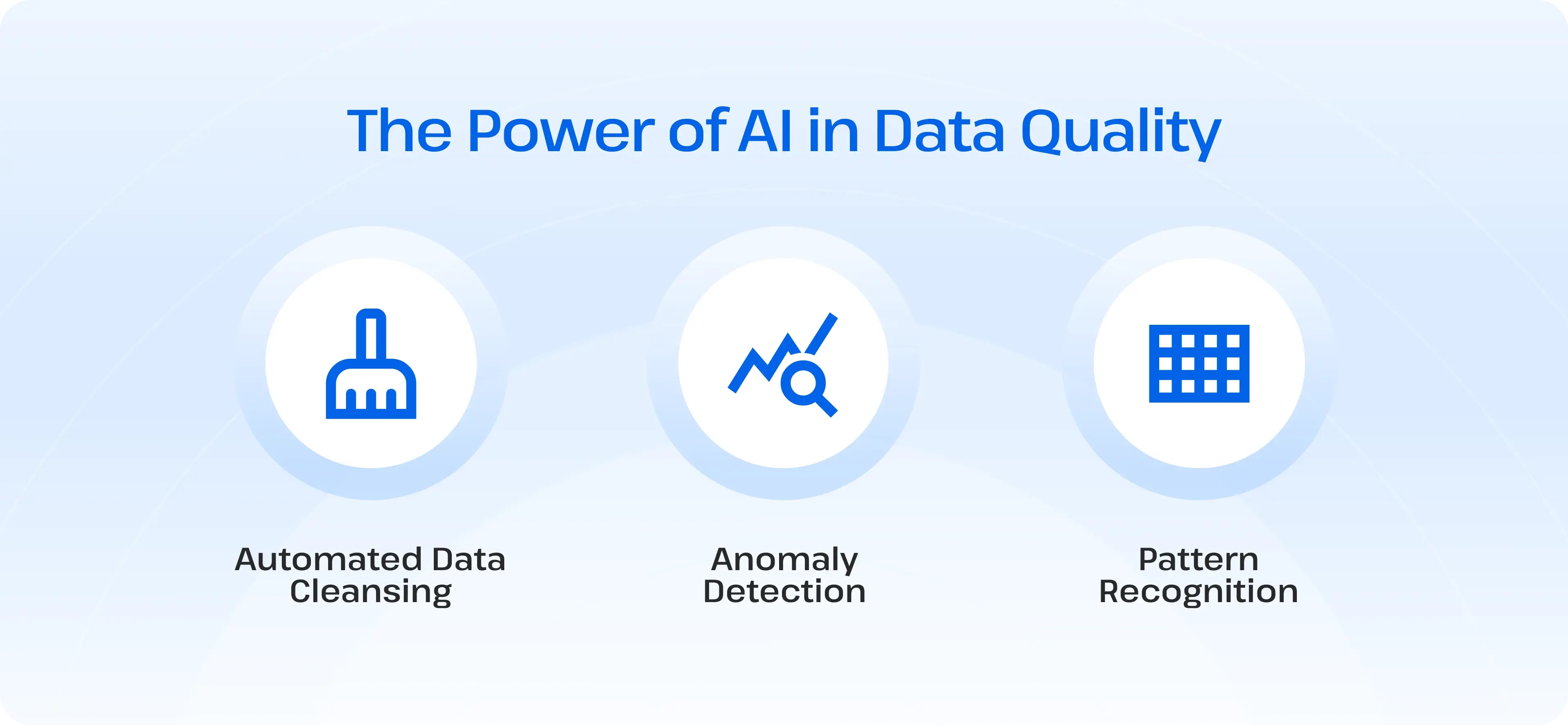
The Power of AI in Data Quality
AI-powered tools offer a revolutionary approach to data quality, automating many of the tasks that were previously manual. Here’s how AI can enhance data quality:
Automated Data Cleansing: AI algorithms can quickly and accurately identify and correct errors, inconsistencies, and duplicates in data.
Anomaly Detection: AI excels at detecting anomalies by analyzing large datasets and recognizing patterns that might be missed by human eyes.
Pattern Recognition: AI can identify complex patterns and trends in data, providing insights that inform strategic decision-making.
By automating these processes, AI frees up human resources to focus on more strategic tasks, ensuring that data quality efforts are both efficient and effective.
The Indispensable Role of Human Expertise
Despite the advances in AI, human expertise remains irreplaceable, particularly in tasks that require judgment and contextual understanding. Humans excel in setting precise data quality rules, analyzing complex issues that require nuanced insights, and providing the necessary oversight to ensure that AI functions correctly and ethically.
Setting Rules and Parameters
Think of AI as a powerful learning machine. Human experts define the parameters within which AI operates, tailoring algorithms to meet specific organizational needs. These rules guide AI in identifying errors and ensuring data adheres to your specific standards.
Complex Problem-Solving
Some data quality issues require nuanced analysis and judgment that AI may not yet be capable of. When data anomalies are too intricate for AI to interpret on its own, human intervention becomes crucial to decipher the underlying issues and rectify them effectively.
Overseeing AI Processes
Monitoring AI operations to ensure they comply with regulatory standards, changing data landscapes, unforeseen biases and ethical guidelines is a critical role that requires human judgment.
digna: Combining AI and Human Expertise
So, the answer isn't a battle between human and AI. It's about collaboration. digna is at the forefront of combining AI automation with human-centric features to offer a comprehensive user-friendly data quality platform that requires no technical know-how. Here’s how Digna empowers you to leverage the strengths of both humans and AI:
digna's Autometrics
Our AI silently analyzes your data over time, capturing key metrics and uncovering hidden patterns. This invaluable intel empowers you to make informed decisions about data quality strategies.
Forecasting Model
digna's unsupervised machine learning algorithms utilize these metrics to predict future data trends. This allows you to anticipate potential issues before they erupt, giving your human team time to intervene.
Smart Thresholds, Smarter Decisions
No more manual threshold setting! digna's AI self-adjusts these thresholds, ensuring early warnings for data deviations. However, the final call on corrective actions remains firmly in your human experts' hands.
Human-Centric Dashboards
digna's intuitive dashboards keep your team informed about data health in real time. These clear visualizations empower data specialists to prioritize tasks and identify areas requiring human intervention.
Instant Anomaly Alerts
Be the first to know! digna's notification system instantly alerts your team of any data anomalies, allowing them to investigate and rectify issues swiftly.
Ensuring data quality is critical for any organization, and the combination of AI and human expertise creates a powerful strategy to achieve this goal. The takeaway? AI is a powerful force multiplier for data quality, but it thrives under human guidance. digna bridges the gap, offering a comprehensive data quality solution that empowers you to leverage the best of both worlds thereby maximizing efficiency and accuracy.
Contact our team today and see for yourself how combining human expertise with AI creates the optimal environment for maintaining impeccable data quality.
By leveraging digna’s innovative features, your organization can effectively manage data quality, ensuring data integrity and operational efficiency. Let's build a data fortress that stands strong against the tides of bad data!
To see how automated detection and expert-defined rules fit together in one programme, read about data quality management with digna.
Frequently asked questions
What are the limitations of manual data quality checks?
Manual checks run into three problems, according to the article. They are time-consuming and labor-intensive given modern data volumes, they are prone to human error that leads to missed anomalies and inconsistencies, and they scale poorly, making accuracy and consistency across large datasets increasingly hard to maintain.
How does AI improve data quality?
AI automates tasks that used to be manual. The article highlights three capabilities: automated data cleansing that identifies and corrects errors, inconsistencies and duplicates; anomaly detection across large datasets that spots patterns human eyes might miss; and pattern recognition that surfaces trends for strategic decisions, freeing people for higher-value work.
Why is human expertise still needed in AI-driven data quality?
Humans supply judgment and context that AI lacks. The article names three roles: setting the rules and parameters AI operates within, solving complex anomalies too intricate for AI to interpret alone, and overseeing AI for compliance with regulations, changing data landscapes, unforeseen biases and ethical guidelines.
Should data quality rely on AI or on people?
Neither alone; the article frames it as collaboration rather than a battle. AI acts as a force multiplier through automation, pattern recognition and anomaly detection, but it thrives under human guidance, with experts defining parameters, interpreting difficult issues and making the final call on corrective actions.
How does digna balance AI automation with human decisions?
digna automates detection while leaving decisions to people. Autometrics captures key metrics over time, a forecasting model predicts trends so teams can intervene early, and Autothresholds self-adjust alert levels, but the article stresses that the final call on corrective action stays with human experts, supported by dashboards and instant alerts.