Public Sector Data Security: Your Complete 2026 Guide
|
0
minute de lecture

32,211 information security incidents hit U.S. Federal agencies in fiscal year 2023, and while the mean time to resolve them was 20 days, some agencies needed 168 days to close incidents, according to Fortinet's summary of GAO-reported federal cybersecurity statistics. That should change how a public sector CIO frames the problem. This isn't mainly about perimeter hardening, annual compliance exercises, or adding one more security product to an already crowded stack. It's about whether agencies can still trust the location, movement, and integrity of the data they hold.
The old perimeter model assumed a cleaner world. Users sat inside managed networks, systems changed slowly, and sensitive records lived in a small number of well-defined applications. That world is gone. Agencies now run hybrid estates, inherited platforms, cloud services, contractor access paths, and cross-department data flows that don't map neatly to a single boundary. If you still organize security around “inside good, outside bad,” your architecture is already behind your threat model.
A stronger approach starts with the data itself. Verify every request. Limit access to the smallest practical scope. Watch how data behaves in place, not only how traffic crosses a gateway. Preserve sovereignty where the mission demands it. And build controls that work with legacy systems instead of pretending they can all be replaced on a clean timeline. The physical side matters too. Good agencies understand that physical locks and cyber resilience support the same outcome: reducing unauthorized access paths before they turn into operational failures.
Table of Contents
The Unseen Challenge of Public Sector Data Security
Public sector data security is harder than most commercial environments for one simple reason. Government systems rarely protect only one thing. They protect citizen records, benefit workflows, tax data, health information, identity systems, law enforcement data, procurement records, and operational platforms that other services depend on.
That creates a compound risk model. A breach isn't only a confidentiality problem. It can become a service availability problem, a legal problem, a trust problem, and a national resilience problem at the same time. When agencies handle sensitive data across old and new platforms, the main issue isn't lack of policy. It's the gap between policy intent and day-to-day technical reality.
Why legacy assumptions fail
Perimeter-heavy strategies break down when access is no longer tied to one network edge. Contractors connect from different environments. Departments share data across organizational lines. Administrators manage systems remotely. Employees use cloud services the security team didn't approve but can't easily see.
A firewall still matters. Network segmentation still matters. But neither answers the core question modern agencies face: who is accessing which data, from what context, for what purpose, and what changed inside the data once access was granted?
Practical rule: If a control can only see the boundary and not the data behavior behind it, treat it as necessary but insufficient.
The real operational burden
Most agencies don't get to rebuild from scratch. They inherit line-of-business systems, procurement constraints, accreditation overhead, and staffing shortages. Security leaders need patterns that improve control without breaking services that citizens rely on.
That means public sector data security has to become more data-centric and more realistic. The right architecture doesn't assume every legacy application can support modern agents, perfect federation, or instant redesign. It wraps high-value data stores with stronger identity controls, narrower permissions, tighter segmentation, and observability that can detect risky changes even when the application itself can't.
Understanding the Evolving Threat Landscape
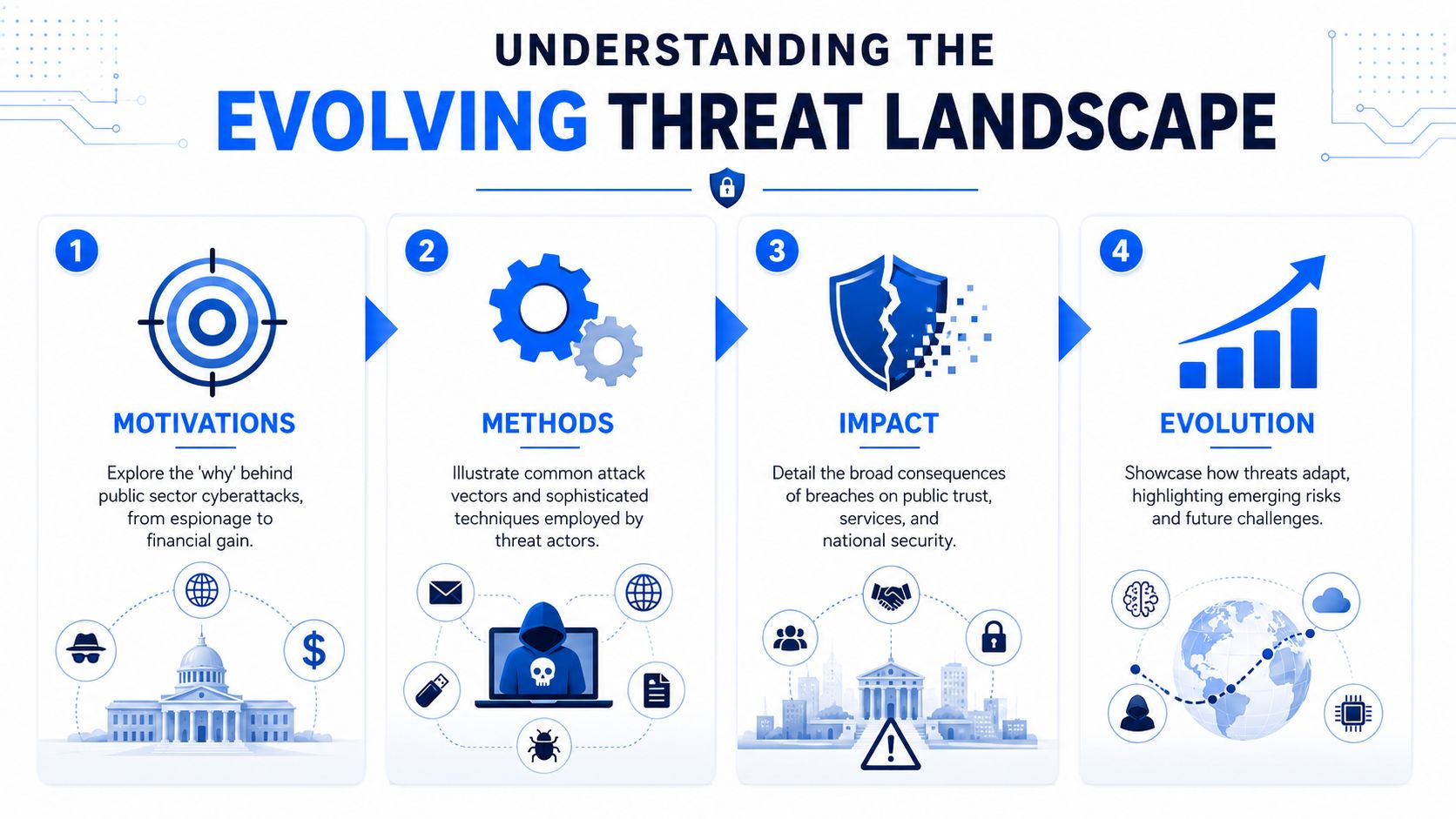
Government environments attract persistent attackers because the value of the target is unusually high. Citizen data enables fraud. Administrative access enables disruption. Operational systems give attackers an advantage. Public visibility increases pressure on leaders to restore services quickly, which is why ransomware groups and state-aligned operators both pay attention to the sector.
The trend line is moving in the wrong direction. U.S. government data breaches rose from 47 incidents in 2020 to 128 in 2024, a 173% increase, according to the University of San Diego's cyber security statistics roundup, which also notes that phishing is involved in 68% of breaches with a human element.
A simple visual helps explain the pattern.
Why government remains a prime target
Attackers don't see agencies as monoliths. They see unevenly defended estates with high-value data and many ways in. One department may have mature identity controls while another still depends on brittle legacy authentication. One team may classify data rigorously while another inherits shared drives and old integrations that nobody wants to touch before a critical reporting cycle.
The motivations usually fall into a few categories:
Espionage and strategic access: Sensitive records, operational insight, and long-term persistence have obvious value.
Financial extortion: Ransomware operators know public services face pressure to restore quickly.
Disruption: Interrupting citizen services creates public impact disproportionate to the initial intrusion.
Fraud enablement: Identity-related records and administrative workflows can support downstream criminal activity.
In reality, many successful attacks don't begin with exotic tradecraft. They begin with an ordinary user action, an over-permissioned account, or an overlooked third-party pathway.
The attack paths that matter most
The first priority is still identity compromise. Phishing works because it bypasses technical elegance and targets human routine. Attackers don't need to “break” the whole environment if they can convince one person to hand over access or approve the wrong action.
A second path is the software and supplier chain. Agencies depend on contractors, integrators, managed services, and packaged platforms. Each connection adds value. Each connection also adds trust assumptions that may be broader than they should be.
Later in the kill chain, lateral movement becomes the key issue. Once attackers obtain a foothold, they look for flat internal connectivity, weak service accounts, exposed administrative tools, and data repositories that aren't segmented from one another. That's where legacy perimeter thinking hurts agencies most. It often secures ingress better than movement and access after ingress.
The video below gives a useful practitioner-level overview of how modern public sector threats develop operationally.
Agencies should threat-model routine behavior, not only obvious attack signatures. The dangerous question isn't “Can someone get in?” It's “What can they quietly reach once they do?”
Navigating Key Regulatory and Compliance Frameworks
Strong public sector security programs treat compliance as a floor, not the architecture. That distinction matters. FISMA, NIST-aligned practices, GDPR obligations where relevant, and sector-specific mandates all push agencies toward the same operational habits: know your data, control access, document accountability, monitor continuously, and respond fast when something goes wrong.
The mistake is turning those frameworks into paperwork projects. Teams drown in control catalogs, audit evidence, and exception handling while actual exposure remains untouched. Mature programs reverse that order. They build controls that improve operations first, then produce compliance evidence as a byproduct of disciplined execution.
Compliance should drive operating discipline
The most useful way to read a framework is to ask what behavior it is trying to force inside the organization.
A few examples matter more than the citations in a binder:
Risk management: Leaders need a repeatable way to rank systems and data by mission impact, not by whoever shouts loudest.
Access control: Every entitlement should have an owner, a purpose, and a review path.
Continuous monitoring: Point-in-time certification won't protect a system that changes weekly.
Incident readiness: Plans, decision rights, and communication pathways must exist before a crisis.
Accessibility and security also intersect more often than teams expect. Agencies modernizing digital services can't separate protection from public access obligations. When web platforms process citizen data, design, usability, and compliance choices affect security outcomes too. Teams dealing with public-facing service delivery should also understand this guide to ADA Title II compliance, because accessibility gaps often surface in the same modernization programs that handle sensitive data.
What mature teams actually operationalize
The most effective public sector programs usually converge on a short list of operating disciplines:
Focus area | What good looks like |
|---|---|
Data ownership | Every critical dataset has a named owner and handling rules |
Access governance | Privileged access is narrow, reviewed, and justified |
Monitoring | Teams watch changes in identity, systems, and data flows |
Third-party oversight | Vendors inherit security obligations, not broad implied trust |
Recovery readiness | Backups, restoration, and communications are tested |
That's the practical value of compliance. It gives CIOs and CISOs a common language to force decisions that otherwise stay ambiguous.
Leadership test: If a control can't be tied to a system owner, a dataset, or a business process, it probably won't hold under pressure.
Core Security Architecture for Modern Government
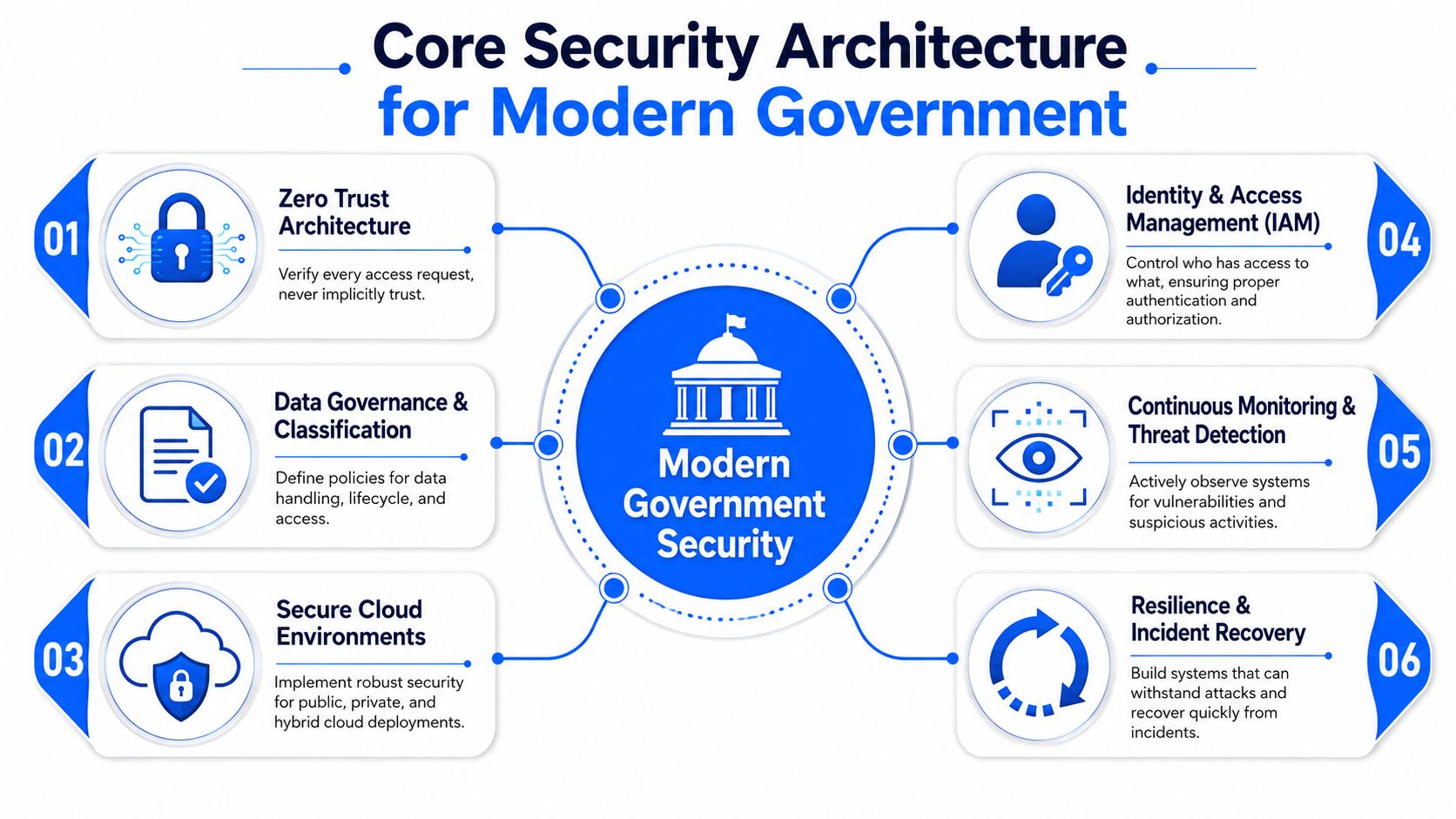
The center of modern public sector data security is Zero Trust Architecture. Not as a slogan. As a design decision. Every user, device, service, and workload has to earn access continuously instead of inheriting trust because it sits on the right network or originates from an approved zone.
According to Commvault's public sector security overview, implementing Zero Trust Architecture can reduce the cyberattack surface by 60-70% compared with legacy perimeter-based models. That's why it has become the benchmark pattern rather than a niche modernization idea.
Zero Trust as an operating model
The easiest way to explain Zero Trust to a nontechnical executive is to compare it to a records facility.
In the old model, once someone got through the front door, they could move too freely inside. In the Zero Trust model, every room, cabinet, and file class has its own control decision. A finance contractor doesn't inherit access to public health records. A help desk session doesn't become a general administrative pathway. A compromised credential doesn't automatically grant access to adjacent systems.
Three design moves make that real:
Strong identity verification: Agencies need reliable authentication for users, services, and devices.
Least-privilege access: People should get the minimum access needed for their role and nothing broader.
Micro-segmentation: Systems and data stores should be isolated so compromise in one zone doesn't become compromise everywhere.
Many programs often stall. They adopt Zero Trust language but keep broad network trust and role sprawl underneath. The architecture only works when authorization becomes granular enough to reflect the actual sensitivity of the data.
How to make Zero Trust work in legacy estates
Legacy systems are where strategy meets friction. Older platforms may not support modern federation, dynamic policy engines, or clean API-based enforcement. That doesn't mean agencies should wait. It means they need compensating patterns.
Start with the data that would cause the most damage if exposed or altered. Wrap those systems with stronger identity brokering, privileged access workflows, and segmented connectivity. Put administrative paths behind controlled jump points. Restrict service accounts aggressively. Log access decisions where the system can't natively express modern policy.
A phased rollout usually works better than a platform-wide mandate:
Map high-value data stores first: Don't begin with the easiest applications. Begin with the most consequential data.
Shrink privileged access: Admin convenience is one of the biggest hidden attack surface multipliers.
Segment by mission and sensitivity: Don't let unrelated systems share trust merely because they share infrastructure.
Add verification layers around legacy apps: If the application can't enforce context, enforce it upstream and around it.
For teams looking at earlier detection near the data layer, this article on how Digna detects cyber attacks early in your database is a useful example of where database-level monitoring fits into a broader Zero Trust approach.
Secure Deployment Patterns and Data Governance
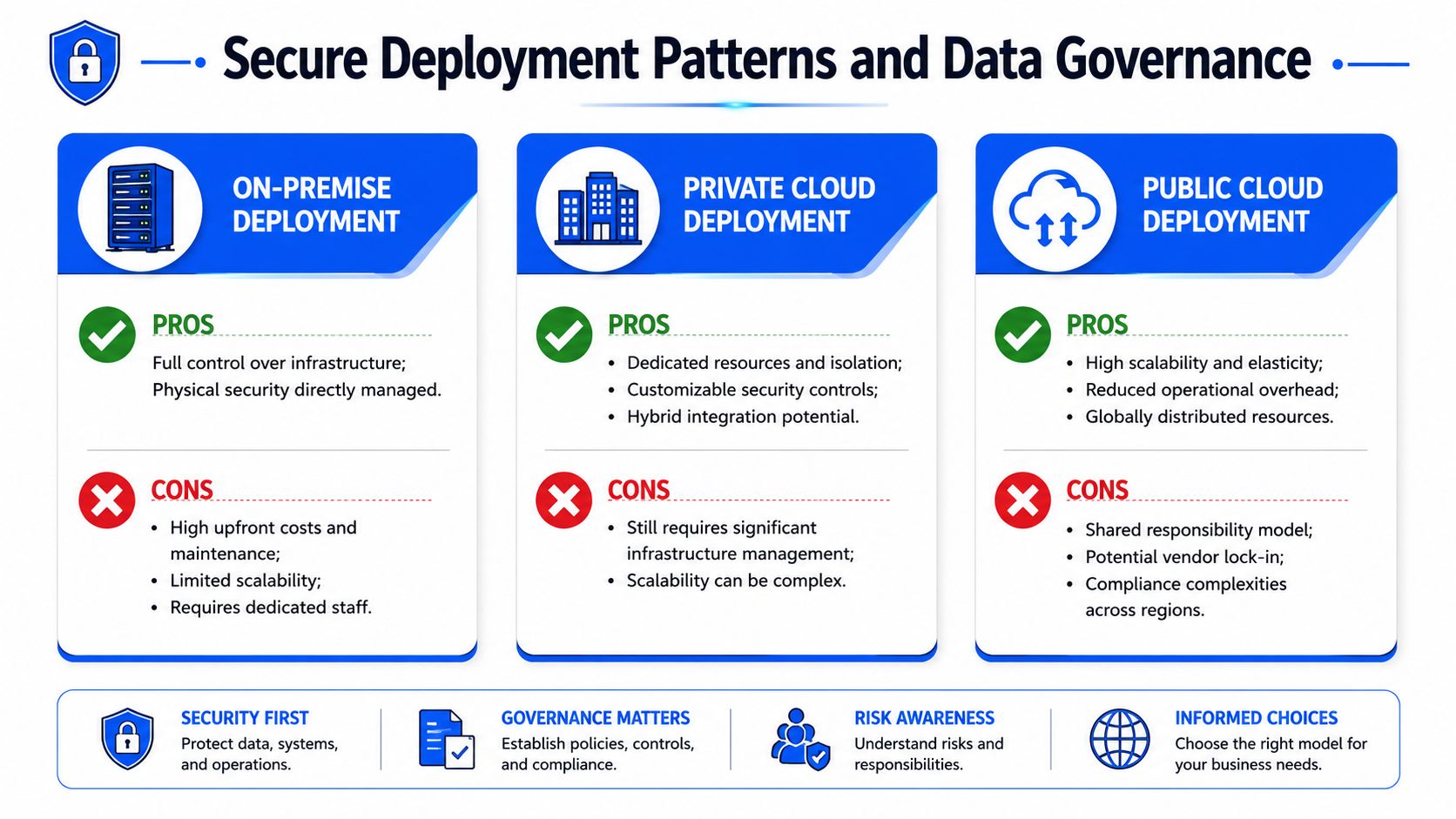
Where data resides changes the security conversation immediately. In government, deployment choice isn't a mere infrastructure preference. It shapes sovereignty, auditability, vendor control, incident containment, and procurement risk.
For some workloads, public cloud is a practical answer. For others, it creates governance complications that agencies underestimate during procurement and then spend years managing through exceptions. The right decision depends less on ideology and more on the sensitivity of the data, the mission impact of service disruption, and the degree of control the agency must retain.
Choosing the right deployment model
For classified information and certain highly sensitive environments, Rocket.Chat's government cybersecurity discussion notes that many regulatory benchmarks require on-premise deployment with air-gapping to ensure data sovereignty, and that air-gapped storage combined with immutable backups is a primary mitigation against ransomware and unauthorized remote access. That principle should guide more than classified workloads. It reminds agencies that some data should not depend on externally reachable management paths.
A practical comparison looks like this:
Model | Best fit | Main trade-off |
|---|---|---|
On-premise | Highest-control environments and strict sovereignty needs | More operational burden on the agency |
Private cloud | Sensitive workloads needing strong control with some flexibility | More design complexity and integration effort |
Public cloud | Elastic services, less sensitive workloads, faster service rollout | Tighter vendor governance and clearer shared responsibility needed |
The mistake is assuming one model should dominate the whole estate. Most agencies need more than one. The challenge is keeping governance consistent across them.
Governance rules that prevent expensive mistakes
Deployment security fails when data governance is vague. Teams need explicit decisions about classification, ownership, retention, access, and permitted processing environments.
The strongest operating patterns are usually simple:
Classify before migration: Don't move a dataset until its sensitivity and allowed hosting pattern are documented.
Tie vendors to enforceable controls: Contract language should match security architecture, not merely procurement templates.
Control data lifecycle: Copies, extracts, and temporary working sets often become the weakest link.
Keep ownership named: Every dataset needs an accountable business owner, not only a technical custodian.
Agencies trying to tighten this discipline across programs should think in terms of policy plus implementation. A practical reference point is this piece on government data quality and public sector data governance, especially for teams aligning governance with operational data usage rather than treating it as a separate paperwork stream.
Reducing Risk with In-Place Data Observability
Traditional controls answer only part of the security question. They tell you whether a connection was permitted, whether a device was enrolled, or whether a policy was triggered. They often don't tell you whether the underlying data has started behaving in a way that signals misuse, process failure, or an intrusion operating below the radar.
That gap matters in public sector environments because risk often shows up first as a data symptom. A table changes structure unexpectedly. A feed arrives late. Records start failing validation. A privileged user accesses data at an unusual pattern. A workload begins sending information into a cloud service the security team didn't know existed.
StateTech Magazine highlights this blind spot directly in its discussion of public sector cloud security, noting the lack of visibility into shadow IT and where employees store cloud data, and recommending in-place monitoring to track what devices are “phoning out to the cloud” because perimeter defenses miss that behavior. See StateTech's guidance on cloud visibility and shadow IT monitoring.
Why perimeter tools miss internal data risk
Perimeter tools were built to watch edges. Modern government risk accumulates inside workflows.
A user can have valid credentials and still misuse data. A pipeline can authenticate properly and still deliver corrupted records. A contractor can use an approved application and still create exposure by exporting data to the wrong location. None of those scenarios look dramatic at the firewall.
That's why public sector data security needs in-place observability. Instead of moving sensitive data out to an external monitoring layer, agencies can analyze behavior where the data already resides, inside controlled databases or private cloud environments. That approach is especially attractive where sovereignty and vendor access restrictions are paramount.
What in-place observability should monitor
The most useful observability programs don't try to duplicate SIEM tooling. They focus on data-native signals that security and governance teams otherwise miss.
Good coverage usually includes:
Schema changes: Added, removed, or altered fields can signal breakage or unauthorized change.
Timeliness anomalies: Delayed or missing loads often reveal operational failures before leaders see bad reports.
Validation failures: Rule-breaking records can expose misuse, integration defects, or tampering.
Behavioral anomalies in data access or output: Unusual query, export, or movement patterns deserve scrutiny.
A strong operating principle is to monitor for silent deviation, not only explicit failure.
If a dataset changes in ways nobody expected, assume there's a security or governance question until a team proves otherwise.
Teams comparing observability and traditional quality controls often benefit from a clearer distinction between the two. This overview of data observability vs data quality is useful because many agencies still fund these capabilities through separate groups even though the operational signals overlap.
Building a Resilient Incident Response Plan
Even strong controls won't prevent every incident. The issue is whether the agency can detect fast, decide clearly, contain effectively, and recover without improvising under pressure. Too many public sector response plans read well in a policy review and fail in the first real escalation call.
The structure should be simple enough to rehearse and specific enough to use. The six-stage cycle below is still the most reliable format for most agencies.
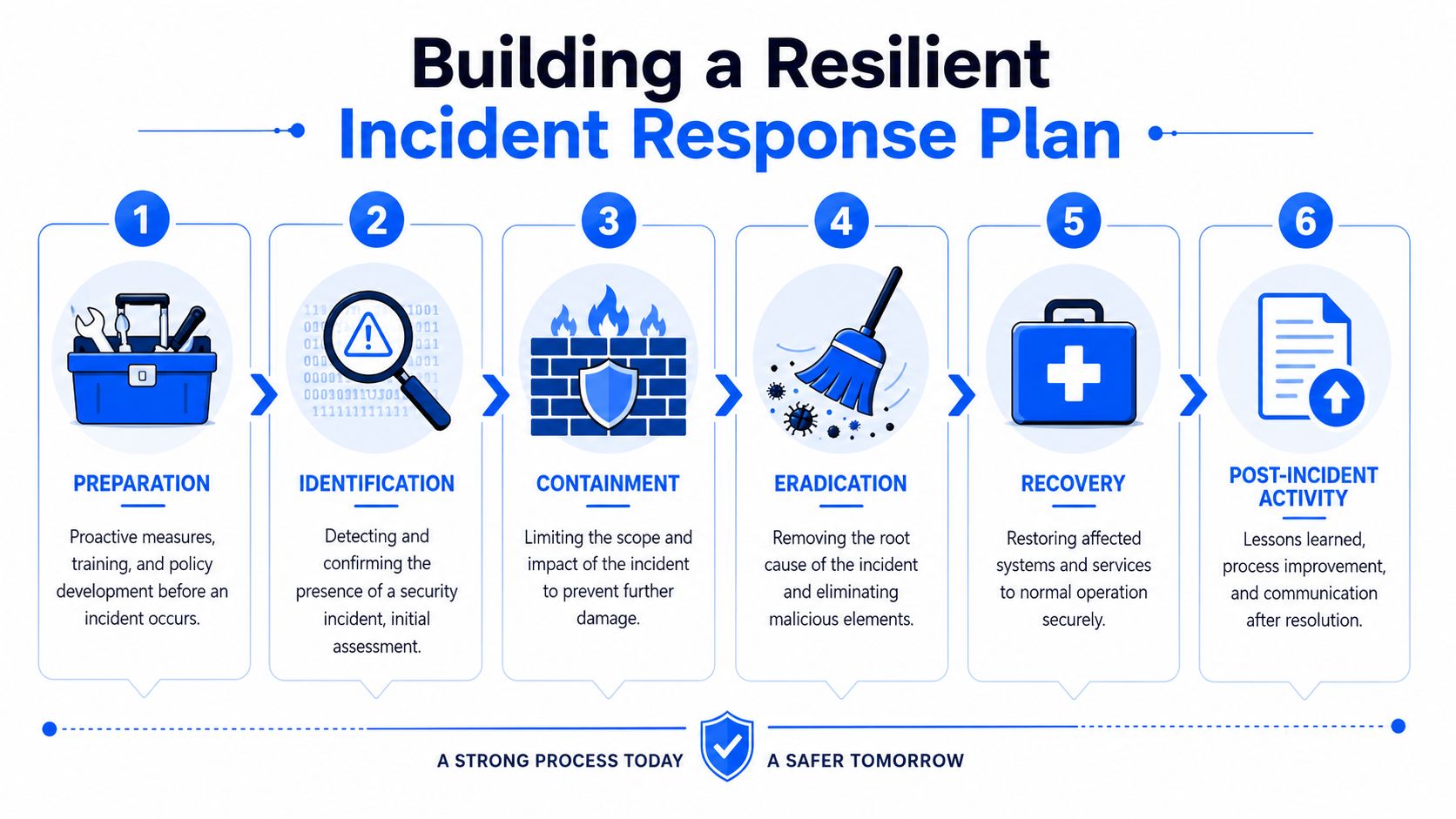
The six-stage cycle that agencies should rehearse
Preparation
Build the team structure, escalation paths, forensic readiness, communications templates, and decision authorities before a crisis. Preparation also includes making sure legal, procurement, operations, and executive stakeholders know their role.Identification
Confirm whether the event is real, what systems are affected, and whether data exposure is plausible. The first job is to reduce uncertainty fast enough for leaders to act.Containment
Stop the spread. That may mean isolating workloads, disabling accounts, cutting integrations, or narrowing network paths. Containment decisions should favor mission continuity where possible, but they can't preserve convenience at the expense of control.
What separates usable plans from shelfware
Eradication
Remove the cause, not only the symptom. If a credential was abused, fix the access condition that made it dangerous. If a vulnerable integration enabled the breach, don't reconnect it unchanged.Recovery
Restore services carefully. Validate system integrity, monitor closely, and communicate clearly with affected stakeholders. Recovery without verification often recreates the same incident in a different form.Post-incident activity
Hold a serious lessons-learned review. Update playbooks, controls, architecture decisions, and training. If the incident exposed an ownership gap, a data visibility gap, or a vendor governance gap, fix that systemically.
A good incident response plan also answers three practical questions in plain language: Who can declare an incident, who can take systems offline, and who speaks externally? If those decisions are unclear, the technical team will lose precious time waiting for administrative certainty.
Operational advice: Run drills against legacy dependencies, shared services, and third-party integrations. Those are the places where real incidents become messiest.
If your agency needs better visibility into data anomalies, schema changes, validation issues, and pipeline timeliness without moving sensitive data outside your environment, digna is worth a close look. Its approach is built for customer-controlled deployments, including private cloud and on-prem environments, which makes it relevant for public sector teams that need stronger observability without giving vendors access to production datasets.